
Hundreds of thousands celebrate Caribbean culture along Eastern Parkway as Haiti’s diaspora turns Labor Day tradition into a powerful display of heritage, resilience and community
BROOKLYN, N.Y. — Brooklyn’s Eastern Parkway erupted in Caribbean color, music and national pride Monday as the 59th annual West Indian American Day Carnival and Parade brought one of New York City’s largest cultural celebrations back to the streets for Labor Day.
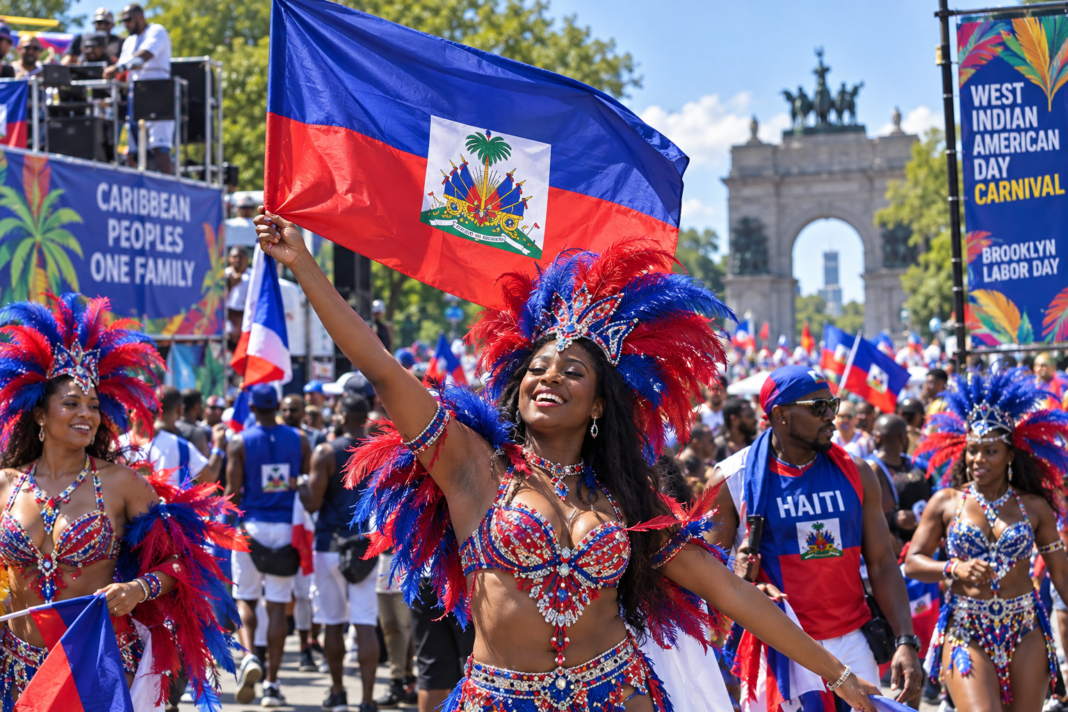
Thousands of masqueraders and spectators carrying the flags of Haiti, Jamaica, Trinidad and Tobago, Barbados, Grenada, Guyana, St. Vincent and the Grenadines and other Caribbean nations filled the Brooklyn thoroughfare with elaborate costumes, steel drums, soca, calypso, reggae, dance and Caribbean food. The parade stepped off at 11 a.m. and traveled along Eastern Parkway toward Grand Army Plaza.
For New York’s Haitian community, however, the 2026 celebration carried particular significance. Haitian organizations participated with costumes and music honoring the country’s revolutionary history and cultural achievements at a moment when many Haitian immigrant families are confronting uncertainty over immigration status and the continuing security and political crises in Haiti.
The festival, commonly known among New Yorkers simply as the West Indian Day Parade or the Labor Day Carnival, has evolved into one of the most visible expressions of Caribbean identity in the United States.
Eastern Parkway Becomes the Caribbean
From early Monday morning, Crown Heights was transformed.
Floats covered in national colors rolled through Brooklyn as revelers danced behind trucks carrying powerful sound systems. Masqueraders appeared in feathers, sequins, beads, elaborate headdresses and brightly colored costumes rooted in Caribbean Carnival traditions.
Steel drums mixed with soca and other Caribbean rhythms while food vendors offered familiar favorites such as jerk chicken, curry goat, oxtail and other dishes associated with the region’s diverse culinary traditions.
The celebration brought together Caribbean-born New Yorkers, second- and third-generation Caribbean Americans, visitors from other states and people with no Caribbean ancestry who came simply to experience the festival.
For many participants, the day was as much about identity as entertainment.
People wrapped themselves in their national flags, danced behind their countries’ floats and used the Parkway as a stage for celebrating cultures that have profoundly shaped Brooklyn and New York City.
One attendee of Dominican and Haitian heritage described the parade as an opportunity to connect with the wider Caribbean diaspora, while other participants spoke of introducing their children to traditions they themselves experienced growing up.
Haiti Makes Its Presence Felt
Haiti was prominently represented in this year’s celebration.
That participation reflected the enormous importance of the New York metropolitan area to the Haitian diaspora. The region is home to roughly 163,000 Haitians, according to Migration Policy Institute figures cited by the Associated Press, making it the second-largest Haitian population center in the United States after metropolitan Miami. Brooklyn neighborhoods including Flatbush, East Flatbush and Crown Heights have been major centers of Haitian life for decades.
Among the Haitian organizations participating was Lespri Ayiti, or “Spirit of Haiti,” a large Haitian mas group involving approximately 180 artists, designers, musicians and community members.
Its presentation combined history with contemporary Haitian culture.
Costumes prepared for the parade drew inspiration from Haiti’s independence and revolutionary legacy, including royal-blue designs honoring Jean-Jacques Dessalines. Other creations celebrated Haitian accomplishments in sports and displayed national symbols.
Haitian music was equally important.
The Haitian contingent incorporated Kompa and Raboday, connecting one of Haiti’s most recognizable musical traditions with a younger generation of performers and paradegoers. DJ Comix of Team Madada was among the performers associated with the Haitian presentation.
For Haitians lining Eastern Parkway, the combination of the blue-and-red flag, music, dance and historical imagery provided an opportunity to celebrate a national identity that extends far beyond Haiti’s borders.
A Celebration During a Difficult Period for Haitians
The festivities came during an especially complicated year for Haitian immigrants.
The termination of Temporary Protected Status for Haitians has affected hundreds of thousands of people who had relied on the humanitarian immigration designation to legally remain and work in the United States. The Associated Press reported that work authorization associated with Haitian TPS expired July 27 after litigation over the administration’s termination of the program.
At the same time, Haiti continues to confront gang violence, displacement, economic hardship and political instability.
Those circumstances gave the Haitian presence on Eastern Parkway a deeper meaning.
Rather than allowing those difficulties to define the community, participants used Carnival traditions—music, dance, fashion and art—to express cultural continuity and resilience.
Natalie Lafontant, who organizes Lespri Ayiti, told the AP that despite the difficult circumstances surrounding Haitian immigrants, Caribbean people have historically relied on music, dance and art to persevere.
That sentiment could be seen throughout the Haitian contingent Monday.
J’Ouvert Begins the Celebration Before Sunrise
The Labor Day celebration actually began hours before the main parade.
J’Ouvert, the traditional pre-dawn celebration that precedes Carnival, officially ran from 6 a.m. until 11 a.m. Monday, although spectator access began at 2 a.m.
Participants traveled along Empire Boulevard from Flatbush Avenue toward Nostrand Avenue before continuing toward Rutland Road.
J’Ouvert—whose name comes from the French Creole expression associated with the “opening of the day”—has deep roots in Caribbean emancipation and Carnival traditions, particularly those of Trinidad and Tobago.
In Brooklyn, it has developed its own distinctive character and remains an important component of Labor Day celebrations.
The main West Indian American Day Parade followed at 11 a.m.
Security Significantly Increased
Celebration was accompanied by one of the most extensive security operations surrounding the event in recent years.
New York City officials had announced increased policing before Labor Day following shootings associated with the parade area in previous years.
NYPD Commissioner Jessica Tisch said thousands of officers would be deployed, with uniformed personnel positioned throughout the route and surrounding neighborhoods. The city also coordinated crisis-management teams and mobile trauma units.
Security for J’Ouvert was particularly strict.
Police established 13 controlled entry points, and spectators were screened with magnetometers. Weapons, alcohol, large bags, coolers, drones and several other items were prohibited inside screened areas.
The main parade also ended earlier than in previous years.
City officials ordered festivities to conclude promptly at 5:30 p.m., explaining that the decision was based on the timing of violence around the 2025 celebration. Police said three shooting incidents occurred at approximately 5:35 p.m., 6:15 p.m. and 6:30 p.m. last year, leaving six people shot.
Officials said there were no known specific or credible threats against the 2026 parade before the event.
Violence Again Challenges the Celebration
Despite the extensive security operation, violence was reported in the vicinity of Monday’s festivities.
Several people were stabbed or slashed during the early-morning period around J’Ouvert, and additional shootings were reported around the broader parade area later in the day. News reports said at least eight people were injured across multiple violent incidents associated geographically or temporally with the celebrations.
Those incidents again raised difficult questions for city officials and community leaders about how to prevent a relatively small number of violent actors from overshadowing an enormous cultural event attended peacefully by hundreds of thousands.
The distinction is important: the West Indian American Day Carnival itself represents generations of Caribbean culture and community organizing, and the overwhelming majority of participants gather peacefully.
For organizers, protecting that tradition while addressing violence around the event remains one of the festival’s most serious challenges.
Debate Over the Earlier Closing Time
The decision to shorten the parade was not universally welcomed.
Some Caribbean community advocates questioned whether ending the celebration earlier would meaningfully address gun violence and worried that increasing restrictions could gradually change the character of the Labor Day tradition.
Some paradegoers also complained that heavier barricades and policing made it more difficult for spectators to interact with masqueraders and performers.
Others welcomed the additional security and said feeling safe was necessary for families to continue participating.
The debate reflects a larger challenge facing the city: maintaining an open, energetic Caribbean street celebration while preventing violence without making the community feel that its signature cultural event is being treated primarily as a security problem.
New York Leaders Join the Parade
The event also remains a major fixture on New York’s political calendar.
New York City Mayor Zohran Mamdani and Gov. Kathy Hochul were among the officials who participated in Monday’s parade. Both appeared as honorary grand marshals as elected leaders joined Caribbean community organizations along the route.
Before the event, Mamdani described the parade as the largest Caribbean parade in North America and emphasized the importance of allowing New Yorkers to celebrate while strengthening public safety.
The presence of city and state leaders also underscored the Caribbean community’s political importance.
Generations of immigrants from Haiti, Jamaica, Trinidad and Tobago, Guyana, Grenada, Barbados and other Caribbean nations have become integral to New York’s political, economic and cultural landscape.
More Than a Parade
The West Indian American Day Carnival has become far more than an annual street party.
For immigrant families, it provides a connection between New York and the islands their families came from. For younger Caribbean Americans, it is an opportunity to inherit traditions they may otherwise encounter only through parents and grandparents.
For musicians and artists, it is a massive public stage.
For small businesses and food vendors, Labor Day weekend brings economic opportunities.
And for Caribbean nations themselves, the parade provides extraordinary visibility in one of the world’s most diverse cities.
The celebration is particularly meaningful in Brooklyn, where Caribbean migration has influenced neighborhoods, restaurants, churches, businesses, music, politics and everyday life for generations.
Haiti’s Flag on Eastern Parkway
For Haitian New Yorkers, Monday’s celebration offered something even more personal.
Haiti may be experiencing one of the most difficult periods in its modern history, and Haitian immigrants in the United States are confronting new uncertainties of their own. Yet along Eastern Parkway, the country was represented not simply through the crises dominating international headlines but through music, fashion, history, art and national pride.
The Haitian flag flew alongside those of neighboring Caribbean nations. Kompa and Raboday joined soca, reggae, calypso and steel-pan music. Costumes recalled Haiti’s revolutionary history while younger performers represented its evolving culture.
That is ultimately what the West Indian American Day Carnival has represented for generations.
Once a year on Labor Day, Eastern Parkway becomes a Caribbean avenue—one where the region’s different languages, islands and histories meet in Brooklyn while retaining their individual identities.
The security challenges surrounding the celebration remain serious and cannot be ignored. But neither can the scale of the peaceful cultural gathering they sometimes overshadow.
For hundreds of thousands of Caribbean New Yorkers and visitors who returned to Brooklyn in 2026, the message was unmistakable: Caribbean culture remains deeply woven into the identity of New York City—and Haiti remains an essential part of that story.
The Haitian Tribune | U.S. News & Caribbean Community