
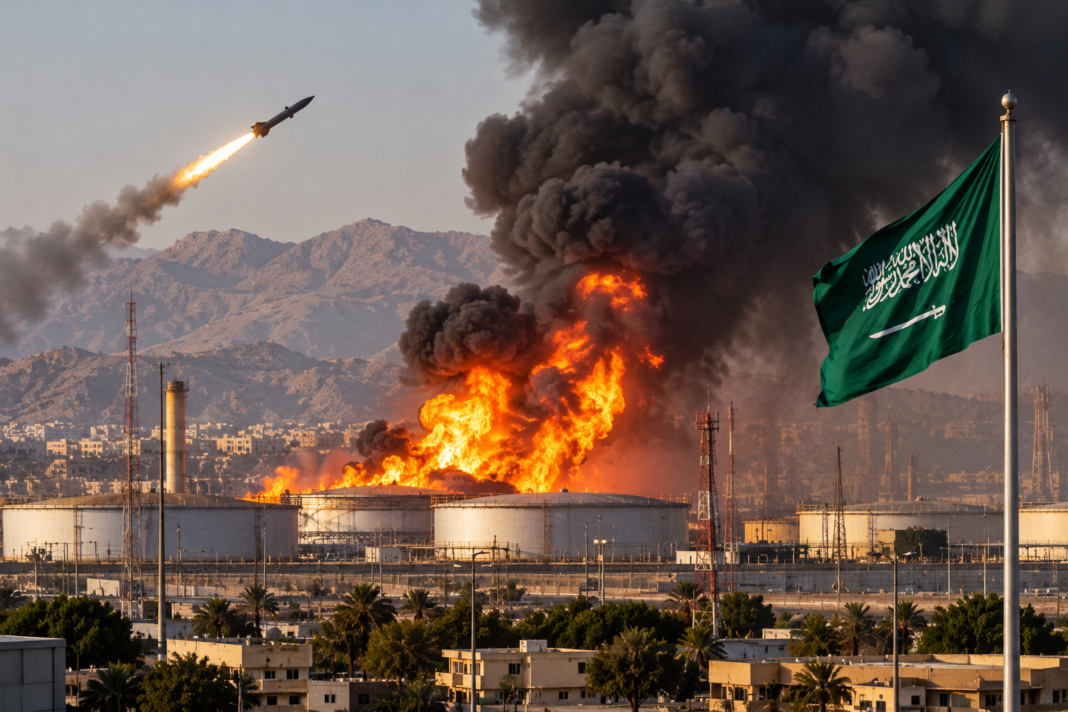

Strikes hit energy facilities and a military air base in southern Saudi Arabia, sending oil prices higher as renewed fighting involving Iran, the United States and Yemen’s Houthis raises fears of a broader regional confrontation
RIYADH, Saudi Arabia — Yemen’s Iran-aligned Houthi movement launched a major wave of missile and drone attacks against southern Saudi Arabia on Tuesday, striking four cities, setting fires at energy facilities and wounding 73 people, including women and children, according to Saudi authorities.
The coordinated assault targeted Abha, Najran, Jazan and Khamis Mushait, marking one of the most serious Houthi attacks against Saudi territory in years and adding another dangerous front to the wider conflict engulfing the Middle East.
The Houthis said they used ballistic missiles and drones in what their military spokesman, Brig. Gen. Yahya Saree, characterized as a broad operation against Saudi military, oil and economic infrastructure.
Among the targets were facilities associated with state oil giant Saudi Aramco in Abha and Najran, the major industrial and refining complex at Jazan, and King Khalid Air Base in Khamis Mushait.
Saudi Arabia described the attacks as a dangerous escalation and warned that it reserved the right to respond.
Fires Break Out at Saudi Energy Facilities
The attacks caused fires at several energy installations and utilities across southern Saudi Arabia.
Saudi Arabia’s Energy Ministry said operations at affected facilities were temporarily suspended while emergency crews worked to contain the fires. Jazan is home to one of the kingdom’s major refineries, with capacity of roughly 400,000 barrels per day.
Satellite imagery cited by Reuters showed a large area of black smoke over the Jazan refinery and lighter smoke rising from an oil-distribution facility in Abha. Independent imagery from the ground remained limited in the immediate aftermath of the strikes.
Saudi officials said 73 civilians were injured, including women and children. The extent of damage to the country’s energy infrastructure was still being assessed Tuesday.
Saudi Arabia Vows to Defend Its Territory
Maj. Gen. Turki al-Malki, spokesman for the Saudi-led coalition fighting in Yemen, condemned the attacks and said the coalition would take measures to counter the threat.
Saudi Arabia’s Foreign Ministry similarly accused the Houthis of threatening civilians, economic infrastructure and regional stability.
The kingdom said it would defend its territory, citizens and national assets while calling on the international community to respond to continuing threats against Saudi Arabia and commercial navigation in the Red Sea.
Saudi Foreign Minister Prince Faisal bin Farhan, speaking during a visit to Moscow, said Riyadh had offered opportunities for negotiations but accused the Houthis of continuing to choose military escalation.
Houthis Say Attacks Were Retaliation
The Houthis presented a sharply different account.
Saree blamed Saudi Arabia for escalating the conflict in Yemen and said Tuesday’s operation was retaliation for Saudi military action.
The strikes came shortly after the Houthis accused Saudi Arabia of responsibility for an airstrike on a prison in Yemen’s northern Jawf province. At least seven people, including a child, were reported killed and seven others wounded in that attack.
The competing accusations come as a period of relative calm between Saudi Arabia and the Houthis has unraveled.
Yemen’s internationally recognized government, backed by Saudi Arabia, has intensified military operations against Houthi-controlled territory, while the Houthis have renewed missile and drone attacks and threats against shipping.
Yemen War Returns to the Forefront
The latest confrontation threatens to reignite the devastating Yemeni civil war.
The Houthis seized Yemen’s capital, Sanaa, in 2014 and forced the internationally recognized government into exile. Saudi Arabia subsequently assembled a military coalition that intervened in 2015 in support of the government.
Years of war produced one of the world’s most severe humanitarian crises.
A 2022 truce dramatically reduced large-scale cross-border attacks and created several years of relative calm between Saudi Arabia and the Houthis, although a comprehensive political settlement was never achieved.
That fragile restraint has now broken down.
Recent fighting between Houthi forces and Saudi-backed Yemeni government troops has intensified across several fronts. According to figures cited by the Associated Press, at least 194 people were killed and more than 880 wounded between Aug. 23 and Sept. 5, while renewed violence has displaced tens of thousands.
The Houthis control Sanaa and much of Yemen’s populated north and are supported by Iran, although analysts have long cautioned that the movement also pursues its own political and military objectives rather than functioning solely at Tehran’s direction.
Oil Markets React
The Saudi attacks quickly reverberated through international energy markets.
Brent crude climbed as high as $99.46 per barrel Tuesday, its highest level since July 24, according to Reuters. West Texas Intermediate also reached its highest level since early June before prices eased somewhat later in the trading session.
The market reaction reflects growing concern that conflict is threatening multiple arteries of the global energy system simultaneously.
The Strait of Hormuz is one of the world’s most important oil transit routes, while the Bab al-Mandeb Strait between Yemen and the Horn of Africa connects the Gulf of Aden with the Red Sea and ultimately the Suez Canal.
Saudi infrastructure near the Red Sea gives the kingdom an alternative export route when Persian Gulf shipping is threatened. Houthi attacks on those facilities therefore increase concerns that disruptions could spread beyond a single maritime corridor.
Explosions Reported in Iran
The Saudi attacks coincided with renewed reports of explosions inside Iran following a two-day pause in reported U.S. strikes.
Iranian media reported explosions around Kharg Island, a strategically important Iranian oil-export center, as well as around Jask, a port on the Gulf of Oman.
Iran’s Tasnim news agency reported that an Iranian tanker approximately four miles from Kharg Island had been struck by what it described as a U.S. missile. Crew members were reportedly being evacuated, with no casualties initially reported.
The Pentagon had not immediately confirmed that account when Reuters published its report, meaning the circumstances surrounding the incident remained uncertain.
The developments come amid the six-month conflict involving the United States, Israel and Iran, which has placed enormous pressure on Gulf shipping and global energy supplies.
Strait of Hormuz Remains a Flashpoint
The Strait of Hormuz remains another major source of tension.
Washington has sought to keep commercial oil moving through the waterway while restricting Iranian exports. Tehran, meanwhile, has announced plans for what it calls a new maritime exclusion zone in and around the strait.
Iran’s Revolutionary Guards also claimed to have captured a U.S. underwater military drone near the strait. A U.S. official told Reuters that an American underwater drone had malfunctioned but said it did not carry classified sonar or radar equipment. Iran separately claimed to have destroyed another U.S. drone, an assertion Washington had not immediately addressed.
These incidents demonstrate how quickly a confrontation involving missiles, drones, oil tankers and military vessels could produce another escalation.
A Conflict With Global Consequences
Tuesday’s attacks are significant not only because Saudi Arabia was struck, but because they connect several previously overlapping conflicts.
Saudi Arabia and the Houthis are again confronting each other after years of reduced hostilities. Saudi-backed forces are fighting the Houthis inside Yemen. The Houthis are threatening shipping around the Red Sea. Iran and the United States remain engaged in their own escalating confrontation. And critical oil infrastructure and maritime trade routes are increasingly exposed.
The economic consequences are already becoming visible through higher oil prices.
Further attacks on Saudi production or export infrastructure could deepen concerns over global crude supplies, potentially raising transportation and energy costs far beyond the Middle East.
For Saudi Arabia, Tuesday’s assault also presents a difficult strategic decision: whether to respond militarily on a large scale and risk a deeper return to the Yemen war, or seek to contain the escalation while protecting critical infrastructure.
For Yemen, renewed confrontation threatens a population that has already endured more than a decade of conflict, displacement and humanitarian hardship.
And for the wider international community, the strikes provide another warning that the region’s interconnected conflicts are becoming increasingly difficult to contain.
What began as separate confrontations now risks developing into a broader regional struggle stretching from Iran and the Persian Gulf to Saudi Arabia, Yemen and the Red Sea—with consequences for civilians, international shipping and the global economy.
The Haitian Tribune | World / Middle East