
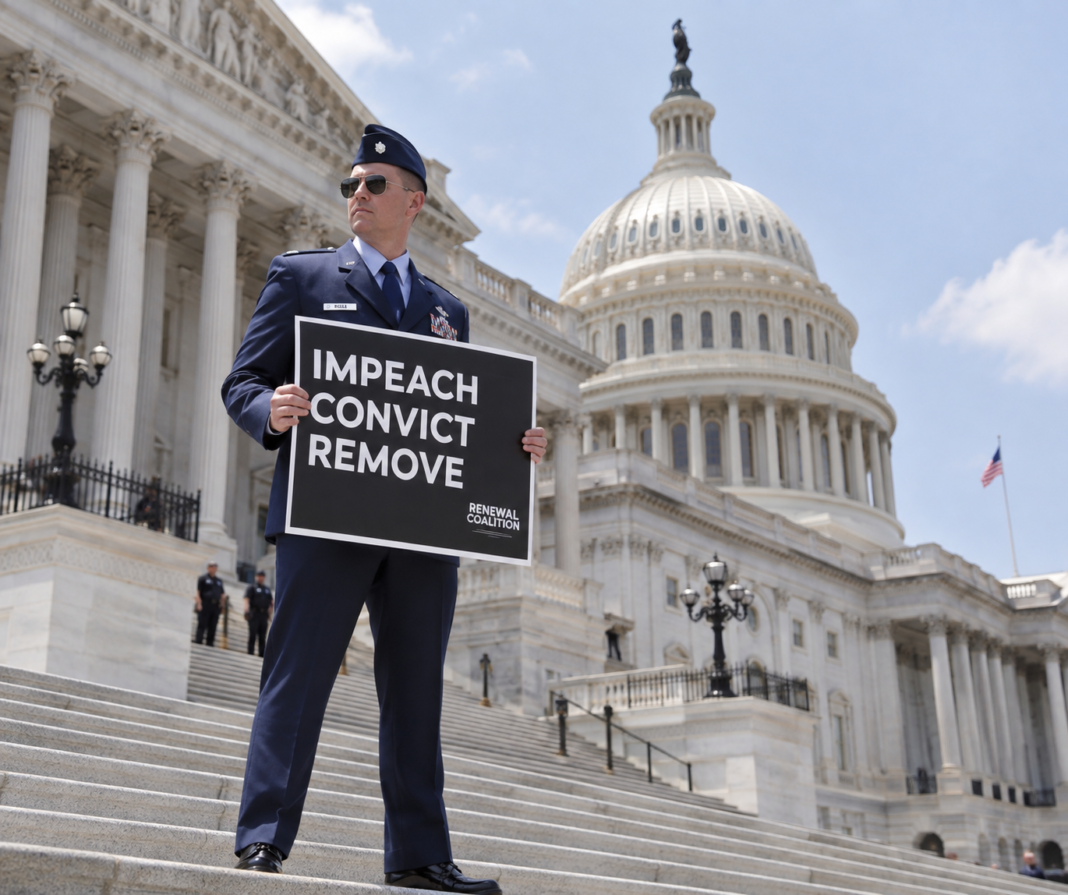

Maj. Jason Watson’s lawyers argue that his public criticism should not be treated as contempt under military law, while prosecutors contend that an active-duty officer crossed legal and professional boundaries
By The Haitian Tribune Staff | September 21, 2026 | WASHINGTON
An active-duty U.S. Air Force major who publicly called for the impeachment and removal of President Donald Trump and Vice President JD Vance is asking that his military case be handled through a special court-martial rather than the more serious general court-martial process.
Maj. Jason Watson made his first public remarks since being charged during an Article 32 preliminary hearing Friday at Joint Base Anacostia-Bolling in Washington. Watson told the hearing that his actions were motivated by his oath to the Constitution rather than partisan politics.
Watson faces 10 specifications under three provisions of the Uniform Code of Military Justice, or UCMJ: three under Article 88, which prohibits commissioned officers from using contemptuous words against specified senior government officials; five under Article 92 involving alleged failures to obey orders or regulations; and two under Article 133, which addresses conduct unbecoming an officer.
He has not been convicted of those allegations and remains entitled to due process and the presumption of innocence.
A Rare Military Free-Speech Case
The proceedings stem partly from Watson’s highly publicized appearance at the U.S. Capitol on July 1, when, while in military uniform, he called for Trump and Vance to be impeached, convicted and removed from office. Capitol Police arrested Watson after he refused instructions to leave the Capitol steps; civilian charges arising from that incident were subsequently dropped.
Other specifications relate to statements Watson made during a June interview with the Defenders of Our Republic newsletter and an August 17 interview with CNN.
The case raises a legal issue distinct from the free-speech protections generally available to civilians. Members of the armed forces retain constitutional rights, but military law and Defense Department regulations impose additional restrictions intended to preserve discipline and the military’s politically nonpartisan character.
Article 88 specifically applies to commissioned officers and prohibits certain contemptuous language concerning the president, vice president and other officials.
The provision is rarely prosecuted. The New York Times, citing retired Army lieutenant colonel and law professor Daniel Maurer, reported that only two Article 88 convictions had occurred since the UCMJ took effect in 1951.
Defense: Criticism Is Not Necessarily Contempt
Watson’s civilian attorney, Christopher Mutimer, argued that the central question is not whether his client’s comments were prudent but whether they constituted criminal conduct under military law.
Watson similarly maintained in an unsworn statement that his actions were rooted in what he viewed as his constitutional responsibilities.
“I understand my words made people uncomfortable,” Watson said, according to Stars and Stripes. “I spoke to change something that was wrong.”
Watson said his position was not partisan and maintained that he would have objected to actions he believed violated the law regardless of which political party controlled the government.
Military prosecutors offered a different interpretation. They argued that Watson’s public statements and conduct went beyond permissible disagreement and violated obligations imposed on commissioned officers. At the hearing, the government characterized some of his statements as attacks on the president’s character.
The Article 32 hearing does not determine Watson’s guilt or innocence. It is a preliminary military proceeding used to examine probable cause, jurisdiction and the formulation of charges and to recommend how a case should proceed before possible referral to a general court-martial.
Defense Points to Stuart Scheller Case
Watson’s lawyers relied heavily on the earlier military prosecution of former Marine Lt. Col. Stuart Scheller in arguing against sending Watson to a general court-martial.
Scheller publicly criticized senior military and civilian leaders in 2021 following the U.S. withdrawal from Afghanistan. He ultimately pleaded guilty to six UCMJ violations, including offenses under Articles 88, 89, 90, 92 and 133.
His case was resolved through a special court-martial rather than a general court-martial. Scheller received a punitive letter of reprimand and forfeited $5,000 in pay for one month before eventually leaving the Marine Corps.
Watson’s defense argues that Scheller’s treatment is relevant when military authorities decide the appropriate forum for Watson’s case. Prosecutors, however, are not legally required to resolve different defendants’ cases identically simply because some charges overlap; the circumstances and evidence in each case can differ.
Special Versus General Court-Martial
The distinction sought by Watson’s attorneys could significantly affect the potential consequences.
A special court-martial generally handles less serious military offenses and has more limited sentencing authority. A general court-martial is the military’s highest-level trial court and can adjudicate the most serious UCMJ offenses and impose substantially greater punishments when authorized.
Watson’s defense maintains that, if the case proceeds to trial, a special court-martial would be the more appropriate forum.
The government has argued for treating the alleged conduct more seriously, particularly given Watson’s status as an active-duty commissioned officer and the public nature of his statements.
Physical-Training Uniform Dispute Also Examined
Not all of Watson’s charges concern political speech.
The government submitted 29 exhibits and called Maj. Bethany Evans, commander of the 811th Force Support Squadron, as a witness during Friday’s hearing, according to Military Times.
Evans testified regarding an allegation that Watson refused to wear required physical-training clothing while performing duties at Joint Base Anacostia-Bolling.
Watson had previously been assigned as a logistics officer in Bydgoszcz, Poland. Following the investigation, he was restricted to Joint Base Anacostia-Bolling rather than returning to his previous overseas assignment.
Pretrial Confinement Becomes Another Point of Dispute
Watson’s lawyers have also challenged the circumstances surrounding his detention.
As of Friday’s hearing, his attorney said Watson had spent more than a month in pretrial confinement and was being held separately from other prisoners.
Mutimer argued that Watson had served in the Air Force for 17 years and did not represent a flight risk.
The preliminary hearing officer, Maj. Joshua Wendell, said Watson’s separation resulted from legal restrictions that prevent him from being housed with civilian detainees, limiting available confinement arrangements at the installation.
Pretrial confinement is not itself a finding of guilt.
Military Neutrality at the Center of the Case
Watson’s prosecution places two principles into direct tension: an individual service member’s ability to express political and constitutional objections and the military’s rules restricting political activity and certain public statements by active-duty personnel.
Air Force Secretary Troy Meink said after Watson’s July protest that allegations of misconduct would be investigated and emphasized the importance of maintaining the armed forces’ nonpartisan status. He also said commanders would determine any appropriate action under military law and established due-process protections.
At Friday’s proceeding, Wendell summarized the issue as a tension between First Amendment rights and the obligations that accompany service as a military officer.
That distinction will be important as the case develops. The proceeding is not determining whether Watson’s political criticisms of Trump or Vance were correct. The military legal question is whether the manner and circumstances in which an active-duty commissioned officer expressed those views violated the UCMJ and applicable orders.
Recommendation Expected
Wendell must now review the evidence and arguments before making recommendations about how the military should proceed.
Under the Article 32 process, the preliminary hearing officer’s role includes evaluating whether probable cause exists for the alleged offenses and recommending the appropriate disposition of the charges. The recommendation is not itself a conviction or final judgment.
Watson’s attorneys want the case referred, if it proceeds, to a special court-martial.
Military authorities will ultimately decide whether the charges move forward and at what level.
Until then, Watson’s case remains at the preliminary stage—leaving unresolved both the criminal allegations against him and the broader legal question of where military discipline ends and constitutionally protected dissent by an active-duty officer begins.
By The Haitian Tribune Staff | September 21, 2026 | WASHINGTON