
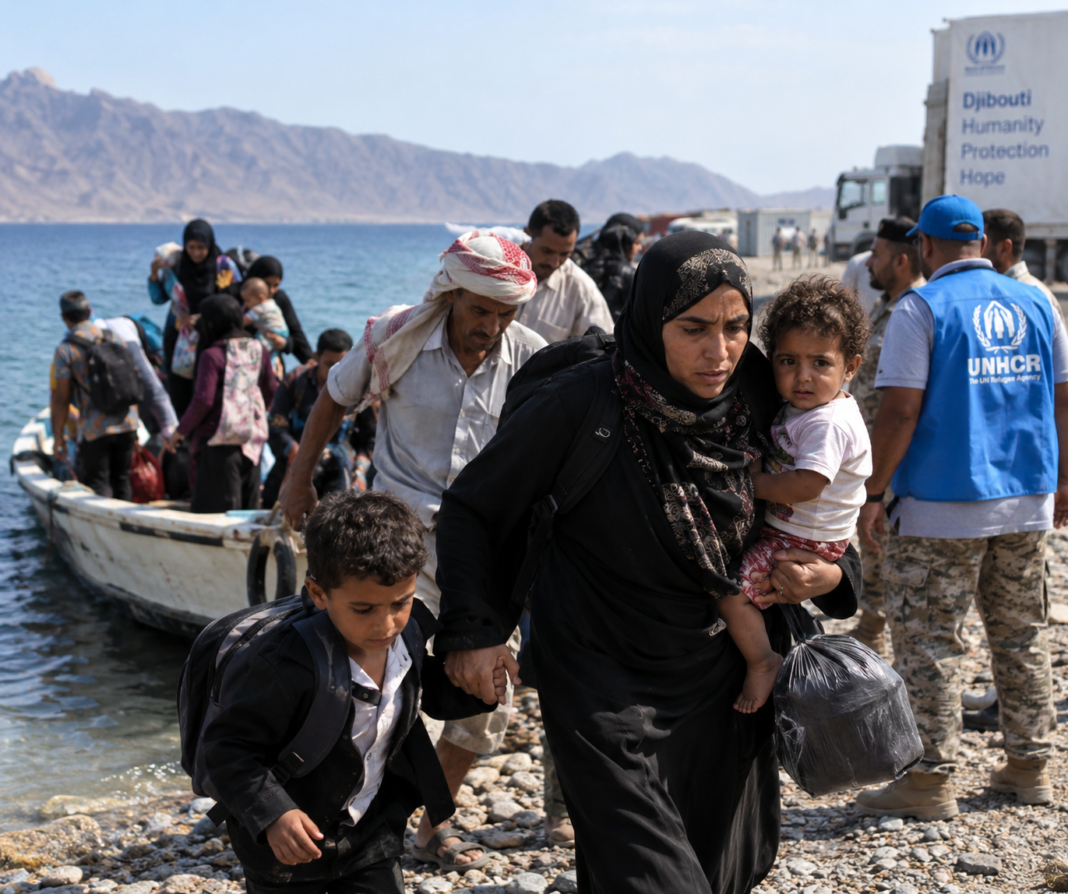

Families fleeing airstrikes and fighting along Yemen’s western coast are arriving by boat near Obock as the battle for territory around the strategic Bab al-Mandab Strait deepens an already severe humanitarian crisis
By The Haitian Tribune Staff | September 21, 2026 | OBOCK, Djibouti
Thousands of Yemenis are crossing dangerous waters toward Djibouti as a sharp escalation in fighting between Houthi forces and Yemen’s Saudi-backed government uproots communities along the Red Sea coast.
In less than a week, nearly 3,000 people reached Djibouti by sea, according to the United Nations refugee agency. Many traveled in small boats across the Bab al-Mandab Strait before arriving at coastal points around Obock, Khor Angar, Moulhoule and Godoria.
For families escaping coastal communities, the journey is the latest displacement in a war that has repeatedly forced Yemenis from their homes since 2014.
At Markazi refugee village near Obock, newly arrived families are being registered and provided with temporary shelter, food, water, health care and other assistance by Djiboutian authorities, UNHCR and humanitarian partners.
Among them are fishermen, children and elderly residents who left homes and livelihoods behind as fighting approached their communities.
Families Flee With Little More Than Their Clothes
For 50-year-old fisherman Ibrahim Issa, remaining in his hometown of Dhubab became impossible as his children reacted with fear whenever military aircraft approached.
Issa owned a boat large enough to take his family across the water. They escaped with only limited possessions and several goats.
Other families were even less prepared.
Some arrived carrying small bundles of belongings; others reached Djibouti with little more than the clothes they were wearing.
Their experiences reflect the speed of the latest displacement. UNHCR says many families fled with few possessions as fighting spread through areas including Al Hodeidah, Taiz, Lahj, Aden, Abyan, Marib, Al Dhaleh and Shabwah.
Fuel shortages have created another obstacle. Some Yemenis trying to leave have been unable to obtain enough fuel for boats, leaving additional families stranded despite their desire to escape.
More Than 100,000 Displaced Inside Yemen
The number fleeing across the sea represents only a fraction of the humanitarian impact.
On September 18, the International Organization for Migration estimated that at least 112,000 people had recently been displaced inside Yemen, while almost 3,000 had crossed into Djibouti.
By September 21, Reuters reported that displacement had climbed above 120,000, with thousands fleeing Yemen by sea as the conflict intensified.
The rapidly changing figures reflect continuing population movements rather than contradictory estimates.
The United Nations has warned that humanitarian agencies are already struggling to respond. Yemen remains deeply vulnerable after more than a decade of conflict, economic deterioration and damage to basic infrastructure.
More than 18 million people are facing severe food insecurity, while approximately 2.2 million children under five are acutely malnourished, according to the World Food Programme.
Battle for Yemen’s Red Sea Coast
The latest displacement follows a major Houthi offensive along Yemen’s western coastline.
The Houthis have made substantial territorial gains near the Bab al-Mandab Strait, the narrow waterway connecting the Red Sea with the Gulf of Aden and, beyond it, the Indian Ocean.
The United Nations told the Security Council on September 15 that fighting had intensified along Yemen’s western coast as Houthi forces advanced toward Bab al-Mandab and reportedly captured several islands in the southern Red Sea. Yemen’s internationally recognized government subsequently launched a counteroffensive, while clashes were reported on several other fronts.
Saudi and Yemeni forces have carried out airstrikes against Houthi positions, while the Houthis have launched missiles and drones toward Saudi cities and energy infrastructure.
The violence has killed nearly 700 people during the latest escalation, according to Reuters.
For civilians caught between the combatants, however, responsibility for individual attacks can be difficult to determine in real time.
That uncertainty is reflected in the accounts of refugees arriving in Djibouti: many describe hearing aircraft, explosions and fighting without knowing which military force was responsible for particular strikes.
An Elderly Fisherman Escapes the Bombing
Among the refugees is Qassim Abraham Abssy, an elderly Yemeni fisherman whose identification documents list his age as 100.
Abssy said the sound of aircraft and explosions convinced his family that they could no longer remain safely at home.
His account illustrates a recurring theme among displaced families: many are less concerned with the political identities of the combatants than with finding somewhere their children can sleep without the sound of explosions.
For now, that place is Djibouti.
But conditions there are difficult.
Temperatures around Obock can be punishing, and humanitarian organizations are trying to accommodate a sudden increase in arrivals while operating with limited resources.
UNHCR has warned that the humanitarian response is already under severe financial pressure and could be overwhelmed if substantially more refugees arrive.
Djibouti Opens Its Doors
Djibouti’s government has kept its borders open to people escaping the fighting.
Authorities have mobilized the country’s navy, military, police and health services to assist arrivals, while UN agencies and other humanitarian organizations provide additional support.
Refugees arriving along the northern coastline are being transported to Markazi, where they can be registered and receive assistance.
UNHCR has publicly thanked Djibouti for continuing to receive Yemenis seeking international protection.
The refugee influx also places additional pressure on a small country already hosting displaced populations and dealing with limited resources.
A Strategic Strait With Global Consequences
The fighting around Bab al-Mandab has implications extending far beyond Yemen.
The strait is one of the world’s most important maritime passages, connecting shipping routes between the Indian Ocean, Red Sea, Suez Canal and Mediterranean.
The United Nations said on September 15 that commercial shipping through the Red Sea appeared to be continuing, but warned that the Houthi advance had increased concern about regional stability and maritime security.
The conflict has also raised concerns about Saudi energy exports and the broader security of commercial vessels moving through the region.
Yet those strategic calculations can obscure what the war means at the household level.
For families arriving in Djibouti, Bab al-Mandab is not primarily an international shipping chokepoint. It is the stretch of water separating bombardment from temporary safety.
Refugees From Yemen’s Earlier War Meet the New Arrivals
Some residents of Markazi have already spent more than a decade waiting for Yemen to become safe enough to return.
Among them is Mohammed Abdullarim, a former tour guide from Aden who fled Yemen in 2015 during the earlier phase of the war.
Now 63, he has watched a new generation of refugees arrive at the same camp.
The sight has revived memories of his own displacement and underscored how little stability Yemen has achieved despite years of negotiations and periods of reduced fighting.
The nationwide truce brokered by the United Nations in 2022 significantly reduced major cross-border hostilities for a period, but it expired without a comprehensive peace settlement. Recent fighting has again spread across multiple fronts.
Peace Determines Whether Families Return
For many refugees, the decision about returning to Yemen is straightforward: they will go home only when they believe it is safe.
That could leave Djibouti preparing for a longer humanitarian emergency if the latest fighting continues.
UNHCR says additional arrivals are expected and has appealed for more international assistance before existing resources are stretched beyond capacity.
For the families now sheltering near Obock, discussions about territorial control, regional alliances and strategic waterways are secondary to immediate concerns—shelter, water, food, education and protection for their children.
They crossed the sea because those basic guarantees had disappeared at home.
Whether their stay in Djibouti lasts weeks, months or years will depend largely on something Yemen has struggled to achieve for more than a decade: a durable peace.
By The Haitian Tribune Staff | September 21, 2026 | OBOCK, Djibouti