
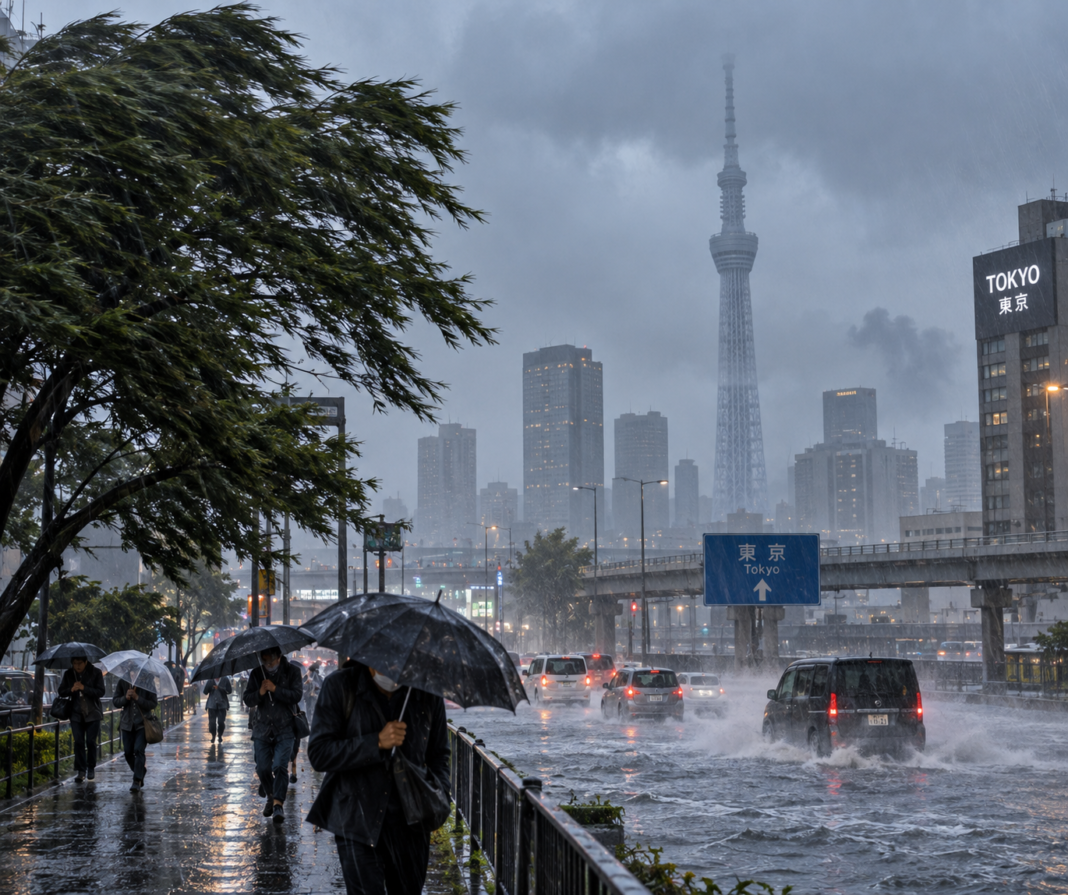

One person is confirmed dead as authorities issue high-level landslide warnings, hundreds of flights are canceled and rail services are disrupted during Japan’s Silver Week holidays
Typhoon Dujuan battered Tokyo and surrounding regions Monday with torrential rain and powerful winds, prompting evacuation orders and emergency warnings as authorities cautioned that landslides, flooding and overflowing rivers could threaten communities across eastern Japan.
The storm brought particularly intense rainfall to the Izu Islands and the Kanto region, which includes Tokyo and neighboring prefectures, while dangerous conditions were also expected along the Pacific coasts of Tokai and Tohoku.
Japan’s Fire and Disaster Management Agency said one person in Miyazaki Prefecture had died in connection with the typhoon and another person suffered minor injuries.
The storm struck during Silver Week, one of Japan’s major holiday periods, disrupting transportation and forcing organizers to cancel events.
Highest-Level Landslide Warning Issued
Northern sections of the Izu Islands were placed under a Level 5 landslide warning, while several locations in the Kanto region received Level 4 warnings because of the danger from heavy rainfall, flooding and landslides.
Japan’s five-level disaster warning system reserves Level 5 for situations in which lives may already be in immediate danger.
At a Monday afternoon news conference, Takuya Hosomi, director of the Japan Meteorological Agency’s forecasting division, warned residents that communities under Level 4 alerts could experience a major disaster with little warning.
Authorities urged residents to follow evacuation instructions issued by local governments and to determine whether their homes or workplaces were located in areas vulnerable to landslides or flooding.
People in heavily developed areas were also warned against entering flooded roads or underground spaces, where rapidly accumulating water can create particularly dangerous conditions.
More Than 670 Millimeters of Rain
Dujuan produced extraordinary rainfall totals in some communities.
During the 24-hour period ending at 4:40 p.m. Monday, Izu Oshima recorded 672.5 millimeters — about 26.5 inches — of rain, according to the Japan Meteorological Agency.
The Sakahata district of Kimitsu in Chiba Prefecture received 324 millimeters, or nearly 13 inches, during the same period.
Additional heavy rainfall remained possible.
Forecasters said that during the 24 hours ending Tuesday evening, another 200 millimeters could fall across Kanto. The Izu Islands and Tohoku could receive as much as 100 millimeters, while Tokai could see up to 80 millimeters.
Officials cautioned that additional rainfall could be dangerous even where precipitation begins to weaken because saturated soil can remain vulnerable to landslides and rivers may continue rising.
Dujuan Moves Along Japan’s Pacific Coast
As of 4 p.m. Monday, Dujuan — the 25th named storm of the year — was approximately 130 kilometers southeast of Katsuura in Chiba Prefecture and moving northeast at about 35 kilometers per hour.
The storm had a central atmospheric pressure of 960 hectopascals, with maximum sustained winds reaching approximately 40 meters per second and gusts as high as 55 meters per second.
The Japan Meteorological Agency warned residents to remain alert for destructive winds and high waves in addition to flooding and landslides.
Hundreds of Flights Canceled
Dujuan caused widespread disruption across Japan’s transportation network at one of the busiest travel periods on the calendar.
According to NHK, Japan Airlines canceled 120 domestic flights, while All Nippon Airways canceled 140, affecting thousands of passengers.
Rail travel was also disrupted.
East Japan Railway suspended or reduced service on several routes in Chiba and Ibaraki prefectures and parts of western Tokyo as operators assessed the effects of the storm and heavy rainfall.
Travelers were advised to check transportation schedules before leaving for airports and railway stations because additional cancellations remained possible as weather conditions evolved.
Tokyo Game Show Cuts Final Day
The severe weather also affected one of Japan’s major entertainment events.
The Tokyo Game Show, which began Thursday, canceled its Monday program because of the typhoon, bringing the five-day event to an early end.
The cancellation illustrated the wider impact of Dujuan during Silver Week, when millions of people typically travel, attend festivals and participate in cultural and recreational events across the country.
Flooding Remains a Major Concern
Although Dujuan was moving northeast Monday afternoon, Japanese authorities emphasized that communities should not assume the danger had passed simply because the storm’s center was moving away.
Extreme rainfall can continue to produce flooding and landslides well after the strongest winds have moved through an area.
Residents in vulnerable communities were urged to monitor municipal evacuation notices, avoid swollen rivers and flooded streets, and stay away from coastal areas experiencing dangerous waves.
For Tokyo and the surrounding region, the combination of exceptionally heavy rainfall, saturated ground and disrupted transportation turned what would normally be a busy holiday period into a day of emergency preparations and widespread travel interruptions.
By The Haitian Tribune Staff | September 21, 2026 | TOKYO