
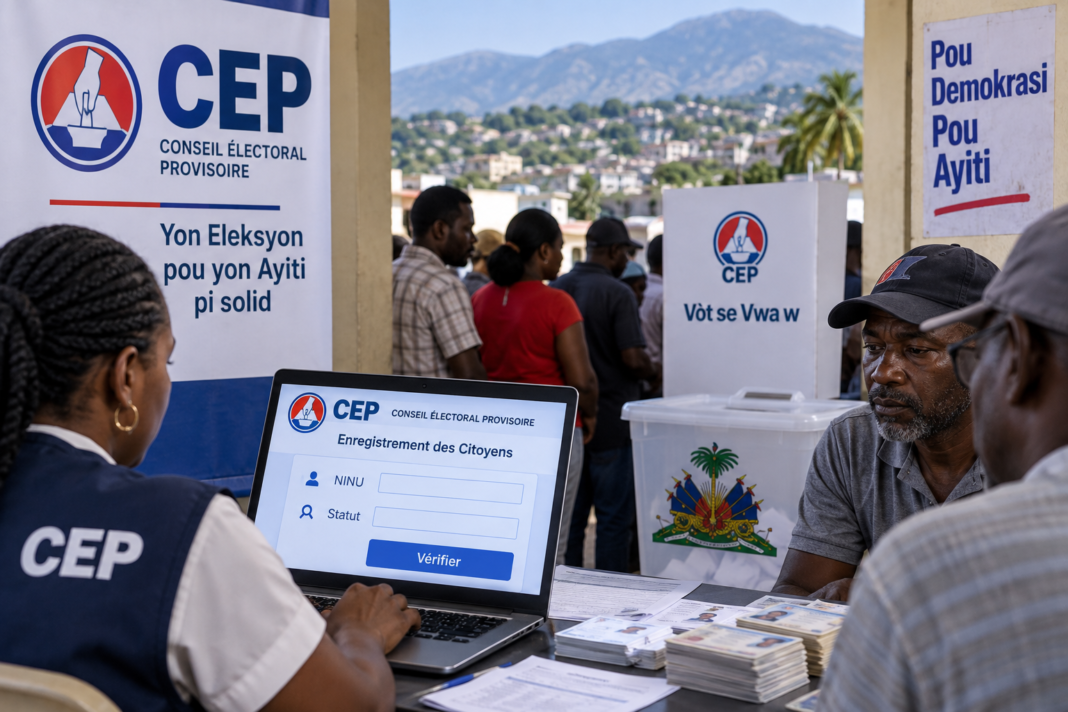

As Haiti prepares for its first national elections in years, problems surrounding the 30,000-member requirement for political organizations are becoming an early test of the credibility of the December vote
Haiti’s preparations for national elections are confronting a significant new challenge after the country’s electoral registration system rejected millions of attempted entries associated with political organizations seeking to qualify for the upcoming vote.
According to a report by Radio Métropole, electoral authorities have identified repeated attempts to enter invalid information into the system used by political organizations to demonstrate that they have the 30,000 registered members required to qualify to present candidates. More than 9 million attempted registrations have reportedly been rejected by the electronic system.
That extraordinary number immediately raises questions about the integrity of the registration process. But it requires an important qualification: nine million rejected entries does not mean nine million proven acts of electoral fraud.
Reynold Guerrier, director general of Haiti’s National Identification Office, or ONI, cautioned against treating every rejected submission as fraudulent. He said users sometimes enter incorrect or randomly generated National Identification Numbers, known as NINUs, while attempting to get around computerized controls. Repeated attempts involving the same person or invalid information can therefore produce a rejection count far larger than the number of actual individuals involved.
Still, the scale of the rejected entries is significant because it comes at a particularly sensitive moment.
Haiti is attempting to organize a presidential and legislative election on December 13, 2026, after years without nationally elected institutions. The official calendar also calls for a second round, if required, on February 21, 2027. The CEP has itself cautioned that implementation of the calendar depends on security conditions and adequate financing.
The controversy centers largely on one of the most consequential requirements imposed on political organizations.
Under the current electoral framework, political parties and groupings must demonstrate a membership base of 30,000 people before they can register candidates. The provision was intended in part to establish that organizations participating in national elections possess a meaningful level of public organization rather than existing principally on paper.
In practice, however, the requirement has created a major administrative and political bottleneck.
Political organizations must submit identifying information that can be checked against ONI’s national identification database. Invalid identification numbers, duplicated information and other discrepancies can be rejected electronically.
That verification mechanism could prove valuable if it prevents fictitious memberships from being used to satisfy the 30,000-member threshold.
But the controversy also exposes a different vulnerability: the possibility that legitimate identification information could be submitted without the person’s knowledge.
Several Haitian political figures have recently alleged that their names and National Identification Numbers were improperly used on the CEP’s platform. Representatives associated with PNN, Lòd Demokratik, UDELH, RESPECT and LAVEH formally demanded that the electoral authorities disclose which political organizations had submitted the disputed information. Their claims remain allegations and do not by themselves establish that identity theft or electoral fraud occurred.
The distinction matters.
A computer rejecting an incorrect NINU is evidence that the verification system detected an invalid submission. It does not establish who entered the information, why it was entered or whether there was criminal intent.
A more serious issue would arise if investigators determine that valid identification information belonging to real citizens was systematically submitted to political organizations without those citizens’ consent.
That would turn what might otherwise be an administrative problem into a question involving personal data, political representation and potentially electoral fraud.
For the CEP, the challenge is therefore not merely to announce how many entries were rejected. Establishing confidence in the system will depend on explaining what caused those rejections and what safeguards exist against unauthorized use of valid identities.
The timing is particularly difficult because other parts of the electoral timetable are already under pressure.
The CEP announced on September 16 that political organizations would receive additional time—through October 9—for online candidate registration and submission of required documents. The council said the extension came after repeated requests from approved political organizations. It also disclosed that discussions were continuing with political actors and the government about possible modifications to the electoral decree.
That represents another adjustment to a calendar that has already been revised.
Earlier this month, the CEP had extended the broader candidate-registration operation and established October 14 as the date for publication of the definitive list of approved candidates after challenges and appeals.
The extensions illustrate the central tension confronting Haiti’s electoral authorities: making participation realistically possible without repeatedly changing the rules in ways that could undermine confidence in the process.
There is also the question of voter participation.
A September 15 report by HaitiLibre, citing electoral figures, said fewer than 600,000 voters had registered as of September 14, compared with the several million registrations authorities hoped eventually to obtain. The outlet also reported operational problems including temporarily closed registration centers, absent personnel and inadequate public information. Those figures should be treated as a dated snapshot rather than the eventual size of the electorate because registration remains underway.
Security presents an even larger challenge.
Several constituencies cannot conduct ordinary electoral operations because of insecurity. The CEP has already instructed candidates from a number of communes—including Carrefour, Gressier, Kenscoff, Cabaret, Croix-des-Bouquets, Ganthier, Thomazeau and Port-au-Prince III—to complete certain candidacy procedures through departmental electoral offices instead. Similar accommodations have been announced for communities in Artibonite and Centre.
These arrangements show that the election is not being organized under normal conditions.
That matters because electoral integrity involves considerably more than preventing someone from entering a false identification number.
A credible election requires eligible citizens to be able to register, candidates to compete under consistently applied rules, polling places to operate safely, ballots and election materials to reach communities, political representatives and observers to monitor voting, results to be tabulated securely and disputes to be resolved through institutions that participants regard as legitimate.
The controversy over rejected registrations should therefore be understood as an early stress test, rather than proof that the December election itself is fraudulent.
In fact, the rejection of invalid information can also demonstrate that an electronic safeguard is functioning as designed.
The more important questions are what happens afterward.
Authorities will need to determine whether the rejected submissions primarily resulted from ordinary mistakes, repeated automated attempts, deliberate efforts to manufacture party membership, unauthorized use of citizens’ identities, or some combination of those problems.
The answers could have consequences for which political organizations ultimately qualify.
Transparency will be especially important because Haiti is attempting to restore elected government after a prolonged institutional crisis. In that environment, even legitimate administrative decisions can become politically contentious if the reasoning behind them is unclear.
The CEP says it intends to conduct the process impartially and transparently. In its September 16 announcement, the council again emphasized electoral independence and democratic accountability.
The coming weeks will provide a practical test of those commitments.
By October 14, Haitians should have a definitive list of approved candidates under the revised timetable. The first presidential and legislative vote remains scheduled for December 13, while the second round and territorial elections are scheduled for February 21, 2027.
Between now and then, the CEP faces several interconnected tasks: resolving disputes surrounding political-party membership, protecting citizens’ identification information, expanding voter registration, accommodating communities affected by insecurity, finalizing candidate lists and preparing election-day infrastructure.
The report of more than nine million rejected entries does not by itself demonstrate that Haiti’s election has been compromised.
It does, however, expose how vulnerable the process could become if political membership and national identification information are not carefully protected and independently verifiable.
For an election intended to restore democratic institutions after years of political uncertainty, the integrity of the December vote will depend not only on who wins, but on whether Haitians can understand and trust the system that determines the result.