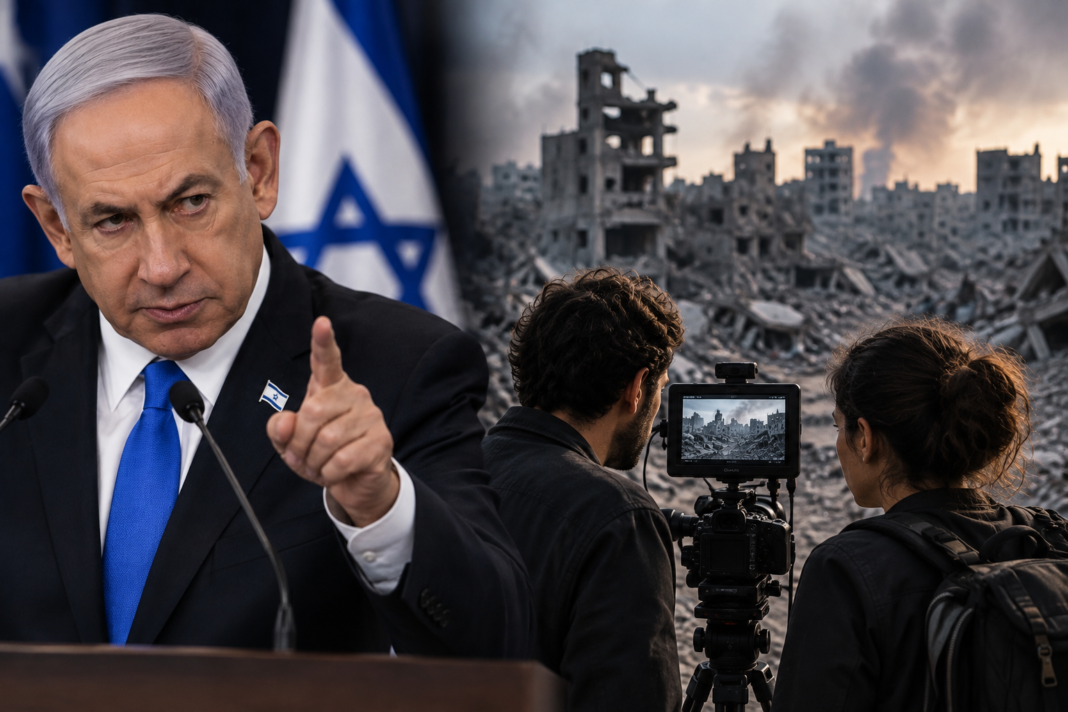

Award-winning film alleges civilian casualties were routinely incorporated into Israeli targeting decisions; Netanyahu and the Israeli military reject its portrayal of the Gaza campaign
Israeli Prime Minister Benjamin Netanyahu says he will pursue legislation that could strip citizenship from Israelis who defame the country’s soldiers, escalating a growing political and legal controversy surrounding NAZA, an award-winning documentary examining civilian deaths during Israel’s war in Gaza.
Netanyahu announced Wednesday that he intends to advance two measures: one addressing citizenship and another that would dramatically increase potential financial damages in defamation cases involving accusations against Israeli soldiers. His announcement followed days of criticism directed at the documentary and its Israeli filmmakers, journalists Yuval Abraham and Rachel Szor.
The proposed measures have not yet become law, and their eventual scope, wording and constitutionality remain unresolved.
At the center of the dispute is NAZA, an investigative documentary built around anonymous testimony from Israeli soldiers and intelligence personnel who served during the Gaza war. The film alleges that large numbers of anticipated civilian casualties became part of some Israeli targeting calculations.
Netanyahu and Israel’s military reject the documentary’s characterization of their operations. The Israeli military has denounced its allegations as distorted and has begun examining whether classified material was improperly disclosed during its production and whether legal action should follow.
The filmmakers say their purpose is to expose military systems and decisions they believe Israelis need to confront publicly.
The documentary received international attention after winning the Special Jury Prize at the 2026 Venice International Film Festival. The festival’s official listing identifies Abraham and Szor as its directors and The Guardian and JW Films among its producers.
The film’s title comes from an Israeli military acronym referring to the estimated number of civilians expected to be killed in an airstrike. According to Film at Lincoln Center, the documentary builds partly upon earlier investigations published by +972 Magazine, Local Call and The Guardian.
Its international recognition has contrasted sharply with the reaction among many Israeli officials.
Netanyahu said the documentary portrayed Israeli officers and soldiers as war criminals. In announcing his proposed legislation, he argued that accusations against military personnel cause substantial harm to soldiers and to Israel.
He said one proposal would allow citizenship to be revoked from people who defame Israeli soldiers, while another would increase statutory damages available through defamation lawsuits by as much as twentyfold.
The proposals immediately raise difficult legal and civil-liberties questions about where Israel could draw the boundary between defamatory accusations and protected journalism, political criticism or artistic expression.
Israel already has legislation allowing citizenship to be revoked in limited circumstances involving acts considered a breach of loyalty to the state. In 2022, the Israeli Supreme Court upheld that authority under particular conditions. A significantly broader law covering speech characterized as defamation of soldiers could therefore face substantial judicial scrutiny.
The controversy has also become intertwined with Israeli electoral politics ahead of the country’s October 27 election.
Netanyahu has criticized political opponents whom he believes have not condemned NAZA forcefully enough. That has turned what began as a dispute over a documentary into a wider argument about the military, freedom of expression, national loyalty and accountability during wartime.
Supporters of a strong response to the film argue that unsubstantiated accusations against Israeli troops can damage the country’s international standing and expose soldiers to legal or security risks.
Critics of the government’s response contend that threatening filmmakers with citizenship consequences could discourage journalists, whistleblowers and citizens from investigating or criticizing state institutions.
The dispute intensified further as demonstrations and threats were reported against Abraham and Szor. At the same time, members of Israel’s film community have rallied behind the directors, arguing that disagreements with the documentary should be addressed through evidence and public debate rather than intimidation.
The military’s response has taken a separate legal track.
Israeli military chief Eyal Zamir ordered officials to examine potential security issues surrounding the production, including whether classified information was leaked. The review does not itself establish that the filmmakers committed a crime.
The underlying allegations in NAZA concern one of the most contentious aspects of the Gaza war: how Israel assessed civilian casualties when authorizing attacks against suspected military targets.
The documentary presents testimony from military and intelligence personnel to support its contention that expected civilian deaths were incorporated into some targeting decisions. The Israeli military disputes the film’s conclusions and maintains that it operates according to international law while targeting Hamas and other armed groups rather than civilians.
Those competing claims should not be confused with independently adjudicated findings. The documentary presents an investigative case; Israeli authorities contest that case; and disputes over individual attacks and the broader conduct of the war remain subjects of international legal, journalistic and political scrutiny.
The human toll provides the backdrop to the controversy.
Gaza health authorities say more than 73,000 Palestinians have been killed during the Israeli military campaign. The war followed the Hamas-led attack on Israel on October 7, 2023, which killed approximately 1,200 people, according to Israeli figures, and resulted in the taking of hostages.
More than numbers, however, the NAZA controversy has become a test of how a country at war handles accusations against its own military.
For Netanyahu and supporters of the proposed legislation, protecting soldiers from what they regard as defamatory accusations is a matter of national responsibility.
For the filmmakers and their supporters, examining the conduct of state institutions—especially during a devastating war—is precisely the kind of work journalism and documentary filmmaking are supposed to perform.
Those positions are now colliding not only in cinemas and political debate, but potentially in Israel’s parliament and courts.
With NAZA receiving international attention and Netanyahu proposing new legal consequences for those he says defame Israeli troops, the controversy surrounding the documentary has grown into a much larger debate over military accountability, national security, citizenship and freedom of expression in wartime Israel.
By The Haitian Tribune Staff | September 17, 2026 | JERUSALEM