
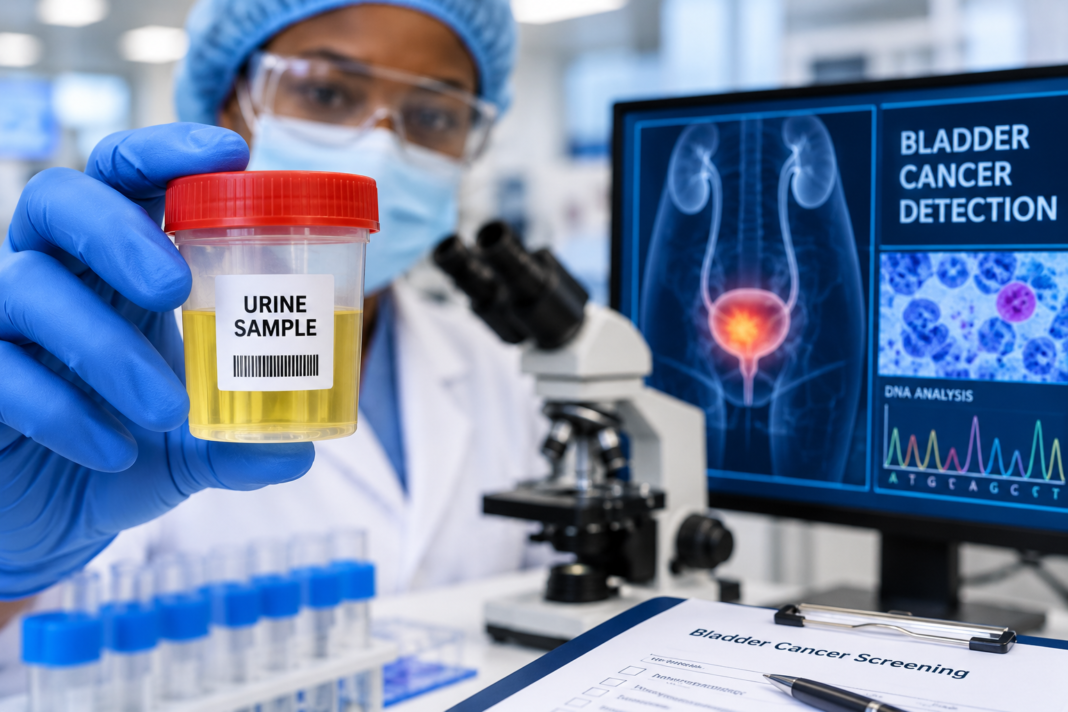

Researchers say the DNA-based test could help identify high-risk patients earlier while reducing the number of people sent immediately for invasive bladder examinations
BIRMINGHAM, England — A simple urine test has detected more than nine out of every 10 bladder cancers in a large British study, offering promising evidence that doctors may eventually be able to identify patients at greatest risk without immediately subjecting everyone with warning signs to an invasive examination.
The GALEAS Bladder test identified 71 of 77 bladder cancers — 92.2% — among 964 patients referred for urgent investigation across seven National Health Service urology departments in England and Scotland.
More significantly, the test detected all 17 cases of muscle-invasive bladder cancer, the more dangerous form of the disease identified in the study. It also found 35 of 36 high-grade cancers, giving it a 97.2% detection rate for those tumors.
The peer-reviewed findings were published in European Urology Oncology and led by researchers at the University of Birmingham working with diagnostic company Nonacus.
Researchers caution that the urine test is not intended to replace cystoscopy or tissue analysis. Instead, they believe it could become an important tool for determining which patients should receive an urgent cystoscopy and which could safely wait when clinically appropriate.
A DNA Test Using Only Urine
GALEAS works by examining genetic material released into urine.
Rather than looking simply for blood or abnormal cells, the test uses next-generation sequencing to search for mutations across 23 genes associated with bladder cancer. The commercial laboratory service generally returns results within five to 10 working days after receiving the sample.
The approach could provide doctors with another layer of information before deciding how urgently a patient needs further investigation.
At present, patients referred with suspected bladder cancer commonly undergo cystoscopy, in which a thin instrument containing a camera is passed through the urethra and into the bladder so doctors can examine its interior.
Cystoscopy remains an essential diagnostic procedure, but it is invasive, requires clinical resources and can be uncomfortable for patients.
The new research suggests urine-based molecular testing could help doctors use those procedures more selectively.
Negative Results Were Particularly Accurate
One of the study’s most encouraging findings involved patients who received a negative result.
Among the population studied, a negative GALEAS result was associated with a 99.3% probability of not having bladder cancer.
The test performed particularly well among patients with non-visible hematuria—microscopic blood in the urine that cannot be seen with the naked eye. In that subgroup, GALEAS detected every bladder cancer diagnosed during the study, while a negative result had a 100% negative predictive value.
Those results are potentially important because blood in the urine is one of the principal reasons patients are referred for bladder-cancer investigations, but most people referred do not ultimately have the disease.
Only 77 of the 964 participants, or 8%, were diagnosed with bladder cancer.
Could Reduce Pressure on Cystoscopy Services
Researchers also examined what could happen if GALEAS were used as a triage test before cystoscopy.
Their analysis estimated that, at the most cautious predetermined clinical threshold, using the urine test could result in approximately 730 fewer urgent cystoscopies for every 1,000 patients assessed, compared with immediately sending everyone for the procedure, without reducing the modeled net clinical benefit.
That does not mean the study actually canceled 730 procedures for every 1,000 patients. The figure comes from decision-curve analysis based on the study results and represents the potential effect of using the test as part of a triage strategy.
Under such an approach, a patient with a positive molecular test could be prioritized for prompt cystoscopy. A patient with a negative result might have the procedure deferred when the treating physician considers that medically appropriate.
The University of Birmingham says the test is already being incorporated into some NHS pathways in England and Wales, with additional sites adopting it.
It Does Not Replace a Cancer Diagnosis
Despite the strong results, GALEAS should not be interpreted as a stand-alone confirmation that a person has—or does not have—cancer.
A positive urine test still requires further clinical investigation.
Cystoscopy, biopsy and histopathological examination remain important because doctors need to see suspicious abnormalities, obtain tissue where necessary and determine precisely what type and stage of cancer is present.
The study authors specifically describe GALEAS as a tool for pre-cystoscopy decision-making, rather than a replacement for the investigations required to establish a definitive cancer diagnosis.
Blood in the Urine Remains an Important Warning Sign
The findings also reinforce the importance of seeking medical attention for blood in the urine, medically known as hematuria.
Visible blood may make urine appear pink, red or dark brown. In other cases, the amount is so small that it can only be detected through laboratory testing.
Blood in the urine does not automatically mean cancer. Urinary tract infections, kidney stones and several other conditions can cause the same symptom.
Nevertheless, unexplained hematuria can be an early warning sign of bladder cancer and should be medically evaluated rather than ignored.
The promise of tests such as GALEAS is that doctors may eventually be able to distinguish more efficiently between the relatively small proportion of patients who need the most urgent cancer investigation and the much larger group whose symptoms have another cause.
Important Limitations Remain
The results are encouraging, but the research has limitations.
The study was prospective and observational, enrolling patients between October 2024 and June 2025. Researchers also noted limited follow-up information for participants who tested positive with GALEAS but did not have a tumor visible during cystoscopy.
The research was funded by Nonacus Limited, the company behind the commercial test, and several authors have affiliations with the company. That does not invalidate the findings, but the relationship is important when interpreting the research and underscores the value of continued independent evaluation.
Larger studies and longer follow-up will help establish how safely the test can be incorporated into routine care and which patients benefit most.
A Potential Change in Bladder-Cancer Testing
The study nevertheless represents an important development in efforts to make cancer detection less invasive.
A urine sample is far easier to collect than performing a cystoscopy, and the ability to detect every muscle-invasive cancer in this study is particularly encouraging because aggressive cancers are the cases physicians are most concerned about finding quickly.
The immediate goal is not to eliminate cystoscopy.
Instead, molecular urine testing could help transform it from a procedure routinely performed urgently on a large group of patients into one prioritized more quickly for those whose biological markers suggest the greatest cancer risk.
If the findings continue to hold up as the test is used more widely, that could mean faster investigation for high-risk patients, fewer unnecessary urgent invasive procedures for lower-risk patients and reduced pressure on overstretched urology services.
For patients, the potential benefit is equally straightforward: a simple urine sample could help doctors determine who needs the most urgent attention—while ensuring that the most dangerous bladder cancers are not overlooked.
The Haitian Tribune | Health & Science