
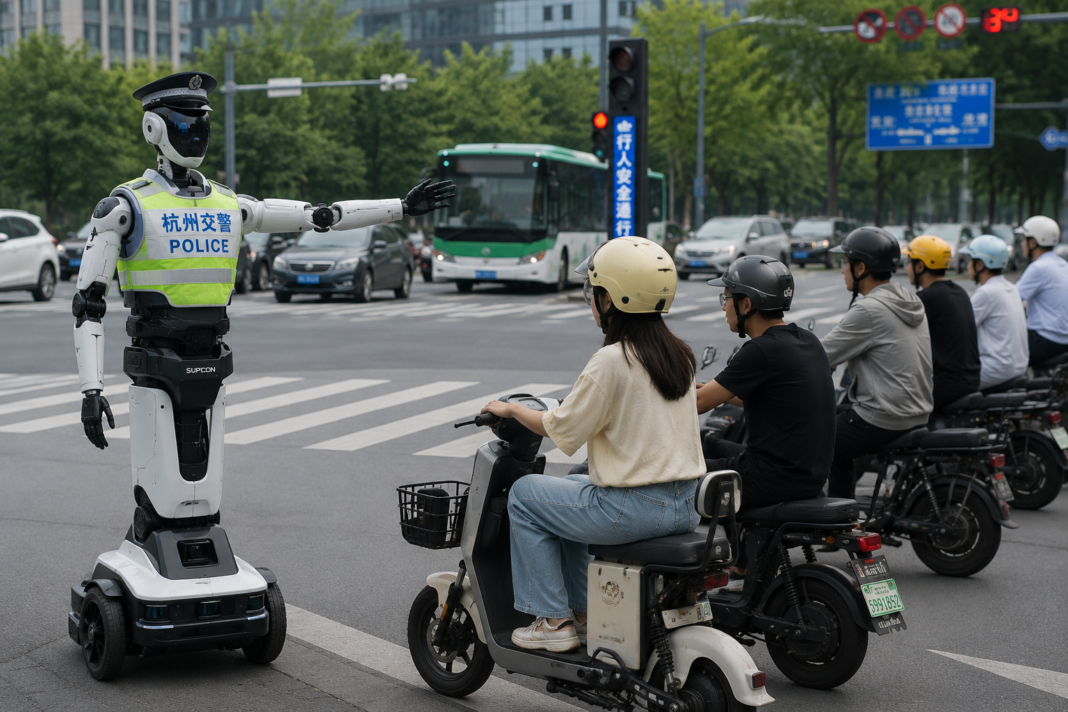

The machines can direct traffic, detect violations and warn motorists, but they cannot make arrests as China tests practical uses for humanoid robotics.
HANGZHOU, China — China is experimenting with a new kind of traffic officer: a nearly six-foot-two-inch robot equipped with cameras, radar and artificial intelligence that can monitor busy intersections, direct vehicles and warn people when they break traffic rules.
According to a Reuters report published on August 20, 2026, the robotic traffic officer is being tested in Hangzhou, a major technology hub in eastern China, as Chinese companies look for practical applications for increasingly sophisticated robots.
The machine bears little resemblance to the armed law-enforcement cyborg made famous by the 1987 movie RoboCop. It carries no weapon, has no authority to arrest anyone and moves on wheels. Instead, its purpose is to perform repetitive traffic-management duties normally handled by human police officers.
A Robot Designed for the Intersection
The T2 robot was developed by Hangzhou-based technology company SUPCON Information. Standing about 1.88 meters tall and weighing approximately 98 kilograms, the machine is designed to operate alongside existing traffic infrastructure.
Its mechanical arms can make traffic-directing gestures synchronized with signals at an intersection.
More importantly, its sensors allow it to observe what is happening around it.
Cao Hui, who leads SUPCON’s intelligent unmanned systems innovation center, told Reuters that the system combines cameras, radar and onboard computing technology to identify several common traffic violations.
Among them are electric-bike riders traveling without helmets, e-bikes carrying unauthorized passengers, vehicles stopping beyond designated road markings and pedestrians attempting to cross when signals prohibit them from doing so.
Once a violation is detected, the robot can issue a warning.
Early Results Show Fewer Violations
The experiment is not simply intended as a technological demonstration.
SUPCON says the pilot program has produced measurable changes in behavior, with some categories of traffic violations falling by more than 40%, according to Reuters.
If those results can be replicated on a larger scale, robots could eventually provide municipalities with another tool for managing crowded intersections while allowing police officers to concentrate on duties requiring human judgment and direct intervention.
However, the machines remain assistants rather than replacements for police.
They do not have independent law-enforcement powers, and their current responsibilities are primarily monitoring, directing traffic and reminding road users to follow regulations.
China Wants Robots to Do Real Work
The Hangzhou experiment reflects a much larger transformation underway in China’s robotics industry.
For years, humanoid robots have attracted attention for demonstrations involving dancing, running, martial arts and other highly choreographed performances. The challenge now facing manufacturers is turning those technological achievements into machines capable of performing economically useful work.
Traffic management represents one possible application.
Factories, warehouses, hotels, hospitals, retail businesses and public facilities are also emerging as potential environments for advanced robots.
The shift is important because the long-term commercial success of humanoid robotics will depend less on spectacular demonstrations and more on whether machines can reliably perform repetitive or labor-intensive tasks at a reasonable cost.
Chinese Companies Look Overseas
China’s ambitions are also international.
Reuters reported that AiMOGA Robotics, which is backed by Chinese automaker Chery, sees opportunities to export robotic systems as companies search for markets beyond China.
But taking these machines overseas presents challenges beyond manufacturing.
Robots operating in public environments can collect substantial amounts of information through cameras, sensors and navigation systems. Different countries maintain different privacy, cybersecurity and data-protection requirements, potentially complicating international deployment.
A robot that continuously observes a public intersection, for example, raises questions about what information is recorded, where that data is stored, how long it is retained and who is permitted to access it.
Those questions could become increasingly important as robots move from controlled environments into public spaces.
Artificial Intelligence Meets Physical Infrastructure
The Hangzhou project also illustrates a significant evolution in artificial intelligence.
Much of the recent global AI boom has centered on software capable of generating text, images, audio and computer code. Robotics takes the technology into the physical world, where machines must interpret their surroundings and respond appropriately in real time.
Traffic control is a particularly demanding environment. Pedestrians, bicycles, motorcycles, cars and buses can move unpredictably, while weather, congestion and unexpected incidents can complicate decision-making.
For now, human authorities remain responsible for the most consequential decisions.
But China’s robotic traffic experiment offers a glimpse of how automation could gradually become integrated into public infrastructure.
The question is no longer simply whether a robot can walk, wave or perform for an audience. The emerging test is whether it can perform an ordinary job safely, consistently and efficiently.
At one busy intersection in Hangzhou, China is beginning to find out.
Source: Reuters reporting published August 20, 2026.
The Haitian Tribune | Science & Technology