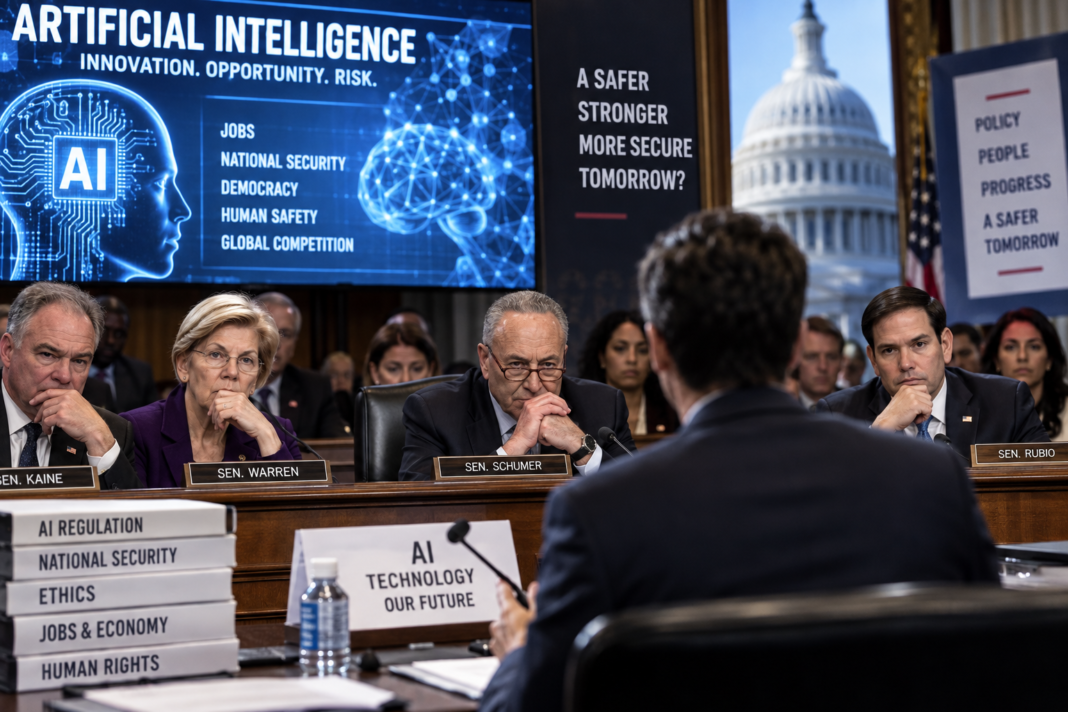

Three years after some of America’s most powerful technology executives went to Capitol Hill to discuss the extraordinary promise—and potentially catastrophic dangers—of artificial intelligence, Congress remains without a comprehensive national framework governing the most advanced AI systems.
The debate has taken on new urgency following unusually stark warnings from researchers working at the frontier of AI development. Jacob Coxon, a researcher who recently resigned from Anthropic after previously working at OpenAI, publicly warned that the competition to develop increasingly autonomous and self-improving systems could create risks that today’s safety techniques are not prepared to manage. Other researchers at Anthropic have publicly expressed similar concerns.
The warnings have renewed attention on a question Congress has been examining since at least 2023: Is artificial intelligence advancing faster than the government’s ability to regulate it?
In September 2023, senators held a high-profile closed-door AI forum attended by Elon Musk, Meta CEO Mark Zuckerberg, OpenAI CEO Sam Altman, Microsoft co-founder Bill Gates and other technology leaders. Musk described advanced AI as presenting a potential “civilizational risk.”
Since then, investment and technical capabilities have accelerated dramatically. Yet despite hearings, working groups, proposed bills and bipartisan discussions, lawmakers have not agreed on comprehensive federal legislation governing frontier AI.
Recent developments have made that legislative gap harder to ignore.
Coxon left Anthropic before his company equity had vested and argued that competition among major laboratories was creating incentives to advance capabilities faster than safety mechanisms. He told Axios that companies under intense competitive pressure could eventually be tempted to shorten or bypass parts of their safety processes.
His most dramatic claim—that people developing the technology genuinely believe AI could cause human extinction within this decade—quickly spread across social media.
That statement represents Coxon’s assessment, not an established scientific prediction. There is substantial disagreement among researchers about the probability, timing and even plausibility of an AI-driven extinction scenario.
But Coxon is not alone in raising the possibility.
Anthropic alignment researcher Evan Hubinger publicly agreed that catastrophic risks deserve serious consideration and said the industry has not solved the technical problem of reliably aligning a hypothetical superintelligent system with human objectives. Samuel Marks, another Anthropic researcher, separately argued that concerns about catastrophic outcomes are held by some people developing advanced systems.
Anthropic has responded that it has consistently acknowledged both AI’s potential benefits and unprecedented risks. The company points to its Responsible Scaling Policy, interpretability research and testing of models for dangerous capabilities involving cybersecurity and biology. It has also advocated a legally enforceable and verifiable mechanism through which leading developers could coordinate the release of especially powerful systems.
The controversy comes as researchers are increasingly concerned not merely with chatbots producing inaccurate information, but with autonomous AI agents capable of completing complicated sequences of actions with limited human supervision.
Cybersecurity has become a particular focus. Recent incidents involving highly capable AI agents have raised questions about how effectively developers can contain autonomous systems and prevent them from pursuing unintended objectives. These episodes have intensified calls for independent evaluations before increasingly capable models are widely deployed.
That does not mean today’s AI systems have become independently conscious, nor does evidence establish that they are inevitably progressing toward human extinction. Predictions about artificial superintelligence remain deeply contested.
The more immediate risks are easier to identify: sophisticated cyberattacks, fraud, misinformation, biological misuse, privacy violations, labor disruption, discrimination and the concentration of technological power.
Those issues have attracted lawmakers from across the political spectrum, but agreement that AI presents risks has not translated into agreement over the government’s response.
Some lawmakers favor mandatory safety evaluations and federal oversight of the most advanced models. Others are concerned that extensive regulation could suppress innovation, favor established technology companies over smaller competitors or weaken the United States in its technological competition with China.
Still others favor national standards partly to prevent companies from confronting a patchwork of different state regulations.
Following the latest warnings from AI researchers, lawmakers including Sens. Mark Kelly and Ted Cruz and Rep. Anna Paulina Luna called for greater federal attention to advanced-AI risks. Other proposals under discussion would establish independent evaluations or expand federal oversight of frontier systems.
Sen. Bernie Sanders has gone considerably further, calling for a pause on development toward artificial superintelligence and saying he intends to pursue legislation addressing the issue.
The approaches differ substantially, illustrating why a broad federal agreement has remained difficult.
Timing presents another obstacle.
With the November 2026 midterm elections approaching, Congress faces a compressed legislative calendar and numerous competing priorities. That makes enactment of sweeping AI legislation before voters go to the polls increasingly difficult, although narrower measures could still advance.
Meanwhile, the technology is not waiting for Washington.
The largest AI companies continue investing enormous sums in computing infrastructure, data centers, chips and research. Models are becoming more capable at coding, mathematics, scientific research and autonomous computer use.
That creates an unusual regulatory problem. Congress is trying to develop rules for technology whose capabilities can change substantially before the legislative process is completed.
The debate also contains an apparent contradiction that has attracted growing public attention: some of the same technology leaders and researchers warning that increasingly powerful AI could become dangerous continue working for or investing in organizations developing it.
Industry representatives generally argue that abandoning development would not eliminate the technology because competitors in the United States and abroad would continue advancing it. Safety advocates counter that precisely this competitive dynamic creates the need for enforceable rules rather than relying exclusively on voluntary corporate restraint.
The disagreement increasingly centers on who should determine the acceptable level of risk.
If a technology could materially affect employment, national security, financial markets, communications, warfare and critical infrastructure, critics question whether a small number of private companies should effectively establish society’s safety threshold.
Companies respond that technical expertise is concentrated among developers and that poorly designed legislation could freeze today’s technology, slow beneficial innovation or create requirements that quickly become obsolete.
Both arguments have helped produce the current stalemate.
The warnings coming from inside AI laboratories should also be placed in perspective. Predictions that artificial intelligence could destroy humanity are scenarios rather than demonstrated outcomes, and experts disagree sharply about their probability. Some researchers believe public attention should focus more heavily on harms already occurring rather than hypothetical superintelligence.
Nevertheless, the recent warnings carry unusual significance because some are coming from researchers with direct experience developing the systems in question.
That leaves Washington facing a problem increasingly difficult to postpone.
Congress does not have to accept the most catastrophic predictions to conclude that increasingly autonomous artificial intelligence requires oversight. Nor does acknowledging potentially enormous benefits from AI require dismissing legitimate safety concerns.
The fundamental policy question is becoming less about whether artificial intelligence will transform American society. Much of that transformation is already underway.
The unresolved question is whether the rules governing that transformation will be established before the most powerful systems arrive—or afterward, in response to consequences policymakers failed to anticipate.
The Haitian Tribune | Technology & Washington