
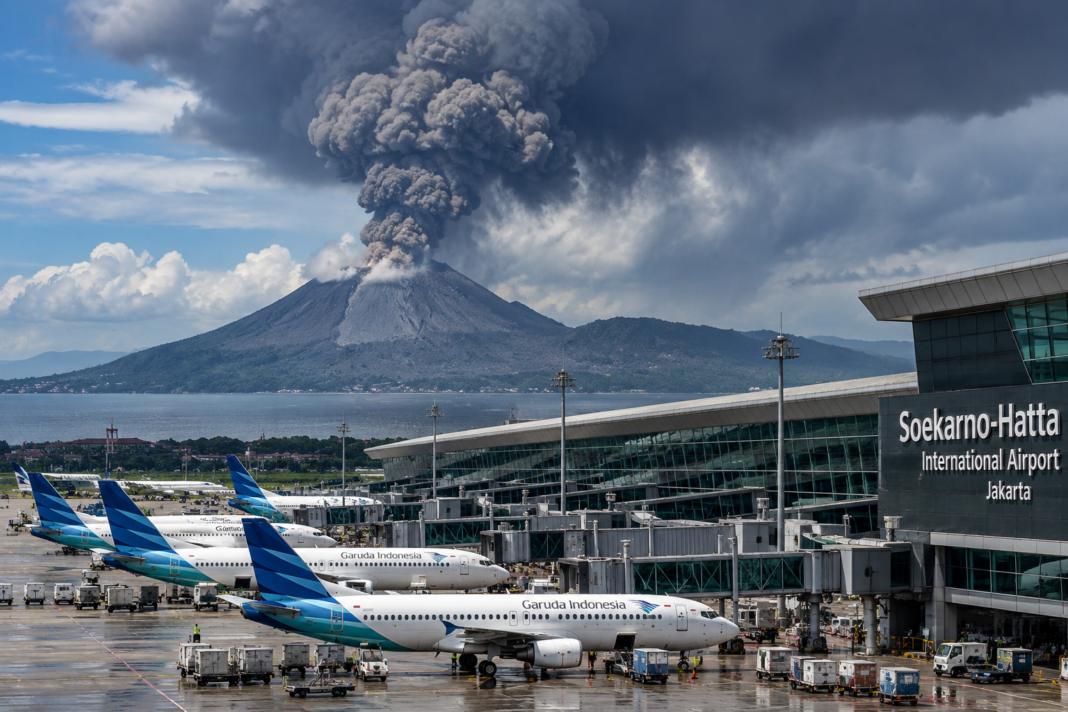

Volcanic ash disrupts hundreds of domestic and international flights, forcing authorities to suspend operations at Jakarta’s main airport and several others
JAKARTA, Indonesia — About 150,000 airline passengers were left stranded or otherwise affected Sunday after ash from the erupting Anak Krakatau volcano forced Indonesian authorities to temporarily close eight airports, triggering widespread flight cancellations, delays and diversions.
The disruption centered on Soekarno-Hatta International Airport, the country’s busiest aviation hub and the primary international gateway serving Jakarta. Authorities suspended operations after tests detected volcanic ash around the airport, prompting officials to repeatedly extend restrictions as conditions evolved.
Indonesia’s Transportation Ministry said eight airports were affected by temporary closures during the day: Soekarno-Hatta, Halim Perdanakusuma, Radin Inten II, Husein Sastranegara, Budiarto Curug, Pondok Cabe, Taufik Kiemas and Atung Bungsu.
About 150,000 Passengers Affected
Transportation Minister Dudy Purwagandhi said roughly 150,000 passengers were caught up in the disruption as authorities prioritized aviation safety.
The ministry reported at one point that 467 flights — 409 domestic and 58 international — had been affected across the airport closures. The figures continued to rise as the disruption stretched through Sunday; Indonesia’s state news agency later reported that 764 scheduled flight movements at Soekarno-Hatta alone had been affected through cancellations, delays, diversions and other operational changes.
The evolving figures underscore the scale and rapidly changing nature of the emergency.
Purwagandhi said authorities would not reopen airports or allow aircraft to operate while volcanic-ash tests continued to indicate unsafe conditions.
International Flights Disrupted
The eruption affected major domestic routes as well as connections between Jakarta and cities across Asia, Australia, Europe and the Middle East.
Early aviation updates listed disruptions involving flights to or from Singapore, Kuala Lumpur, Hong Kong, Sydney, Seoul/Incheon, Doha and Amsterdam. Malaysia Airlines canceled a dozen Jakarta flights, while Singapore Airlines was among carriers canceling services as the ash cloud disrupted the region’s aviation network.
Authorities prepared other Indonesian airports as alternatives for aircraft unable to reach their scheduled destinations.
Passengers were urged to check directly with airlines and airport operators before traveling because closures and reopening times could change depending on the movement of volcanic ash.
Why Volcanic Ash Is Dangerous to Aircraft
Volcanic ash poses a serious aviation hazard even when visibility appears relatively normal.
Unlike ordinary smoke, volcanic ash contains tiny fragments of rock, minerals and volcanic glass. When sucked into jet engines, the particles can melt under extreme temperatures and accumulate inside turbines, potentially damaging engines or causing a loss of power.
Ash can also damage windshields and other aircraft components.
That danger explains why aviation authorities often impose large exclusion zones or shut airports even when an eruption occurs considerable distance from an airport.
Soekarno-Hatta is more than 150 kilometers, or roughly 93 miles, from Anak Krakatau, illustrating how far airborne volcanic material can travel.
Anak Krakatau Remains Active
Indonesia’s disaster agency said continuous eruptive activity at Anak Krakatau had been observed since late Friday, accompanied by rumbling, explosions and lava fountains.
Monitoring during the early hours of Saturday recorded continuous eruptive seismic activity lasting about six hours, according to Indonesia’s Center for Volcanology and Geological Hazard Mitigation.
The eruption sent ash high into the atmosphere and across portions of Java and Sumatra. Authorities distributed masks in communities experiencing ash fall, while officials continued monitoring the volcano for further changes.
No tsunami warning was issued in connection with Sunday’s eruption.
A Volcano With a Deadly History
Anak Krakatau — meaning “Child of Krakatau” — emerged from the volcanic system associated with the catastrophic 1883 Krakatau eruption, one of history’s most powerful volcanic events.
The younger volcano has remained highly active.
In December 2018, part of Anak Krakatau collapsed into the sea following an eruption, generating a tsunami that struck coastlines along the Sunda Strait and killed more than 400 people.
That history means significant activity at the volcano is closely watched by Indonesian authorities.
Indonesia sits along the Pacific Ring of Fire, an enormous belt of tectonic activity responsible for many of the world’s earthquakes and active volcanoes. The country has more active volcanoes than almost any other nation.
Travelers Face Continuing Uncertainty
For passengers, the immediate challenge is determining when normal schedules can resume.
Indonesia’s Transportation Ministry said airport closures are being reassessed according to ash dispersion, airspace conditions and aviation-safety monitoring. Authorities have instructed airlines and airport operators to provide passengers with timely information as conditions change.
With Anak Krakatau still active, further disruptions remain possible.
For now, the eruption has demonstrated how a volcano in the Sunda Strait can rapidly disrupt one of Southeast Asia’s largest aviation networks — affecting tens of thousands of travelers within hours and forcing authorities to choose safety over keeping the country’s busiest airports operating.
by The Haitian Tribune Staff