
United Nations Official Says Approximately 1,600 Personnel Are Already Deployed, With a Goal of Reaching 5,500 by March 2027
By The Haitian Tribune Staff | October 09, 2026
PORT-AU-PRINCE, HAITI — The United Nations is strengthening its operational presence in Haiti through a new international security framework designed to improve coordination, overcome logistical challenges, and support efforts to dismantle armed gangs that have destabilized large portions of the country.
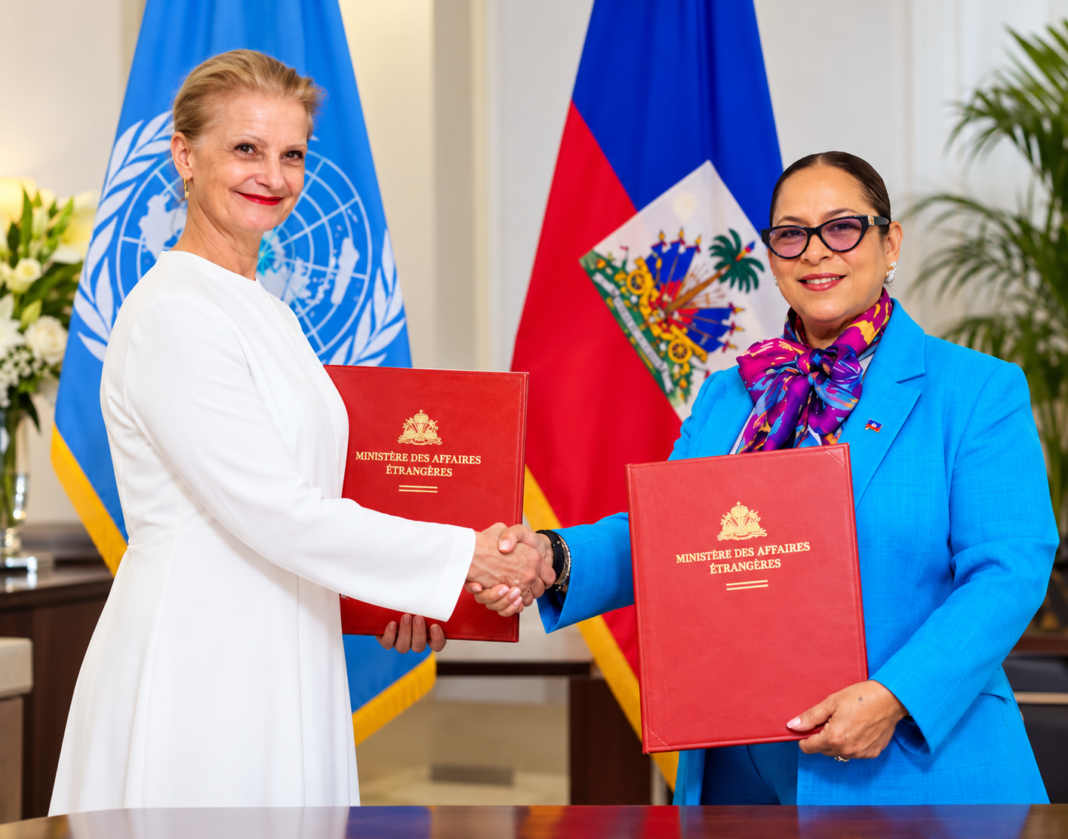
Daniela Kroslak, head of the United Nations Support Office in Haiti (BANUH), says the new structure is intended to provide more effective and sustainable international assistance as Haiti struggles to restore public security and create conditions for credible national elections.
The framework brings together three complementary components: the Gang Suppression Force (GSF), the United Nations Integrated Office in Haiti (BINUH), and BANUH, which provides essential administrative and logistical assistance.
According to Kroslak, the arrangement represents an effort to address operational weaknesses that undermined previous international security initiatives.
Addressing the Shortcomings of the Previous Mission
The Kenya-led Multinational Security Support Mission (MSS), established to assist the Haitian National Police in confronting heavily armed criminal organizations, encountered significant financial and logistical obstacles.
Despite international commitments, the mission struggled to reach its authorized personnel strength, largely because of inadequate funding and difficulties securing the equipment and resources necessary for sustained operations.
The newly established BANUH seeks to address those shortcomings by creating a more reliable support structure for international security personnel.
Unlike the Gang Suppression Force, BANUH does not conduct combat operations. Its primary responsibility is to coordinate logistical arrangements, administrative services, and operational support to ensure that contributing countries can deploy their personnel and equipment efficiently.
The office also provides assistance to BINUH, helping strengthen coordination among the United Nations entities operating in Haiti.
Approximately 1,600 Personnel Already Deployed
Kroslak reported that approximately 1,600 personnel are currently deployed in Haiti under the Gang Suppression Force framework.
Initial deployments have focused on the West and Artibonite departments, two regions severely affected by organized gang violence, territorial disputes, kidnappings, and attacks against civilian communities.
The West Department, which includes the capital, Port-au-Prince, has experienced particularly intense violence as armed groups continue to challenge state authority and control important transportation routes.
Artibonite, traditionally one of Haiti’s most productive agricultural regions, has also suffered from escalating insecurity, forcing families to abandon their communities and disrupting economic activity.
According to Kroslak, additional contingents are expected to arrive during October as participating countries continue preparing their personnel and equipment for deployment.
Although she declined to provide a specific projection for the total number of personnel expected by the end of 2026, she expressed confidence that the force could reach its planned strength of approximately 5,500 personnel by March 2027.
Why Has Deployment Taken So Long?
Questions surrounding the pace of international troop deployment have intensified as Haiti’s security crisis continues to threaten civilians and undermine essential government services.
Responding to concerns about delays, Kroslak emphasized that organizing a multinational force involves complex international coordination.
Participating countries are located across different continents, requiring extensive planning to transport personnel, vehicles, communications systems, and other operational equipment.
Some resources must be delivered by aircraft, while heavier equipment and supplies require maritime transportation.
These arrangements also involve administrative preparations, logistical coordination, and the establishment of adequate support systems before additional personnel can become operational.
Kroslak maintained that BANUH plays an essential role both before and after the arrival of international contingents.
She also acknowledged that Haitians ultimately have the right to evaluate the international missions according to their results rather than their announcements or deployment targets.
Three UN Components With Different Responsibilities
Although the three entities operate within the same international framework, their responsibilities are distinct.
BINUH: Political and Institutional Support
The United Nations Integrated Office in Haiti focuses primarily on political engagement and institutional assistance.
Its responsibilities include supporting Haitian authorities in preparing for elections, strengthening governance, and advancing disarmament, demobilization, and reintegration initiatives.
These programs are intended to help reduce armed violence while creating opportunities for individuals associated with criminal groups to leave those organizations and reintegrate into society.
Gang Suppression Force: Security Operations
The Gang Suppression Force is responsible for supporting operations against armed gangs and helping restore security in areas where criminal organizations have weakened government authority.
Its mission is particularly important to the electoral process because widespread insecurity has made political participation and election preparations extremely difficult in several regions.
The force is expected to work alongside Haitian security institutions as part of broader efforts to restore stability.
BANUH: Logistics and Administrative Assistance
BANUH provides the logistical foundation necessary for the international security mission to function.
Its responsibilities include supporting troop deployment, facilitating the transportation of equipment, and coordinating administrative resources.
Kroslak explained that BANUH’s assistance also extends to the Haitian National Police during joint operations involving the Gang Suppression Force.
However, she clarified that the office does not intend to provide support to the private military company associated with Haiti’s security task force.
A Critical Test for International Intervention
The expanded international security framework comes at a decisive moment for Haiti.
Years of political instability, gang expansion, institutional weaknesses, and humanitarian emergencies have placed enormous pressure on the country’s government and security institutions.
Previous international initiatives have faced criticism over limited results, insufficient resources, and the failure to produce lasting improvements in public safety.
The latest United Nations arrangement seeks to avoid repeating those mistakes by separating political assistance, security operations, and logistical support into coordinated but distinct responsibilities.
However, the success of the initiative will depend on more than the number of international personnel deployed.
Effective cooperation with the Haitian National Police, adequate resources, intelligence coordination, and the ability to maintain security in recovered territories will be essential.
Equally important will be protecting civilians and ensuring that security operations respect human rights and Haitian sovereignty.
Analysis: Will the New UN Framework Deliver Results?
For Haiti, the central question is not simply whether the international community can deploy 5,500 personnel by March 2027. It is whether those forces can produce measurable improvements in security.
The previous Kenya-led mission demonstrated that international commitments can lose effectiveness when financial resources, equipment, and operational capacity fail to match expectations.
BANUH’s creation represents an attempt to establish a stronger logistical foundation, potentially allowing security personnel to concentrate on their operational responsibilities rather than persistent supply and administrative problems.
Nevertheless, logistical improvements alone cannot resolve Haiti’s security crisis.
Armed gangs have developed extensive networks involving territorial control, illicit financing, weapons trafficking, and intimidation of civilian populations.
Disrupting those networks will require sustained law enforcement operations, stronger judicial institutions, and efforts to address the economic and political conditions that allow criminal organizations to flourish.
The relationship between international forces and Haitian authorities will also be crucial.
A lasting security strategy must strengthen Haiti’s own institutions rather than create permanent dependence on foreign intervention.
Furthermore, the restoration of public safety must extend beyond major security operations. Communities need functioning schools, hospitals, transportation networks, commercial activity, and access to basic government services.
Without those improvements, even successful operations against armed groups may produce only temporary stability.
The Road Ahead
With additional personnel expected during October and a target of 5,500 by March 2027, the coming months will provide an important indication of whether the revised international security strategy can overcome the limitations of its predecessor.
For the United Nations, the challenge is to transform organizational reforms and deployment commitments into tangible progress.
For Haitian authorities, the priority remains rebuilding the capacity of national institutions while ensuring that international assistance contributes to a sustainable security framework.
And for millions of Haitians living under the threat of armed violence, the most meaningful measure of success will be the ability to move freely, return to their communities, conduct business, and live without fear.
Ultimately, the credibility of the new United Nations security architecture will be determined not by the number of personnel deployed, but by whether it helps restore lasting security and stability across Haiti.
The Haitian Tribune | Haiti News & International Affairs