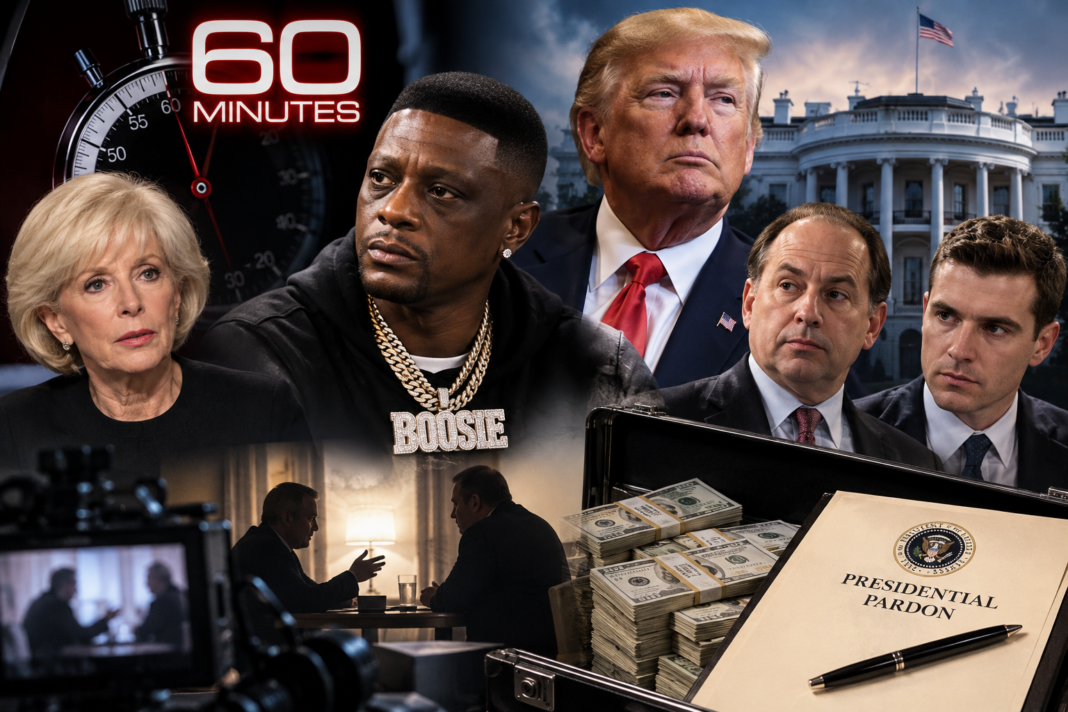

INVESTIGATION – Hidden-camera reporting focused on lobbyists Jack Burkman and Jacob Wohl, while rapper Boosie Badazz says he paid $600,000 believing their efforts would help secure a presidential pardon
A new 60 Minutes investigation is raising questions about a lucrative business surrounding presidential clemency, documenting lobbyists who charge convicted individuals hundreds of thousands of dollars while claiming they can use political connections and public pressure to bring pardon requests to President Donald Trump’s attention.
The CBS News program opened its 59th season Sunday with a report titled “The Pardon Economy.” Using interviews, lobbying records, documents and hidden-camera footage, the investigation examined how lawyers, lobbyists and political operatives market their ability to navigate a clemency process in which the president ultimately possesses extraordinarily broad constitutional authority.
The investigation does not establish that Trump sold pardons or received money from the brokers, and the White House strongly rejected suggestions that presidential clemency is being traded for payments. Instead, the report focused largely on private intermediaries who charge clients substantial fees based partly on their claimed ability to reach people within Trump’s political orbit.
At the center of the report were Washington lobbyist Jack Burkman and political operative Jacob Wohl.
The two men have previously faced criminal cases unrelated to pardons. In 2022, they pleaded guilty in Ohio to telecommunications fraud stemming from robocalls prosecutors said were designed to discourage Black voters from voting by mail. They later pleaded no contest to voter-intimidation-related charges in Michigan and received probation.
According to 60 Minutes, Burkman and Wohl have since been working as pardon lobbyists.
To examine how that business operates, CBS News enlisted Ammon Covino, an aquarium operator who previously served federal prison time after a conviction involving illegal trafficking of marine wildlife and later violating supervised release.
Covino had unsuccessfully sought presidential clemency. Working with CBS News, he approached Burkman and Wohl while carrying hidden cameras.
During an August meeting at the Ritz-Carlton in Tysons Corner, Virginia, the lobbyists offered to pursue Covino’s case for $300,000, according to the broadcast.
Their strategy, as described during the recorded meeting, was not simply to submit paperwork through the Justice Department’s traditional Office of the Pardon Attorney.
Instead, they described attempting to generate attention around a client through influential political figures and others who might ultimately bring the case to Trump’s attention. Burkman described the strategy as applying pressure from multiple directions.
The brokers predicted they could potentially obtain a pardon for Covino as early as October, according to CBS.
But presidential pardons cannot be guaranteed by a lobbyist. Under Article II of the U.S. Constitution, the president has broad authority to grant reprieves and pardons for federal offenses, except in impeachment cases. No private intermediary can legally compel the president to exercise that power.
After CBS disclosed its hidden-camera operation, Burkman and Wohl agreed to be interviewed.
They denied that their business represented an improper pay-to-play system.
Burkman characterized their work as conventional advocacy, arguing that people frequently hire professionals with expertise and contacts to advance their interests in Washington. Wohl similarly maintained that presidential clemency ultimately belongs to the president rather than career officials within the Justice Department.
One of the most striking stories in the investigation involved Louisiana rapper Boosie Badazz, whose legal name is Torence Hatch.
Hatch told 60 Minutes that he paid Burkman and Wohl $600,000 upfront while seeking a presidential pardon following his federal gun case.
Hatch pleaded guilty in August 2025 to being a felon in possession of a firearm and ammunition. In January 2026, he was sentenced to three years of supervised release, 300 hours of community service and a $50,000 fine.
He has not received a Trump pardon.
Hatch told correspondent Lesley Stahl that he came away from his dealings with the lobbyists believing that paying the requested amount would produce clemency.
According to CBS, an agreement involving Hatch provided for $300,000 to be returned if the pardon effort was unsuccessful. Hatch is now seeking money from Burkman and Wohl through arbitration.
Burkman disputes Hatch’s interpretation of the agreement and told CBS that the final contract was never signed. Burkman and Wohl maintain that they do not owe the rapper money and say his claim lacks merit. The dispute has not been finally resolved, meaning Hatch’s accusation that he was improperly deprived of the money remains a contested allegation.
CBS also examined text messages connected to Hatch’s pardon effort.
Messages presented in the report referred to efforts to enlist conservative figures, including Laura Loomer, House Speaker Mike Johnson and others, to support or draw attention to the pardon request.
Those references became another point of dispute.
Wohl denied sending one of the messages attributed to his number. Loomer told CBS that she does not participate in pardon lobbying and said her name had been invoked without authorization. Representatives for Johnson and Turning Point USA similarly said they had not endorsed Hatch’s pardon application.
The White House also denied that the brokers possessed the influence they claimed.
White House officials told CBS that Trump does not know Burkman or Wohl and argued that anyone paying lobbyists under the assumption that money can guarantee presidential clemency is wasting that money.
White House Counsel Will Scharf defended Trump’s use of his constitutional authority, saying the president performs his pardon responsibilities ethically.
That distinction is central to understanding the investigation.
60 Minutes documented a private marketplace built around access to the pardon process; it did not demonstrate that the president accepted payments in exchange for clemency.
The larger issue examined by CBS is whether changes in the way pardon requests reach the president have created an environment in which people with substantial financial resources can purchase more effective political advocacy than people who rely exclusively on the traditional government process.
Presidential clemency is nearly as old as the United States itself.
George Washington issued the first presidential pardons in 1795 following the Whiskey Rebellion. Alexander Hamilton defended the pardon power in Federalist No. 74, arguing that mercy was necessary because criminal law could sometimes be too rigid to account for exceptional circumstances.
Modern presidents have used that authority in dramatically different—and sometimes controversial—ways.
Gerald Ford pardoned former President Richard Nixon after Watergate. Bill Clinton’s pardon of financier Marc Rich generated scrutiny partly because of political donations associated with Rich’s former wife. Joe Biden issued a sweeping pardon to his son Hunter Biden after previously saying he would not do so and also issued preemptive pardons to several public figures before leaving office. Trump has likewise used the authority extensively, including granting sweeping clemency to people charged or convicted in connection with the January 6, 2021, attack on the U.S. Capitol.
Traditionally, many clemency petitions travel through the Justice Department’s Office of the Pardon Attorney, where applications are reviewed before recommendations are forwarded to the White House.
But that system is advisory.
A president does not need Justice Department approval to issue a pardon and is constitutionally free to consider requests arriving through other channels.
According to 60 Minutes, Trump’s second administration has increasingly relied on its own method of reviewing clemency cases rather than exclusively following the traditional Justice Department pipeline. The administration says its approach reflects Trump’s desire to address cases he believes involved excessive punishment or politically motivated prosecution.
CBS also examined the pardon of Joseph Schwartz, a nursing-home operator who had pleaded guilty to federal charges involving more than $38 million in unpaid employment taxes and a required employee-retirement-plan financial report, as well as separate Arkansas charges.
Federal lobbying disclosures cited by CBS show that JM Burkman & Associates received $960,000 from Schwartz. Trump pardoned Schwartz in November 2025, several months into his three-year prison sentence.
Burkman and Wohl cited that case when promoting their record to prospective clients.
The White House told CBS that Schwartz had been over-prosecuted and that imprisonment was particularly harmful given his age and deteriorating health. Burkman said his firm’s work helped save Schwartz’s life.
Some people affected by Schwartz’s former nursing-home operations viewed the pardon very differently, telling 60 Minutes that they believed the clemency decision undermined accountability.
The contrasting accounts illustrate why the pardon power has generated controversy across administrations.
A president’s authority to grant clemency is exceptionally broad, and the Constitution does not require presidents to follow the Justice Department’s recommendations, explain their decisions or limit consideration to applicants who demonstrate remorse.
But the emergence of expensive private pardon advocacy raises a separate issue: whether access to influential people can become more valuable than the merits of an applicant’s case.
There is nothing inherently illegal about hiring a lawyer or registered lobbyist to advocate for clemency. Attorneys have represented pardon applicants for generations, and lobbying the executive branch is itself a lawful activity when applicable disclosure and other laws are followed.
The concern highlighted by the 60 Minutes investigation arises when clients are led to believe that large payments can provide privileged access—or even guarantee a presidential decision that no private person has the power to promise.
CBS reported that some brokers operating in the wider clemency business have sought fees reaching into the millions of dollars.
Burkman and Wohl insist that their own services are legitimate and that high fees reflect the amount of advocacy required.
Covino, the pardon applicant who cooperated with the hidden-camera investigation, offered a different perspective. He said he participated because he wanted to expose what he considered an unfair system in which money and connections can determine who receives attention.
The debate therefore reaches beyond Trump, Burkman, Wohl or any individual pardon recipient.
The Constitution intentionally places the clemency power in the hands of one elected official so mercy can exist outside the normal judicial process. Yet precisely because that authority is so broad, the system depends heavily on transparency and public confidence that presidential mercy is not something that can simply be purchased.
The White House says Trump’s decisions meet that standard and rejects allegations of a pay-to-play system.
Burkman and Wohl say they are paid advocates doing lawful work.
Hatch says he believed his $600,000 payment would result in a pardon and is now seeking the return of part of that money.
Those competing claims will continue to be scrutinized.
What 60 Minutes established through its hidden-camera reporting is that a high-priced industry has developed around people seeking Trump’s attention for clemency—and that some brokers are willing to charge extraordinary sums for the effort to get a client’s case before the most powerful decision-maker in the process.
Whether that industry represents ordinary Washington lobbying, exploitation of desperate applicants, or something requiring greater regulation is a question likely to remain part of the broader debate over presidential pardon power.
By The Haitian Tribune Staff | September 15, 2026 | WASHINGTON