
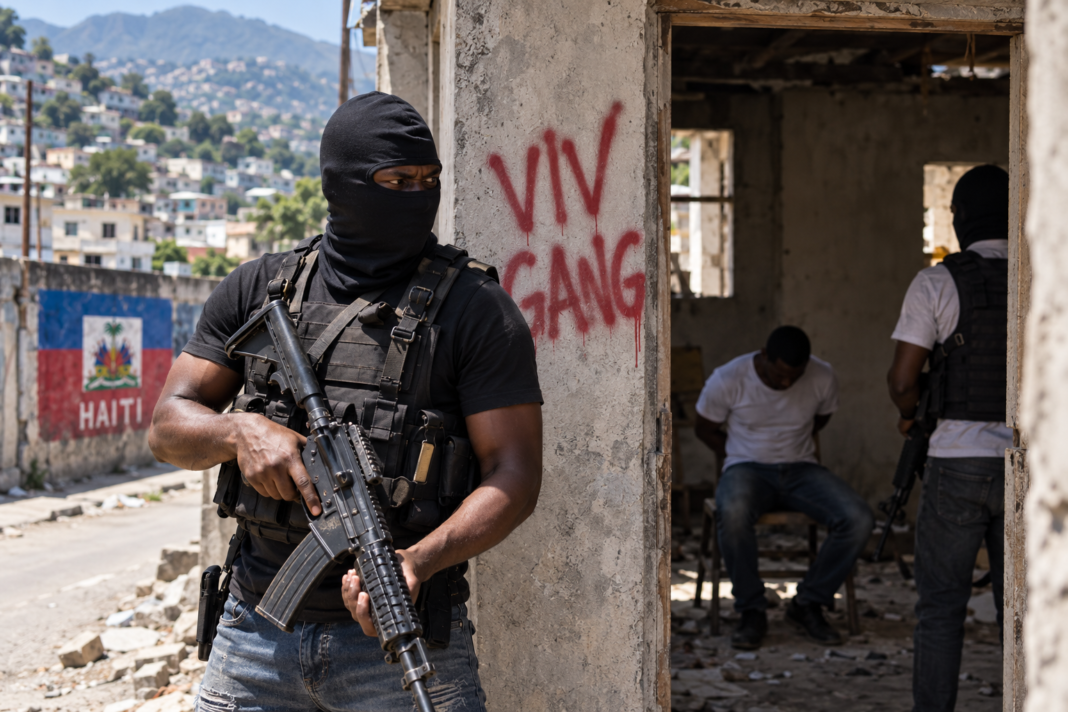

Security expert Réginald Delva says criminal groups are adapting their kidnapping operations, exploiting gang-controlled neighborhoods and abandoned properties, while victims and families increasingly fear cooperating with authorities
PORT-AU-PRINCE, Haiti — Armed gangs operating across the Port-au-Prince metropolitan area are intensifying kidnappings as a source of revenue, while developing increasingly sophisticated methods to conceal and hold victims for extended periods, according to Haitian public-security specialists.
Réginald Delva, a security expert, former Haitian Armed Forces officer and former interior minister, says kidnapping remains an important component of the criminal economy operating in areas where armed groups exercise significant territorial control.
According to Delva, gangs have developed the logistical capacity to hold kidnapped people for weeks or even months while ransom negotiations continue. Neighborhoods largely inaccessible to law enforcement provide particularly favorable conditions for these operations.
The evolving tactics are making kidnapping more difficult to combat and increasing the importance of recovering territory, restoring roads and rebuilding a permanent government presence in communities affected by gang violence.
Gang-Controlled Areas Provide Safe Havens
Kidnappers have traditionally taken advantage of neighborhoods where police operations are difficult or dangerous.
Delva said specialized police units recently succeeded in freeing a hostage who was being held in an area that security forces could reach. But many sections of the capital remain difficult for authorities to access consistently.
Vacant houses have become an additional concern.
Haiti’s prolonged security crisis has forced large numbers of residents to abandon their homes, while others have left the country. In some neighborhoods, properties left behind have become vulnerable to illegal occupation or criminal use.
Delva said gangs have increasingly used unoccupied residences as temporary detention sites. In some cases, victims have reportedly been held in unexpected locations, including empty properties and undeveloped land.
Such tactics make it harder for neighbors and law enforcement officers to identify places where hostages may be confined.
Suspect Allegedly Posed as Real Estate Agent
The problem has also raised concerns about people entrusted with managing vacant properties.
According to Delva, authorities recently apprehended an alleged repeat offender who had presented himself as a real estate agent while being implicated in the confinement of kidnapping victims.
The case highlights a broader vulnerability created when homes are left under informal supervision without adequate verification of the people responsible for them.
Delva argues that recovering gang-held territory must therefore be accompanied by stronger oversight and functioning public institutions.
Reopening major roads and retaking neighborhoods are essential, he said, but deploying police officers or soldiers represents only the beginning.
For recovered communities to remain outside gang control, residents also need access to government administration, transportation, schools, health care and other basic services.
Without those services, security gains can prove difficult to sustain.
Vacant Homes Require Greater Vigilance
Delva is urging residents and local authorities to pay closer attention to abandoned or temporarily unoccupied properties.
The issue is particularly important for members of the Haitian diaspora who own homes in Haiti but spend long periods abroad.
Some properties are placed in the hands of caretakers or intermediaries through informal arrangements with little background screening or professional oversight.
In the most troubling cases, Delva warned, individuals entrusted with protecting properties may cooperate with criminal organizations and allow houses to be used to hold kidnapping victims.
He called for greater professional accountability in property management and encouraged owners to carefully investigate the backgrounds of people given access to their homes.
Where appropriate, he said, property owners should seek reliable information and verification rather than relying exclusively on informal recommendations.
Kidnapping Numbers May Understate the Crisis
Another major challenge is determining the true scale of kidnapping.
Delva believes publicly reported statistics may significantly underestimate the number of people abducted because some families never report kidnappings to police.
Fear is a major factor.
Relatives negotiating with kidnappers may worry that contacting authorities could become known to the criminals and place the hostage in greater danger. Families may consequently attempt to negotiate privately, leaving authorities unaware that an abduction has occurred.
That secrecy also makes it harder for investigators to identify patterns connecting kidnappings, locations and criminal networks.
Former Hostages Often Remain Afraid
The psychological influence gangs exert over victims can continue long after a hostage is released.
People held captive may witness firsthand the weapons, personnel, territory and organizational capabilities available to gang leaders. Delva said that experience can leave former hostages deeply reluctant to provide investigators with information.
Some may fear retaliation against themselves or their relatives if they identify kidnappers, describe detention locations or cooperate with law enforcement.
That fear can unintentionally benefit criminal organizations by depriving investigators of evidence that might help locate hideouts or identify perpetrators.
Delva also raised concern that information obtained from kidnapped individuals could potentially be exploited to identify additional targets.
That possibility, he said, could help investigators understand cases in which multiple people associated with the same company, institution or social network are abducted over time.
Such a theory, however, would need to be established through individual investigations rather than assumed in every series of related kidnappings.
Kidnapping as Part of a Larger Criminal Economy
The broader problem extends beyond individual abductions.
Where armed groups control territory and legitimate economic opportunities have collapsed, criminal organizations can create their own underground economies built around kidnapping, extortion, illegal taxation, trafficking and other illicit activities.
Financial incentives can also draw vulnerable people into those networks.
Delva warned that the prospect of quick money, combined with weak law-enforcement reach in certain areas, can encourage people who were not previously involved in organized crime to participate as informants, intermediaries, property caretakers or accomplices.
That means fighting kidnapping requires more than responding after someone disappears.
Authorities must disrupt the financial and logistical networks that allow kidnappers to operate, restore access to neighborhoods, investigate accomplices and establish a durable state presence after territory is recovered.
For residents, meanwhile, vigilance remains essential. Suspicious activity around abandoned homes, unexplained movements at vacant properties and unauthorized occupancy can become important information for law enforcement.
As Haiti continues confronting armed groups across the capital region, Delva’s assessment underscores a central challenge: recovering territory from gangs is only the first step. Keeping those communities secure requires rebuilding the institutions and public services that prevent criminal organizations from returning.
The Haitian Tribune | Haiti
Setting the scene