
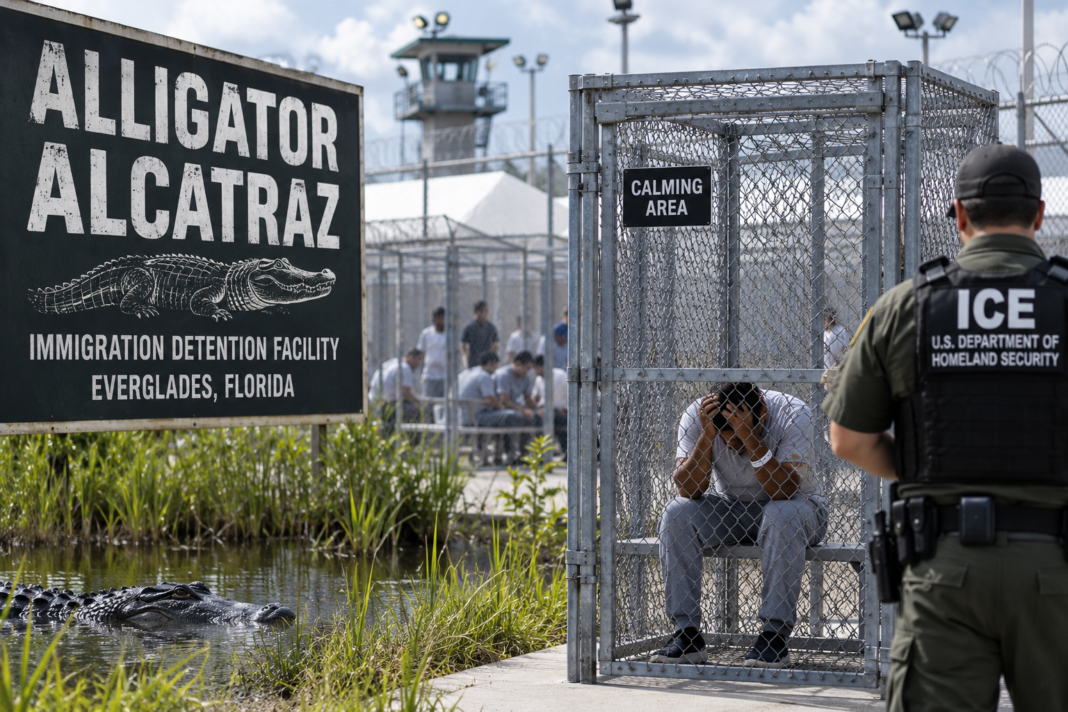

A federal watchdog has concluded that immigrants detained at Florida’s controversial Everglades detention center known as “Alligator Alcatraz” were placed in extremely small metal enclosures, sometimes for nearly two hours, in a practice investigators said was inconsistent with standards for humane treatment.
The findings come from the Department of Homeland Security’s Office of Inspector General, which conducted an unannounced inspection of the state-run immigration facility in January. Investigators documented problems extending beyond the metal enclosures, including inadequate living space and shortcomings involving hygiene, medical care, food service and recreation.
The facility, officially known as the Florida Soft-Sided Facility, was constructed in 2025 at the Dade-Collier Training and Transition Airport in the Everglades as Florida expanded its role in federal immigration enforcement. It has since closed.
Among the inspector general’s most striking findings were small outdoor metal structures that employees described as “calming areas.”
Investigators found that the enclosures provided only about 18 square feet of floor space. One measured approximately 4 feet 3 inches across and stood about 7 feet 9 inches high.
Records reviewed by investigators showed that 79 detainees were placed in the enclosures between July 2025 and January 2026, with stays ranging from several minutes to almost two hours.
Facility employees told investigators that the spaces were intended to allow detainees to separate themselves from others and calm down.
But investigators found evidence that their use was not always voluntary.
According to the report, at least one detainee was placed in an enclosure after failing to follow an officer’s command, indicating that the space had been used as a disciplinary measure.
The inspector general said the practice was unlike what its investigators had encountered during inspections of other immigration detention centers and concluded that such restrictive confinement presented significant concerns for detainee health and safety.
The cages were only one part of the watchdog’s criticism.
Inspectors found that people detained at the center did not receive the amount of living space required under applicable national detention standards. At maximum capacity, housing areas provided approximately 28 square feet per detainee, according to the report, compared with a standard of at least 75 square feet.
That meant detainees were spending much of their time in substantially more crowded conditions than federal detention guidelines contemplated.
Investigators also documented problems with showers.
Detainees were generally permitted to shower only three times per week, and inspectors reported observing small insects in shower facilities. Some detainees additionally told investigators that they lacked dependable access to clean drinking water and could not properly clean the reusable plastic cups from which they drank.
The watchdog identified deficiencies involving medical services, personal hygiene, food operations, recreation, environmental health and safety.
At the same time, the report did not find violations in every category examined. Investigators said the center complied with certain standards involving intake procedures and use of force.
The findings add federal scrutiny to a facility that had been controversial almost from the moment it opened.
Florida rapidly constructed the detention center in the summer of 2025 as part of the state’s cooperation with the Trump administration’s expanded immigration-enforcement campaign.
Florida Gov. Ron DeSantis promoted the Everglades site as a way for the state to assist federal authorities in detaining immigrants awaiting immigration proceedings or removal.
President Donald Trump also toured the center shortly after it opened.
Supporters portrayed the facility as an innovative way to rapidly increase detention capacity during an intensified federal immigration crackdown. Critics argued that its remote Everglades location, temporary infrastructure and detention conditions raised serious humanitarian, environmental and legal concerns.
The center eventually became one of the most recognizable symbols of the administration’s immigration-enforcement strategy.
Its population also complicated early political descriptions of those being detained there.
Data obtained by the Miami Herald during the facility’s early weeks indicated that, among more than 700 people sent there or scheduled for transfer, only about one-third had criminal convictions. Hundreds were being held over immigration violations rather than criminal charges.
That distinction is important because immigration detention is generally civil detention, not a criminal sentence. A person may therefore be held by immigration authorities without having been convicted of a crime.
Questions about conditions at the center emerged long before the inspector general released its findings.
Former detainees and advocacy organizations had previously alleged insufficient medical treatment, restricted showers, inadequate access to lawyers and family members, poor sanitation and punitive treatment.
Amnesty International documented allegations involving small confinement spaces in a 2025 report. The federal inspector general’s subsequent inspection independently established that small metal enclosures were in fact being used, although individual allegations concerning what occurred inside them must still be distinguished from the watchdog’s verified findings.
Another significant issue identified by investigators was confusion over which detention standards actually governed the facility.
Alligator Alcatraz was operated by Florida rather than as a conventional federally operated ICE detention center. DHS told its inspector general that oversight of the facility belonged to the state and noted that the department did not have a conventional detention contract with Florida for the site.
Yet the detainees remained in ICE custody, and ICE materials were distributed to people housed there.
Investigators therefore examined the center against both federal immigration-detention requirements and relevant Florida standards and found numerous deficiencies.
That federal-state arrangement also complicated the watchdog’s effort to obtain corrective action.
The inspector general issued 10 recommendations, but according to the report, DHS did not take responsibility for implementing them because it maintained that Florida controlled the facility.
The dispute raises a broader accountability question as states become more directly involved in federal immigration enforcement: when immigrants remain under federal authority but are housed in state-operated facilities, who is ultimately responsible for ensuring their treatment complies with required standards?
The financial cost of the operation has generated scrutiny as well.
The Everglades center reportedly cost Florida more than $1 million per day to operate, in part because water had to be transported to the remote location and wastewater removed. Federal emergency-management funding was expected to reimburse Florida for part of the expense.
Florida ultimately shut down the facility in June 2026. DeSantis said it had served the purpose for which it was created and described it as a temporary operation.
The inspector general’s findings, however, ensure that questions surrounding the facility will continue after its closure.
At issue is more than the reputation of a single detention center.
The report touches on a fundamental principle governing immigration detention in the United States: the government possesses authority to detain people under immigration law, but that authority remains subject to legal requirements and standards governing their treatment.
The debate over U.S. immigration policy remains intensely political. Americans and their elected representatives disagree sharply over border security, deportation, detention capacity and the proper scope of immigration enforcement.
The inspector general’s findings address a different question.
Regardless of those political disagreements, federal detention standards establish minimum requirements for how people in government custody are to be housed and treated.
At Alligator Alcatraz, the Department of Homeland Security’s own independent watchdog concluded that multiple aspects of the facility failed to meet those standards—including a system that placed dozens of detainees inside unusually restrictive metal enclosures.
The facility may now be closed, but its legacy is likely to remain part of the national debate over how far the government can go in enforcing immigration laws—and what obligations it retains toward the people it takes into custody.