
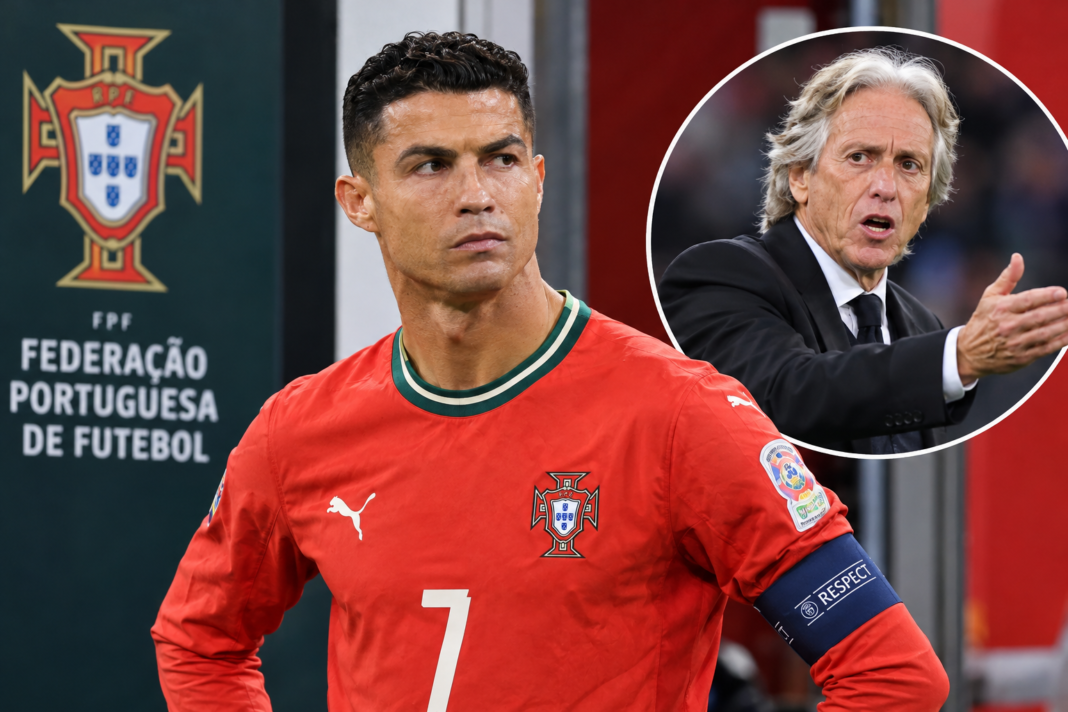

Portugal’s football federation reportedly opens disciplinary proceedings against its longtime captain after he leaves training camp amid disagreements over playing time.
By The Haitian Tribune Sports Desk | October 10, 2026
LISBON, PORTUGAL — Cristiano Ronaldo, one of football’s most celebrated players and Portugal’s all-time leading goalscorer, is at the center of a reported disciplinary controversy after leaving his national team’s training camp following a disagreement over his role in recent UEFA Nations League matches.
According to the report, the Portuguese Football Federation (FPF) provisionally suspended the 41-year-old forward after opening disciplinary proceedings concerning his departure from camp ahead of Portugal’s match against Denmark.
The controversy reportedly began when Ronaldo became frustrated over a coaching decision that left him on the sidelines during Portugal’s encounter with Norway.
The situation escalated after Ronaldo accused head coach Jorge Jesus of failing to honor assurances about his participation in the match.
Despite acknowledging that leaving camp was inappropriate, the veteran striker maintained that the disagreement involved a breakdown of trust between himself and the coach.
The reported suspension has raised questions about Ronaldo’s future with the national team, his responsibilities as captain, and how Portugal will manage one of its most influential football figures.
A Disagreement Over Playing Time
The dispute began during Portugal’s September Nations League fixtures, when Ronaldo was left on the bench throughout the team’s 2-1 victory over Norway.
Ronaldo subsequently claimed that he and Jesus had previously discussed a plan to manage his playing time and physical condition. According to the forward, the coach later assured him that he would feature for approximately 30 minutes against Norway.
Ronaldo warmed up during the match but was never brought onto the field.
He interpreted the decision as a failure by the coach to honor their understanding.
Tensions intensified when Jesus indicated that Ronaldo would not start the following match against Denmark. The veteran forward subsequently left Portugal’s training base in Copenhagen after speaking with federation officials.
Portugal went on to defeat Denmark 4-2 without its longtime captain.
Ronaldo Accepts Responsibility but Criticizes Coach
Following his departure, Ronaldo issued a lengthy public statement explaining the circumstances behind his decision.
Although he criticized Jesus for what he described as repeated failures to honor commitments, Ronaldo acknowledged that abandoning the national team was inappropriate.
He apologized to his teammates and supporters and accepted personal responsibility for the incident.
Ronaldo also emphasized that his status as national team captain should subject him to greater accountability, rather than preferential treatment.
The five-time Ballon d’Or winner indicated that he would accept any disciplinary punishment imposed by the federation and remained willing to represent Portugal in the future.
His statement suggested that the dispute was not simply about being named among the substitutes, but about communication, trust, and expectations between a senior player and the national team manager.
Portuguese Federation Opens Formal Proceedings
On October 10, the Portuguese Football Federation confirmed that disciplinary proceedings had been initiated following a decision taken on October 9.
The federation imposed a provisional suspension and classified the case as urgent, referring it to its disciplinary investigation body.
The suspension is a temporary measure while the proceedings continue, rather than a final determination of punishment.
Under the federation’s disciplinary framework, leaving national team activities without authorization can carry significant penalties. Reports have suggested that Ronaldo could face a suspension ranging from one to six months, although no final sanction has been announced.
Federation President Pedro Proença has expressed hope that the disagreement can be resolved and Ronaldo can return to the squad.
However, the final decision rests with the federation’s independent disciplinary authorities.
Ronaldo Continues Scoring for Al Nassr
Despite the controversy surrounding his international career, Ronaldo has continued playing club football in Saudi Arabia.
The Portuguese forward returned to action for Al Nassr and scored in the club’s 3-0 victory over Diriyah on Friday, October 9.
The goal was reported as the 980th of his professional career, bringing him closer to the extraordinary milestone of 1,000 career goals.
His continued productivity at 41 highlights the remarkable longevity of a player who has remained competitive at the highest levels of international football for more than two decades.
A Historic International Career at a Crossroads
Cristiano Ronaldo — Portugal
International appearances – 234
International goals – 146
World Cup appearances – 6
Age – 41
Since making his senior international debut in 2003, Ronaldo has become the defining figure of modern Portuguese football.
He helped lead Portugal to the 2016 European Championship and the inaugural UEFA Nations League title in 2019, establishing himself as one of the most accomplished international footballers in history.
His record of 146 goals in 234 international appearances reflects a career characterized by exceptional consistency, physical discipline, and an intense competitive mentality.
Following Portugal’s elimination from the 2026 FIFA World Cup, questions had already emerged about whether Ronaldo would continue representing his country.
The appointment of Jorge Jesus as national team manager in July appeared to offer an opportunity for continued cooperation, particularly because the two had previously worked together at Al Nassr.
However, the latest disagreement has placed their relationship under considerable strain.
Analysis: Leadership, Discipline and the End of an Era
The controversy raises important questions about the relationship between star players and national team coaches.
Ronaldo’s achievements have earned him extraordinary respect, but they do not exempt him from the rules governing national team participation.
As captain, he is expected to demonstrate leadership, professionalism, and respect for coaching decisions, even when those decisions are personally disappointing.
At the same time, effective leadership also requires coaches to communicate clearly and maintain trust with experienced players.
If Ronaldo’s account of the disagreement is accurate, the breakdown in communication may have contributed significantly to the confrontation.
Nevertheless, the authority to select players and determine playing time ultimately belongs to the manager.
For Portugal, the challenge will be balancing respect for Ronaldo’s historic contributions with the need to build a competitive team for the future.
At 41, Ronaldo remains an influential figure, but Portugal must also prepare younger players to assume greater responsibilities.
A prolonged disciplinary dispute could distract from that transition.
On the other hand, a constructive resolution could allow Ronaldo to continue contributing his experience and leadership while accepting a changing role within the squad.
What Happens Next?
Portugal is scheduled to face Denmark and Wales in November Nations League fixtures, creating uncertainty over whether Ronaldo will be available for selection.
The federation’s disciplinary committee must determine whether further punishment is warranted and how long any suspension should last.
Although Ronaldo has expressed his willingness to return, his immediate international future remains dependent on the outcome of the proceedings.
For now, the dispute represents one of the most significant challenges to his relationship with the Portuguese national team.
Ronaldo’s legacy in Portuguese football is secure. What remains uncertain is how the final chapter of his extraordinary international career will unfold.
The Haitian Tribune | International Sports | October 11, 2026