
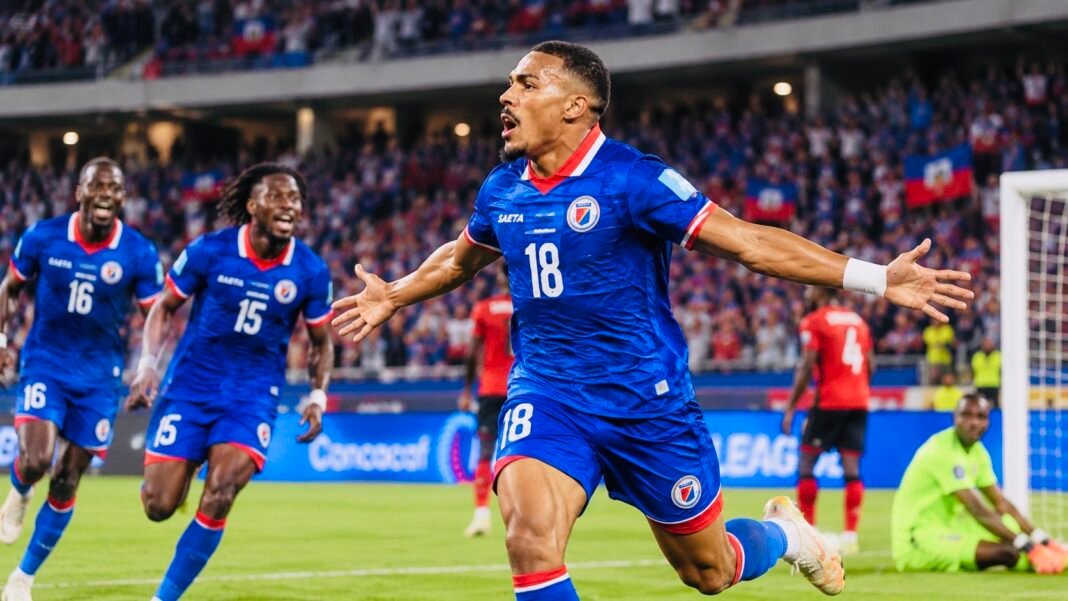

Two assists and a 98th-minute winner from Wilson Isidor powered the Grenadiers to a remarkable victory at Sabina Park, giving new head coach David Badia a winning start and Haiti three important points in Concacaf Nations League Group A.
Haiti could hardly have scripted a more dramatic beginning to the David Badia era.
Trailing Trinidad and Tobago 2-1 as the match entered stoppage time Thursday night, the Grenadiers appeared headed toward a frustrating defeat despite controlling most of the possession and creating considerably more attacking opportunities.
Then everything changed.
Garven-Michée Metusala equalized in the 91st minute. Seven minutes later, with virtually the final action of the match, Wilson Isidor completed an extraordinary turnaround by scoring Haiti’s winner in the 98th minute.
Final score: Haiti 3, Trinidad and Tobago 2.
Concacaf’s official match report confirms the sequence: Fabrice Picault put Haiti ahead in the 23rd minute, Wayne Frederick equalized eight minutes later, Levi García gave Trinidad and Tobago a 2-1 advantage in the 59th, Metusala leveled the match at 90+1 and Isidor delivered the winner at 90+8.
But the score alone does not fully explain what happened at Sabina Park.
This was a match in which Haiti demonstrated both sides of the team Badia has inherited: an encouraging ability to control possession, create chances and sustain attacking pressure — and defensive vulnerabilities that nearly turned that superiority into defeat.
Above everything else, however, it was the night Wilson Isidor announced his importance to Haiti.
Isidor at the Center of Everything
The Sunderland striker did not simply score the winning goal. He was directly involved in all three Haitian goals.
Haiti’s opening breakthrough arrived in the 23rd minute when Isidor supplied Fabrice “Fafà” Picault, whose header gave the Grenadiers a deserved 1-0 advantage. The combination offered an early glimpse of how dangerous Haiti can become when Isidor is surrounded by runners capable of exploiting the spaces he creates.
Picault’s movement was important. Instead of leaving Isidor isolated as the central striker, Haiti pushed attackers into advanced positions around him, giving the forward passing options and forcing Trinidad and Tobago’s defenders to make decisions.
For a while, it worked beautifully.
But Haiti’s advantage lasted only eight minutes.
Wayne Frederick equalized in the 31st minute, punishing the Grenadiers for failing to turn their early superiority into greater control of the scoreline. The teams entered halftime tied 1-1.
That equalizer provided the first warning of what would become Haiti’s biggest concern of the evening: controlling the ball did not necessarily mean controlling the danger.
Trinidad Punishes Haiti Again
The problem became more serious after halftime.
In the 59th minute, Trinidad and Tobago captain Levi García put the Soca Warriors ahead 2-1, with Frederick involved in creating the goal. Suddenly Haiti found itself chasing a match it had largely dictated.
The statistical contrast was striking.
Haiti finished with approximately 69% possession, compared with 31% for Trinidad and Tobago. Available match data credits the Grenadiers with 23 shots, eight on target and 44 touches inside the opposition penalty area. Trinidad and Tobago managed 11 attempts, five on target and only 14 touches in Haiti’s box. Haiti also completed approximately 91% of its passes.
Those numbers point to an important tactical lesson.
Haiti controlled territory and circulation, but Trinidad and Tobago remained dangerous with far fewer opportunities. Five shots on target produced two goals. The Soca Warriors did not need prolonged possession to threaten Alexandre Pierre’s goal.
For Badia, that is likely to be one of the most important areas to address.
A possession-oriented team must protect itself when attacks break down. If Haiti pushes its fullbacks and midfielders forward simultaneously, the spaces left behind can become invitations for opponents with quick attackers.
Against Trinidad and Tobago, Haiti survived that danger.
Against stronger opposition, it may not.
Badia Refuses to Abandon the Attack
One encouraging feature of Badia’s debut was that Haiti did not panic after falling behind.
The Spanish coach started in a 4-2-3-1 formation and made three changes around the 58th minute, bringing on Jean-Ricner Bellegarde, Kervens Belfort Quétant and Yassin Fortuné. Ruben Providence followed later, while Frantzdy Pierrot was introduced in the closing stages as Haiti increased the pressure.
The objective became increasingly obvious: keep Trinidad and Tobago pinned deep and find a way through.
Haiti continued attacking.
Trinidad and Tobago continued defending.
The clock continued disappearing.
Yet the Grenadiers did not abandon their structure simply to send hopeful balls forward. They kept circulating possession, entering the final third and forcing the Soca Warriors to make repeated defensive interventions.
Trinidad and Tobago ultimately recorded nearly four times as many clearances as Haiti, another indication of how sustained the Haitian pressure became.
Eventually, it broke the defense.
Metusala Changes the Match
In the first minute of stoppage time, Isidor became the creator again.
Garven Metusala converted for 2-2, apparently rescuing a point from a match that had been slipping away. Concacaf records the goal in the 90+1 minute.
At that moment, a draw would already have represented a successful recovery.
Haiti wanted more.
That mentality may ultimately be the most significant takeaway from Badia’s first match.
Rather than protecting the point, the Grenadiers continued searching for another goal.
Seven minutes later came the defining moment.
Isidor Delivers at 90+8
With the match effectively down to its final action, Isidor finally became the scorer.
The Sunderland forward beat the Trinidad and Tobago goalkeeper in the 98th minute, completing Haiti’s transformation from 2-1 down to 3-2 winners. Concacaf officially records the strike at 90+8.
Two assists.
One goal.
Three direct goal contributions.
One extraordinary night.
It was a complete attacking performance from a center forward whose value extended far beyond finishing.
Isidor linked the attack, created for teammates and remained dangerous enough to become the player Haiti needed when one final opportunity arrived.
That versatility could be especially important for Badia’s system. If Isidor can operate simultaneously as a scorer and facilitator, Haiti’s wide players and attacking midfielders should have considerably more freedom to attack the penalty area rather than simply trying to supply the striker.
A Promising Beginning — With a Warning Attached
For Badia, the result could hardly have been more emotionally satisfying.
His first match as Haiti’s coach produced three goals, sustained possession, a dramatic comeback and three points.
HaitiLibre reported that Badia deployed a 4-2-3-1 with Alexandre Pierre in goal; Carlens Arcus, Metusala, Hannes Delcroix and Martin Expérience across the defense; Carl Sainté and Danley Jean Jacques in midfield; and an attacking group including Picault, Dany Jean, Don Deedson Louicius and Isidor.
There were signs of the identity Badia may be attempting to establish: possession, technical control, patient buildup and numbers around the opposition penalty area.
The statistics support that interpretation.
But they also reveal the unfinished work.
A team that enjoys nearly 70% possession and produces more than twice as many shots should not ordinarily require two stoppage-time goals to survive.
Haiti’s challenge will be converting territorial dominance into earlier goals while becoming more secure against transitions and isolated defensive breakdowns.
That distinction matters because the next opponent presents a different test.
Costa Rica Comes Next
Haiti’s victory carries particular weight because of the unusual format of this season’s Nations League.
League A’s group stage contains six teams in each group, but each country plays only four matches. The top two teams in each group advance to November’s quarterfinals, where they will join the four pre-seeded nations — the United States, Mexico, Canada and Panama.
That leaves little room for dropped points.
Haiti’s Group A contains Costa Rica, Curaçao, Nicaragua, the Dominican Republic and Trinidad and Tobago.
The Grenadiers return to Sabina Park on Sunday, September 27, at 7 p.m. ET to face Costa Rica. The Costa Rican federation and Concacaf’s schedule confirm the Kingston fixture.
Costa Rica should provide a useful measure of how much of Thursday’s performance can be sustained against one of Concacaf’s established national teams.
Badia will want the same ambition without requiring another miracle in stoppage time.
A Victory That May Mean More Than Three Points
One match cannot establish what the Badia era will become.
There were defensive mistakes against Trinidad and Tobago. There were periods when overwhelming possession failed to produce enough reward. And there will be significantly more difficult moments ahead.
But something important happened at Sabina Park.
At 90 minutes, Haiti was losing.
At 91, Haiti had rescued a draw.
At 98, Haiti had won.
That progression says something about the mentality Badia will want to preserve even as he works on the tactical weaknesses exposed during the match.
For supporters of the Grenadiers, the lasting image of the night belongs to Wilson Isidor: first creating for Picault, then creating for Metusala, and finally taking responsibility himself when Haiti needed one final goal.
The David Badia era has begun with imperfections, questions and plenty of work ahead.
It has also begun with a victory Haiti will remember.
By The Haitian Tribune Sports Desk | September 25, 2026 | KINGSTON, Jamaica