

Haiti Revises Electoral Decree, Reduces Candidate Registration Fees Ahead of Planned December Elections
Government removes several administrative requirements and lowers fees for legislative candidates as electoral authorities extend registration deadline to October 31.
By The Haitian Tribune Staff | October 11, 2026
PORT-AU-PRINCE, HAITI — Haiti’s government, led by Prime Minister Alix Didier Fils-Aimé, has introduced significant changes to the country’s electoral regulations, easing several requirements for political candidates as authorities continue preparations for the upcoming general elections.
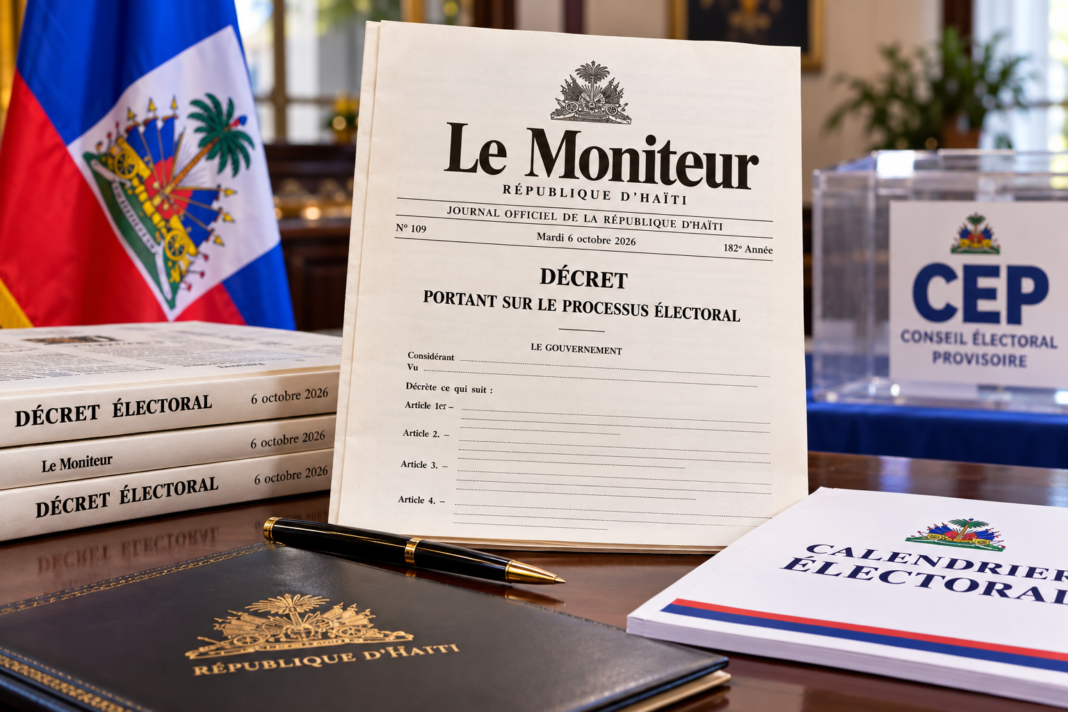
The revised electoral decree was published October 6 in Le Moniteur, Haiti’s official government gazette.
The amendments modify several conditions governing eligibility and registration for elected office, including reductions in certain registration fees and the elimination of administrative documentation previously required from candidates.
The changes come as Haiti continues to confront political uncertainty, widespread insecurity, and logistical challenges surrounding the organization of national elections.
Government Eliminates Several Documentation Requirements
Under the revised decree, candidates will no longer be required to submit certain certificates previously requested from several financial and public institutions.
These include documents issued by the Bank of the Republic of Haiti (BRH), the National Old-Age Insurance Office (ONA), and the Industrial Development Fund (FDI).
The government has also eliminated the medical certificate requirement previously imposed on candidates seeking elected office.
The changes are expected to simplify the registration process and reduce administrative obstacles for individuals seeking to participate in the elections.
Supporters of the revisions may view them as an opportunity to expand political participation by eliminating requirements that could discourage or delay potential candidates.
However, questions remain about how electoral authorities will maintain appropriate oversight and verify compliance with other eligibility requirements.
Registration Fees Significantly Reduced
One of the most notable changes involves the cost of registering as a candidate for legislative office.
The government has substantially reduced fees for Senate and Chamber of Deputies candidates while maintaining the existing presidential registration fee.
| Elected Office | Previous Fee | Revised Fee |
| President | 2,000,000 gourdes | 2,000,000 gourdes |
| Senator | 800,000 gourdes | 400,000 gourdes |
| Deputy | 300,000 gourdes | 100,000 gourdes |
The reduction represents a 50% decrease for Senate candidates and approximately a 67% decrease for candidates seeking seats in the Chamber of Deputies.
Presidential candidates, however, must still pay two million Haitian gourdes to register.
The adjustments could make legislative races more accessible to individuals and political organizations with limited financial resources.
Nevertheless, the presidential registration fee remains a substantial financial requirement, particularly in a country facing severe economic hardship.
Electoral Registration Extended Until October 31
The Provisional Electoral Council (CEP) has extended the candidate registration period until October 31, providing additional time for political parties and independent candidates to complete the necessary procedures.
The extension comes amid broader adjustments to Haiti’s electoral calendar.
Authorities are expected to publish an updated schedule following delays affecting preparations for the official campaign period.
Despite those changes, the first round of presidential and legislative elections remains scheduled for December 13, 2026, according to the timetable described in the October 10 report.
Whether that date can be maintained will depend on the country’s security conditions, logistical preparations, and the ability of electoral institutions to organize voting nationwide.
Security Remains the Greatest Electoral Challenge
While the revised decree addresses financial and administrative barriers, Haiti’s security crisis continues to pose a serious threat to the electoral process.
Armed gangs have disrupted transportation, displaced communities, and weakened government authority in several regions.
These conditions could complicate voter registration, political campaigning, the distribution of election materials, and access to polling stations.
The ability of candidates to campaign freely and voters to participate without intimidation will be essential to the credibility of the elections.
Security challenges are particularly significant in metropolitan Port-au-Prince, where armed organizations continue to control or threaten important neighborhoods and transportation corridors.
Efforts by the Haitian National Police and international security forces to restore territorial control could therefore play a decisive role in determining whether elections can proceed as planned.
Analysis: Electoral Reform Is Necessary, but Security Will Determine Success
The government’s decision to reduce candidate registration fees represents a potentially meaningful step toward broadening political participation.
High registration costs can discourage qualified candidates, particularly those without substantial financial backing or support from established political organizations.
By reducing these expenses, the revised decree may create opportunities for greater competition in legislative races.
However, lowering fees and simplifying paperwork will not resolve the deeper challenges facing Haiti’s electoral system.
Credible elections require more than accessible registration procedures.
They depend on transparent administration, political neutrality, reliable voter information, independent electoral oversight, and adequate security throughout the country.
The decision to eliminate certain documentation requirements may simplify the process, but electoral authorities must still ensure that candidates meet all applicable legal standards.
The extension of the registration deadline also raises questions about the feasibility of maintaining the December 13 election date.
With less than three months remaining, authorities face considerable pressure to complete preparations while addressing the security conditions affecting large portions of the population.
For Haiti, the central challenge is not simply holding elections on a predetermined date, but ensuring that those elections are credible, inclusive, secure, and capable of restoring democratic legitimacy.
A Critical Moment for Haiti’s Political Future
The revised electoral decree reflects the government’s effort to move the political transition forward despite persistent national instability.
The coming weeks will be crucial as the Provisional Electoral Council prepares its updated calendar and political parties finalize their participation.
Meanwhile, security operations in Kenscoff, Tabarre, Cité Soleil, and other vulnerable communities will remain closely connected to the broader electoral process.
Without meaningful improvements in public safety, the government’s efforts to organize nationwide elections could encounter significant obstacles.
Ultimately, Haiti’s political future will depend on whether electoral reforms, institutional cooperation, and security operations can create conditions that allow citizens to choose their leaders freely.
The success of the transition will be measured not only by whether elections take place, but by whether Haitians can participate safely and have confidence in the results.
The Haitian Tribune | Independent News, Politics & Analysis – October 11, 2026