
Agreement would give a U.S.-linked venture majority control over production from 17 Venezuelan oil fields as Washington looks to increase supplies and ease pressure at the pump
WASHINGTON — President Donald Trump announced Friday that the United States and Venezuela have reached an extraordinary energy agreement involving more than 65 billion barrels of proven Venezuelan oil reserves, a deal that could significantly expand American influence over one of the world’s richest petroleum regions.
Trump said the arrangement was negotiated by Secretary of State Marco Rubio and Defense Secretary Pete Hegseth in cooperation with Venezuela’s interim president, Delcy Rodríguez, and private-sector partners.
The president characterized the agreement as the largest oil transaction in history and said it would give the United States majority control over the reserves without direct cost to American taxpayers. He also predicted that expanding access to Venezuelan crude would eventually help bring down gasoline prices in the United States.
The precise meaning of U.S. “control” is important. The agreement does not mean Washington is taking ownership of Venezuela’s entire petroleum supply. Venezuela has roughly 303 billion barrels of proven crude reserves, the world’s largest, according to U.S. government estimates. The newly announced arrangement covers 65 billion barrels associated with specific fields and represents roughly one-fifth of Venezuela’s overall reserves.
17 Strategic Oil Fields
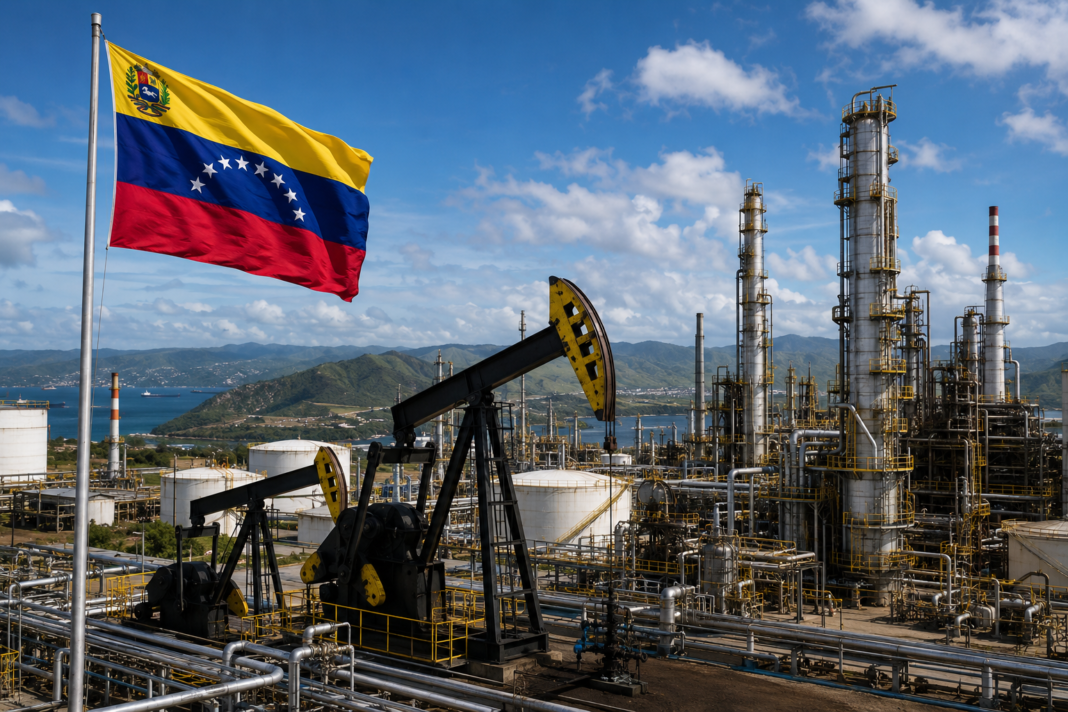
Rodríguez’s government said the agreement involves developing 17 strategic oil fields with an estimated proven potential of 65 billion barrels.
According to details reported by AP and Reuters, the arrangement would establish a private company involving the United States and an unnamed private operator. A U.S. official said the venture would have long-term development rights and that the American side would effectively control 55% of its output through a combination of ownership and purchasing rights.
Caracas says the project could attract approximately $100 billion in private investment into Venezuela’s deteriorated petroleum industry and eventually generate more than $200 billion in tax revenue for the Venezuelan government. Rodríguez described the agreement as an opportunity to accelerate her country’s economic recovery.
Venezuela Has Oil — But Producing It Is Another Matter
Venezuela’s enormous underground reserves have long contrasted sharply with the country’s relatively low production.
Years of insufficient investment, deteriorating infrastructure, political instability, sanctions and management problems have weakened an industry that was once among the world’s most important petroleum producers.
Many facilities require extensive repairs and modernization before production can increase substantially.
That means Americans should not necessarily expect the agreement to produce an immediate drop in gasoline prices. Energy companies would first have to invest billions of dollars in drilling equipment, pipelines, refineries, electricity systems and other infrastructure.
Chevron is currently the major U.S. oil company operating in Venezuela. Other American energy companies have been cautious about committing large amounts of capital after previous nationalizations and years of political uncertainty.
Trump Says Deal Will Lower Gas Prices
Energy costs are a major political issue for the administration.
U.S. gasoline prices have risen considerably over the past year amid disruptions to global petroleum markets and the continuing conflict involving Iran. The national average stood at approximately $4.09 per gallon Friday, compared with $3.21 a year earlier, according to figures cited by AP.
Trump says increasing Venezuelan production will provide the United States with a more stable source of petroleum close to home and eventually reduce fuel costs.
Rubio similarly described the agreement as beneficial to both countries, arguing that Americans could gain access to lower-cost energy while Venezuela receives badly needed investment and employment.
Some oil purchased through the new venture could also be directed toward replenishing the U.S. Strategic Petroleum Reserve and supplying the military, according to a U.S. official familiar with the arrangement.
A Dramatic Shift in U.S.-Venezuela Relations
The agreement represents another remarkable change in relations between Washington and Caracas following years of confrontation.
Former Venezuelan President Nicolás Maduro was removed from power in a U.S. military operation in January and transported to the United States to face federal charges that include narcoterrorism and drug trafficking. Maduro has pleaded not guilty and is expected to face trial in New York in 2027.
Rodríguez subsequently assumed interim leadership and moved to open more of Venezuela’s petroleum sector to private investment, reversing important elements of the state-dominated energy policies associated with former presidents Hugo Chávez and Maduro.
The oil agreement could now make American companies major players in Venezuela’s economic reconstruction.
Questions Remain Over Implementation
Despite the scale of Friday’s announcement, significant questions remain.
The companies participating in the venture have not all been publicly identified, and analysts have raised questions about how the agreement will operate under Venezuela’s constitution and petroleum laws. The country’s infrastructure problems and continuing political uncertainty could also complicate plans to rapidly increase production.
What is clear is the extraordinary scale of the resources involved.
If successfully implemented, the agreement could redirect a substantial portion of Venezuela’s oil development toward American companies and markets, provide Caracas with billions of dollars in new investment and give Washington a powerful new position in the Western Hemisphere’s energy landscape.
Whether it ultimately delivers Trump’s promised reduction in gasoline prices will depend on how quickly Venezuela can turn billions of barrels of underground reserves into oil that actually reaches the global market.
The Haitian Tribune | U.S. & World News