
Death toll reaches 469 as rescuers confront destroyed roads, isolated communities and the danger of another major flood
KATHMANDU, Nepal — The humanitarian emergency along the Nepal-Tibet border intensified Friday as rescue teams raced to reach isolated communities while authorities warned that a newly formed barrier lake could burst and unleash another destructive surge through the Himalayan valleys.
The confirmed death toll in Nepal has climbed to 469, according to police, while large numbers of people remain missing across Nepal and China’s Tibet region. The disaster began Wednesday when a glacier collapse sent an enormous torrent of rock, ice, mud and water through mountain river systems, destroying communities and critical infrastructure.
The evolving situation has created two simultaneous emergencies: finding survivors from the initial catastrophe and preparing communities downstream for the possibility of another flood.
New Lake Creates Dangerous Second Threat
One of the greatest concerns is a lake created when massive quantities of debris blocked the natural flow of water near the disaster zone.
Chinese authorities reported Friday that the lake had begun overflowing. Rescue personnel operating near the most dangerous area in Tibet were ordered to withdraw as officials evaluated the possibility that the natural barrier could fail.
Continued rainfall could push water levels higher over the next several days, potentially sending another surge downstream toward communities and infrastructure already devastated by the first flood.
The threat has complicated rescue operations at a critical moment when hundreds of families are still waiting for information about missing relatives.
Roads and Bridges Destroyed
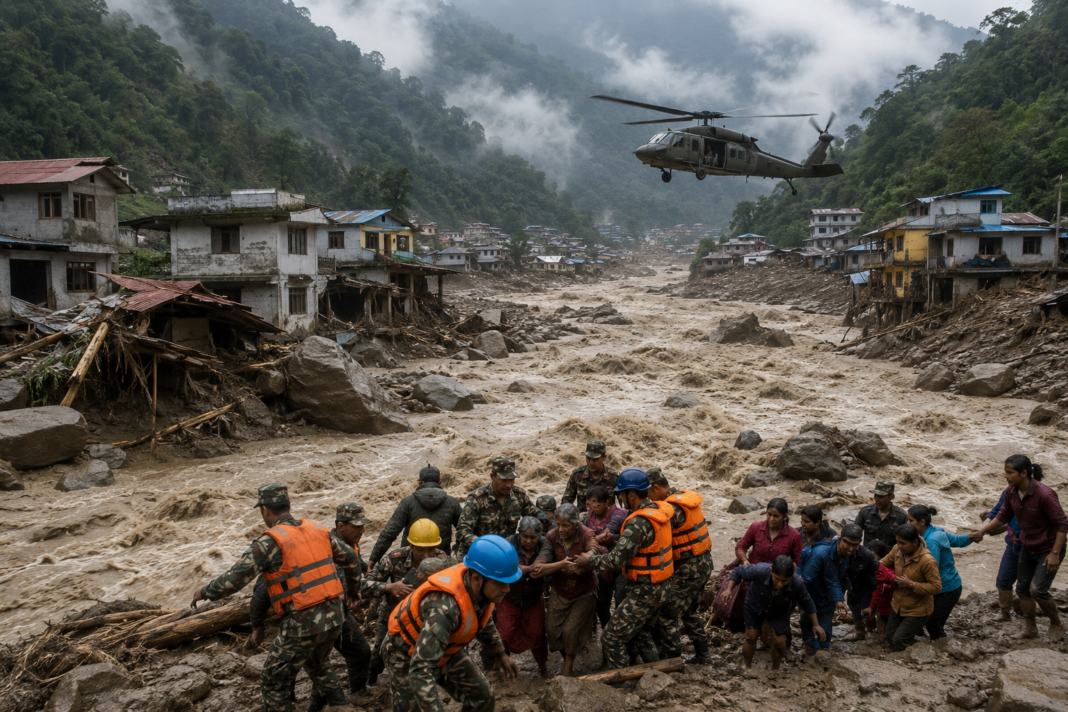
The initial torrent swept through valleys with extraordinary force, destroying homes, bridges, roads and power facilities.
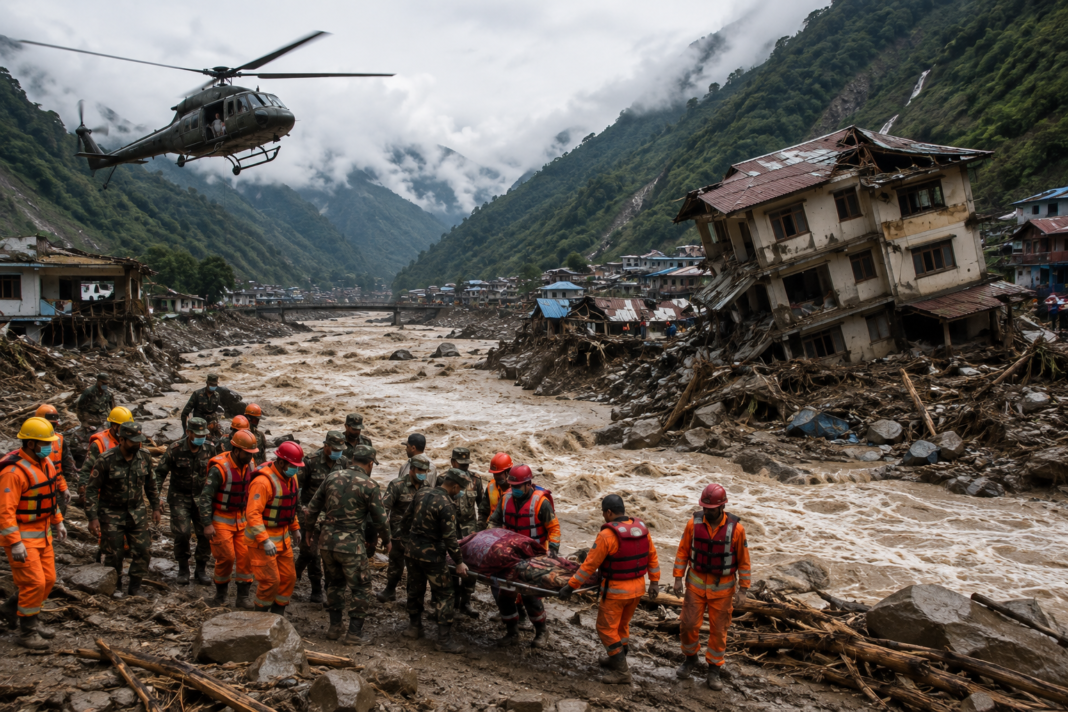
Nearly 40 kilometers, about 25 miles, of roads and numerous bridges were reported damaged or destroyed, severely limiting ground access to some of the hardest-hit communities.
Helicopters have consequently become one of the most important tools in the emergency response.
Nepal’s military has deployed aircraft to evacuate survivors, transport injured residents and deliver essential supplies into areas that can no longer be reached easily by road.
Rescue teams have also been attempting to reach people trapped inside a tunnel at the Trishuli 3A hydropower project. Nepalese authorities said hundreds of workers and residents had already been rescued from the area.
Hundreds of Foreigners Among Missing
The catastrophe has taken on an international dimension because the Himalayan border region attracts tourists, trekkers and religious pilgrims from around the world.
More than 500 foreign nationals were among those reported missing in Nepal during the early accounting of the disaster. They included travelers from India, the United States, Australia, Britain and Canada. Many were visiting the region as part of pilgrimages connected to Mount Kailash and Lake Manasarovar, sacred destinations for several religious traditions.
About 90 Americans were reported unaccounted for as of Friday, according to the Associated Press.
Because communications and transportation networks have been badly damaged, however, authorities continue to reconcile lists of missing people, survivors, and evacuees.
International Assistance Mobilized
Foreign governments and humanitarian organizations are beginning to mobilize assistance.
The United Nations has allocated an initial $2 million for emergency medical assistance, shelter and water, while other governments and relief organizations are preparing or delivering supplies.
The challenge will be getting that assistance into isolated mountain communities.
With roads buried or washed away and continuing concerns about landslides and additional flooding, humanitarian agencies could remain heavily dependent on helicopters and temporary access routes.
What Triggered the Catastrophe?
Early reports initially raised the possibility that an earthquake had triggered the disaster. Subsequent analysis indicated that seismic activity detected around the time of the catastrophe was likely generated by the enormous collapse of glacial ice and rock rather than a conventional earthquake.
The collapse unleashed a massive mixture of ice, rock, sediment and water into the river system below.
The disaster is also likely to renew scientific attention on the rapidly changing Himalayan environment.
Scientists have repeatedly warned that warming temperatures are destabilizing glaciers and high-altitude landscapes. However, establishing exactly how much climate change contributed to this particular collapse will require further scientific investigation.
A Humanitarian Crisis Still Unfolding
For survivors, the disaster has already transformed entire communities.
Homes have disappeared beneath mud and debris. Transportation networks have been severed. Hydroelectric facilities and other infrastructure have suffered major damage, while families continue searching for relatives who vanished when the floodwaters arrived.
The danger is also far from over.
Authorities are closely monitoring the unstable barrier lake while emergency crews assess whether additional evacuations will be necessary downstream.
What began as a devastating glacial collapse has therefore developed into a broader regional emergency—one in which rescuers must search for the missing while simultaneously preparing for the possibility of another destructive flood.
With hundreds confirmed dead and many others still unaccounted for, the full scale of one of the Himalayan region’s most devastating recent natural disasters is still emerging.
The Haitian Tribune | World News
This article was independently written and updated using information from multiple reports, including Reuters, the Associated Press, and other international reporting.