
JOHANNESBURG, South Africa — South Africa’s political landscape appeared headed toward a historic transformation as early election results showed the African National Congress falling well below the majority it has maintained since Nelson Mandela led the party to power at the end of apartheid in 1994.
With slightly more than 16% of ballots counted following the May 29, 2024 national election, the ANC had received just over 42% of the vote. Although the figures represented only an early snapshot, they reinforced expectations that the party could lose its parliamentary majority for the first time in democratic South Africa’s history.
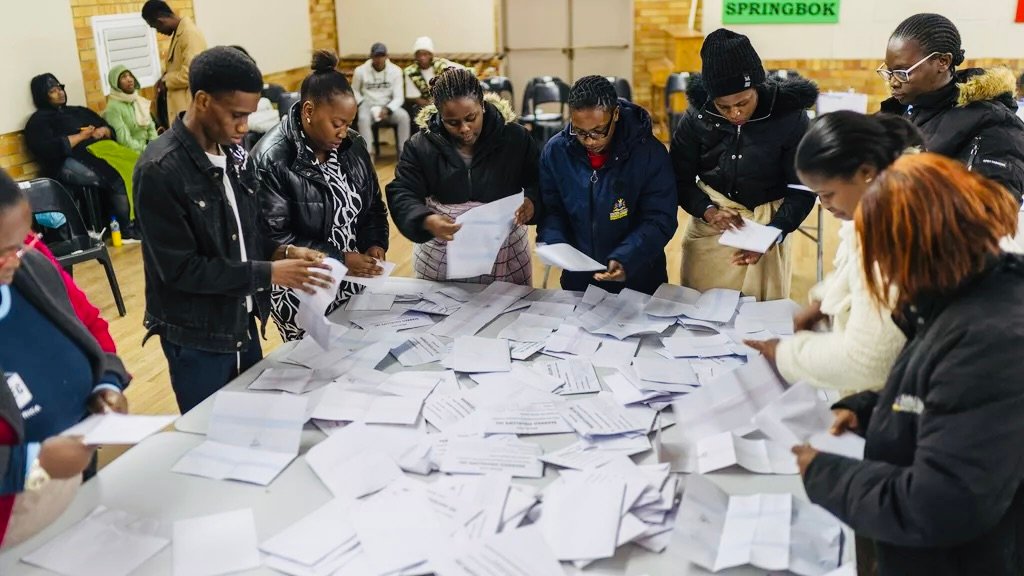
Final results were expected within several days, with the country’s Independent Electoral Commission working through ballots from more than 23,000 polling stations across South Africa’s nine provinces.
For a country where the ANC has dominated national politics for three decades, the election represented potentially the most significant political turning point since apartheid ended.
ANC Faces Its Toughest Election
The ANC entered the election under extraordinary pressure after years of declining public support.
The party holds a unique place in South African history. Its struggle against apartheid eventually helped dismantle the country’s system of institutionalized racial segregation, and Mandela became South Africa’s first Black president following the landmark multiracial election of 1994.
But the ANC’s electoral dominance has gradually weakened.
In the 2019 national election, the party received 57.5% of the vote, its lowest national result at the time. Ahead of the 2024 election, several opinion polls suggested support could fall below 50%.
The early count appeared to strengthen that possibility.
High Turnout Reflects Importance of Election
Nearly 28 million people were registered to participate in the election out of a national population of approximately 62 million.
Election officials projected turnout at around 70%, compared with approximately 66% in 2019.
Large crowds gathered at polling stations throughout Election Day, with voters in Johannesburg, Cape Town and other communities waiting in long lines to cast their ballots.
Although polling stations were scheduled to close at 9 p.m., voting continued much later in some locations. Election rules allowed anyone already waiting in line at closing time to cast a ballot.
The scenes reminded some South Africans of the enormous lines seen during the historic 1994 election.
Opposition Parties Challenge ANC Dominance
Early results placed the Democratic Alliance, the country’s largest opposition party, at approximately 25%.
The Economic Freedom Fighters followed with roughly 8% in the preliminary count.
Another important factor was the emergence of former President Jacob Zuma’s uMkhonto weSizwe Party, commonly known as the MK Party.
Zuma, once one of the ANC’s most powerful leaders, has become a fierce political opponent of his former party. Early returns suggested that MK was attracting a meaningful share of voters and potentially contributing to the erosion of ANC support.
Because counting was still in its early stages, however, the percentages remained subject to substantial change.
Coalition Government Could Become Necessary
The most consequential question was whether the ANC could remain above the crucial 50% threshold.
South Africans do not directly elect their president during national elections. Instead, voters choose political parties, which receive seats in the National Assembly based broadly on their share of the vote. Members of Parliament then elect the country’s president.
Since the ANC has always controlled a parliamentary majority during the post-apartheid era, South Africa’s presidents have consistently come from the party.
Losing that majority would create an unprecedented situation.
The ANC could remain South Africa’s largest political party but be forced to negotiate with one or more rivals to secure enough parliamentary support to govern and elect a president.
President Cyril Ramaphosa, who also leads the ANC, expressed confidence after casting his ballot that his party would emerge with a firm majority.
The early numbers, however, suggested that the final outcome could be considerably closer than in previous elections.
Economy and Unemployment Weigh Heavily on Voters
Despite possessing one of Africa’s largest and most developed economies, South Africa continues to struggle with deep economic inequality.
Millions of people remain in poverty more than three decades after apartheid ended, with economic hardship disproportionately affecting the country’s Black majority.
Unemployment has remained exceptionally high, particularly among younger South Africans.
Crime, electricity problems, deteriorating infrastructure and dissatisfaction with government services have also contributed to frustration among voters.
Meanwhile, years of corruption allegations involving ANC officials have damaged public confidence in the party.
For many voters, the election was therefore not simply about South Africa’s political history. It was also a judgment on whether the ANC had successfully delivered economic opportunities and effective government after three decades in power.
A Historic Moment for South African Democracy
Whatever the final result, the election demonstrated that South Africa’s political system was becoming increasingly competitive.
For 30 years, the ANC’s role in defeating apartheid provided it with extraordinary political loyalty. But younger generations of voters increasingly judge the party on current conditions rather than its liberation-era legacy.
If the ANC ultimately falls below 50%, South Africa could enter an entirely new political era—one in which coalition negotiations and compromises between competing parties become central to governing the country.
With thousands of polling stations still awaiting final tabulation in the early count, South Africans were watching closely as each new result arrived.
The question was no longer simply how large the ANC’s victory would be.
For the first time since Nelson Mandela’s historic 1994 election, the country was seriously confronting the possibility that the ANC might no longer be able to govern alone.
The Haitian Tribune | Africa & International News