
Armed groups push into mountainous communities while Haitian police deploy specialized units and armored vehicles to protect a critical corridor linking Port-au-Prince to the southern peninsula
GRESSIER, Haiti — Security conditions in Gressier deteriorated sharply this week after armed groups launched a renewed offensive, extending their attacks beyond the town center and into communities in the surrounding hills. The latest violence represents a troubling development for the commune, located along the strategic southern approach to Port-au-Prince. Residents of the Jasmin communal section were among those particularly affected as armed men moved into areas that had previously been relatively insulated from the fighting. Local community defense members and residents reportedly fled several neighborhoods as the attacks intensified. Municipal officials say hundreds of people have been newly displaced, adding to the population already uprooted by insecurity in the region.
Residents Flee as Violence Reaches the Hills
The displacement has not been limited to the mountainous areas. Some families living closer to central Gressier also left their homes out of fear that armed groups could expand their operations. The developments underscore the continuing difficulty Haitian authorities face in securing Gressier and the National Road No. 2 corridor, a vital transportation artery connecting the Port-au-Prince metropolitan area with Haiti’s southern departments.
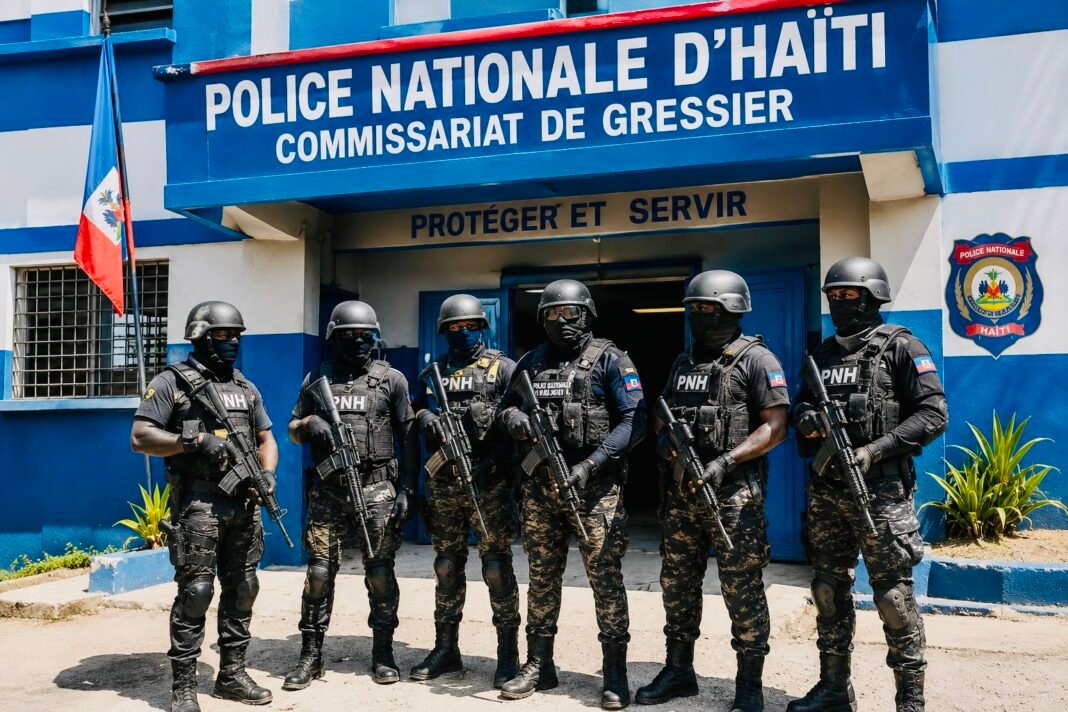
Local authorities say security forces have so far managed to contain at least part of the latest offensive. Specialized officers from the Haitian National Police’s BRI unit were deployed with additional armored vehicles during the week, reinforcing personnel from CIMO and SWAT units already operating in the area. According to Alexis Claudy, director general of the Gressier municipal administration, aerial support was also used during security operations aimed at pushing back the armed groups. Claudy indicated that police needed time to adjust their strategy to the scale and direction of the new attacks.
Armed Groups Target Strategic Transportation Routes
Beyond territorial expansion, control of transportation routes appears to be a central element of the confrontation. The armed group known as 103 Zombies, which had reportedly suffered setbacks around central Gressier, had withdrawn toward territory bordering Mariani before renewing its offensive. The stakes extend beyond control of individual neighborhoods. Because insecurity has repeatedly disrupted travel along National Road No. 2, secondary and agricultural roads have become increasingly important for merchants, passengers, and vehicles transporting goods between the capital region and Haiti’s southern peninsula.
Despite their poor condition, these alternative routes provide critical passages when the main highway becomes inaccessible. Armed groups have reportedly attempted to establish checkpoints along some of these roads, increasing concerns that control of the area could allow them to restrict movement and exert greater economic pressure on communities dependent on the corridor.
Police Work to Recover Territory
Municipal authorities say security forces have regained some positions and removed barricades from secondary roads. Claudy also rejected reports that new barricades had been erected along the principal roadway. He said he traveled with a police patrol to the Carrefour Quatre Gendarmes area and observed that the road remained open. He praised officers deployed in Gressier for continuing operations despite difficult security conditions. Earlier efforts involving police, municipal authorities, and local brigades had also resulted in the removal of large concrete barricades that had completely obstructed portions of National Road No. 2. However, the destruction of a newly established police substation earlier this month represented a significant setback for efforts to establish a lasting security presence.
Gressier’s Importance Goes Beyond the Commune
The battle for Gressier has broader implications for southern Haiti. Its location makes the commune strategically important for transportation between metropolitan Port-au-Prince and communities farther south. Persistent insecurity there can disrupt passenger travel, commercial activity, and the movement of food and other essential supplies. That makes control of roads and surrounding communities particularly significant. Even when armed groups do not completely occupy the highway, instability along alternative routes can make transportation more dangerous and expensive.
The latest push into mountainous communities also illustrates how Haiti’s security crisis can evolve geographically. Pressure on armed groups in one location may cause them to reposition themselves or seek control of less-protected areas.
Returning Displaced Families Remains the Goal
For Gressier’s municipal administration, restoring enough security for displaced residents to return home remains the principal objective. But the latest wave of displacement demonstrates how difficult that goal remains. Temporary police gains will have to be followed by a sustained security presence if communities are to regain confidence that returning home will not expose them to another attack.
The situation in Gressier therefore remains fragile. Police reinforcements and recent territorial gains have provided some relief, but the renewed offensive shows that armed groups retain the ability to regroup and threaten strategically important communities.
For hundreds of families who have once again fled their homes, the most meaningful measure of progress will not simply be whether a road remains open or a barricade is removed. It will be whether security can be maintained long enough for residents to return and remain safely.
The Haitian Tribune | Haiti News