
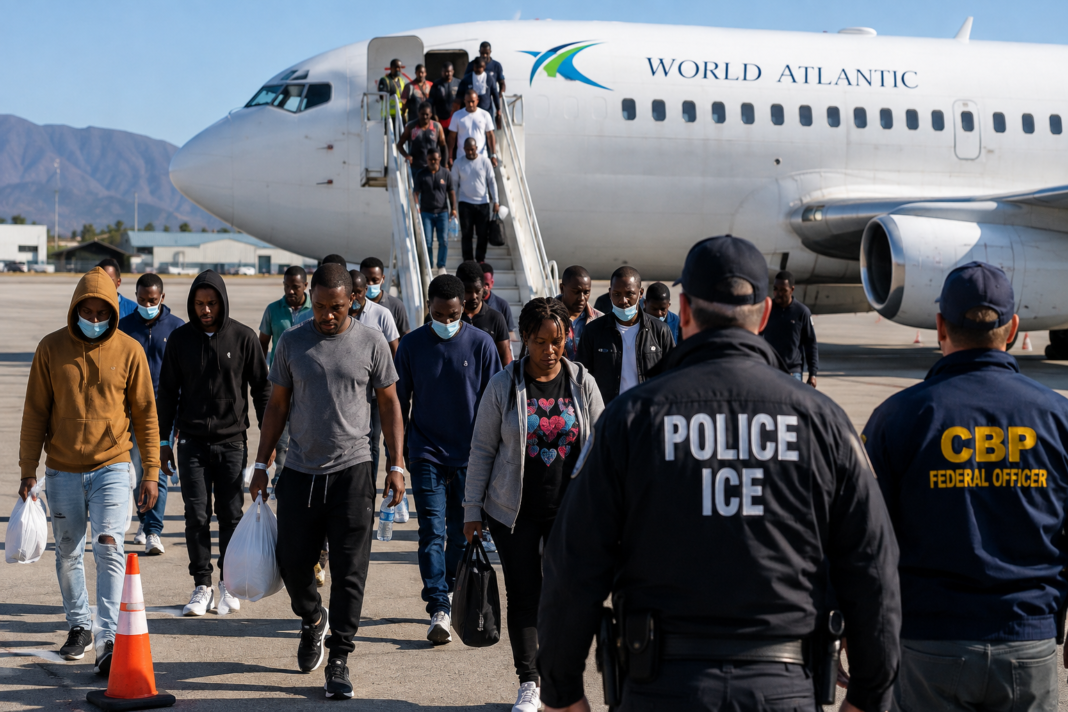

More than 160 Haitians were returned from the United States as Washington prepares to increase deportation flights following the end of Temporary Protected Status
CAP-HAÏTIEN, Haiti — More than 160 Haitian nationals were deported from the United States to Haiti on Thursday aboard a charter flight operated for U.S. Immigration and Customs Enforcement, marking the first such flight since the Trump administration ended Temporary Protected Status for hundreds of thousands of Haitians. The aircraft landed shortly before noon on August 20 in Cap-Haïtien, Haiti’s second-largest city, rather than Port-au-Prince, where widespread insecurity has severely disrupted normal government operations and transportation.
Thursday’s arrival was reportedly the eighth U.S. deportation flight to Haiti in 2026, but its timing gives it particular significance. It comes after the termination of TPS protections affecting more than 300,000 Haitians and amid warnings that the United States intends to accelerate removals.
Deportations Expected to Increase
U.S. authorities have informed Haitian officials that deportation flights are expected to become more frequent following the end of TPS. Under the anticipated schedule, the United States could operate as many as two removal flights per week, potentially returning approximately 250 Haitians weekly.
If maintained, that pace would represent a significant increase in the number of people Haiti must receive and reintegrate at a time when the country is already confronting an extraordinary humanitarian and security emergency. The development also signals that the termination of TPS is moving beyond a legal and political debate and beginning to produce tangible consequences for Haitian immigrant communities in the United States.
What the End of TPS Means
Temporary Protected Status is a humanitarian immigration designation that allows eligible nationals of countries experiencing armed conflict, natural disasters or other extraordinary conditions to remain temporarily in the United States. TPS does not automatically provide permanent residency or citizenship. However, while the designation remains valid, eligible beneficiaries generally receive protection from deportation and authorization to work legally in the United States.
For many Haitians, TPS became particularly important following years of political instability, natural disasters and escalating insecurity.The Trump administration’s decision to terminate the designation therefore created considerable uncertainty among Haitian families, immigrant advocates, and community organizations.
Not every former TPS beneficiary will immediately face deportation. Individual immigration circumstances differ considerably, and some Haitians may have other legal protections, pending immigration cases, or separate pathways allowing them to remain in the country. Nevertheless, the resumption and expected expansion of removal flights underscores the increased enforcement risks facing Haitians without another lawful basis to remain in the United States.
Deportees Return to a Country in Crisis
The deportations are especially controversial because of conditions inside Haiti. Large sections of the Port-au-Prince metropolitan region have experienced severe gang violence, while displacement has reached extraordinary levels. Access to housing, employment, health care, and basic public services remains difficult for many Haitians.
Returning deportees can face additional challenges. Some have lived abroad for years or even decades and may have limited family connections remaining in Haiti. Others may return without employment, housing, or the financial resources necessary to rebuild their lives. That places additional pressure on Haitian authorities and humanitarian organizations responsible for receiving and assisting returnees. Cap-Haïtien has increasingly become strategically important as insecurity in and around the capital has disrupted transportation and government activity.
Immigration Enforcement Remains a Trump Administration Priority
The flight also reflects the Trump administration’s broader immigration enforcement agenda. Since returning to office, President Donald Trump has made expanded deportations and stricter immigration enforcement central components of his domestic policy. Haitians are among several immigrant communities affected by the administration’s effort to narrow or terminate humanitarian programs that previously allowed certain foreign nationals to remain temporarily in the United States.
For Haitian-American communities, however, the issue carries particular urgency because of Haiti’s current conditions. Critics of deportations argue that returning large numbers of people to a country experiencing severe instability could worsen an already difficult humanitarian situation. Supporters of the administration’s approach argue that temporary immigration programs cannot become indefinite substitutes for permanent immigration status and that the federal government has an obligation to enforce existing immigration laws.
Pressure Could Grow on Haitian Authorities
If the United States follows through with plans for approximately two deportation flights each week, Haiti could soon receive hundreds of deportees every month. That raises an important question: What happens after they arrive?
Receiving deportees at an airport is only the first stage. Haitian authorities will have to coordinate identification, transportation and potentially reintegration assistance, while humanitarian organizations may be asked to provide emergency support to people without immediate housing or family networks. The challenge becomes even greater when deportees are returned to northern Haiti but ultimately need to travel elsewhere in the country. Transportation between regions can be complicated by insecurity, damaged infrastructure and limited economic resources.
A New Phase for Haitians in the United States
Thursday’s flight could represent the beginning of a much more consequential period for Haitian immigrants. For years, TPS provided a degree of stability to Haitian beneficiaries who established careers, raised families, paid taxes, and built lives in American communities. With that protection ending, immigration status is again becoming an urgent concern for thousands of households. The consequences also extend beyond the individuals potentially facing removal. Many Haitian TPS holders have American-born children, spouses, or relatives whose lives could be disrupted if a family member is deported.
Meanwhile, Haiti may be asked to absorb an increasing number of returnees while simultaneously dealing with internal displacement, insecurity, and economic hardship. The arrival of more than 160 Haitians in Cap-Haïtien on Thursday therefore represents more than another deportation flight. It is an early indication of how a major shift in U.S. immigration policy could affect communities on both sides of the Caribbean. And if Washington proceeds with its planned increase in removals, Thursday’s flight may be only the beginning.
The Haitian Tribune | Haiti & U.S. Immigration