
IOM says insecurity continues to disrupt communities in the West and Artibonite departments while humanitarian needs remain critical
PORT-AU-PRINCE, Haiti — Armed violence continued to worsen Haiti’s humanitarian emergency in July, forcing more families from their homes and making it increasingly difficult for aid organizations to reach vulnerable communities, according to a new report from the International Organization for Migration (IOM).
The report, released on August 13, 2026, indicates that approximately 1.47 million people are internally displaced across Haiti, highlighting the enormous human cost of the country’s prolonged security crisis.
Communities in the West and Artibonite departments remain particularly affected as insecurity continues to disrupt transportation, public services, economic activity and humanitarian operations.
Nearly 1.5 Million Haitians Displaced
The scale of internal displacement has created urgent needs for housing, clean water, sanitation, health care and protection services.
Many displaced families have sought refuge with relatives or host communities, while others remain in temporary sites where access to essential services can be limited.
At the same time, violence and insecurity have made humanitarian operations more difficult in some of the areas where assistance is needed most.
The situation is placing additional pressure on communities already struggling with poverty, limited infrastructure and weakened public services.
More Than 61,000 People Assisted in July
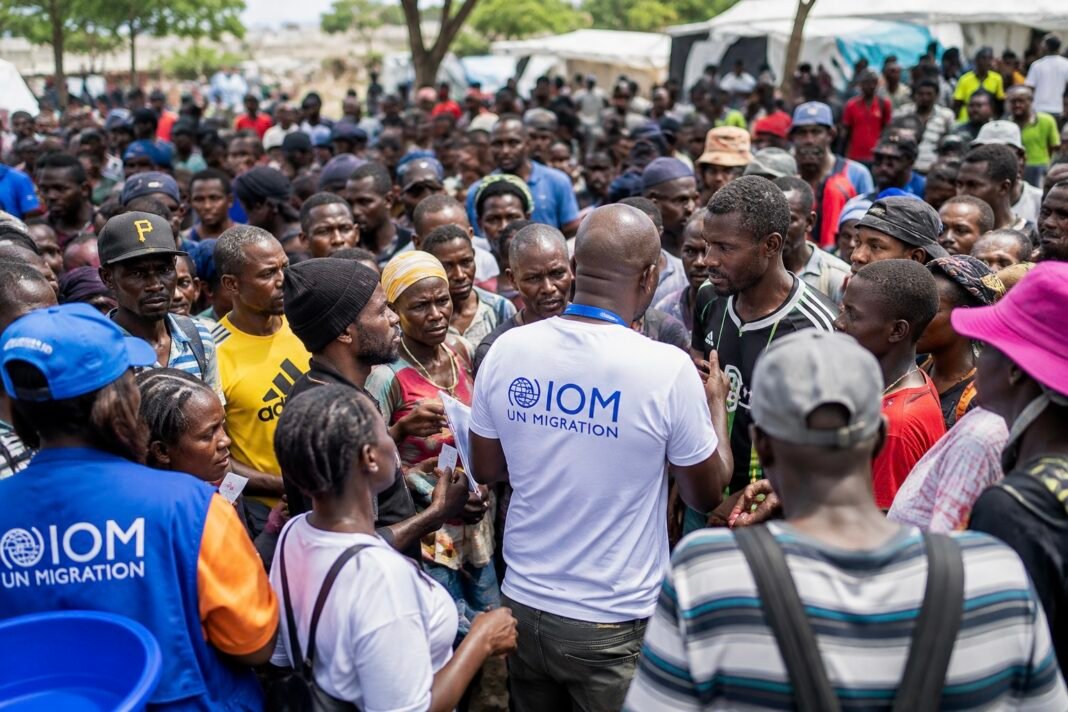
Despite those challenges, the IOM reported providing humanitarian assistance to 61,256 people during July.
More than 16,000 people received medical care, while 40,451 people were provided with non-food assistance, including essential supplies intended to help families cope with displacement and difficult living conditions.
The figures illustrate both the scale of humanitarian operations underway and the significantly larger challenge facing Haiti as displacement approaches 1.5 million people.
Artibonite Communities Under Growing Pressure
The humanitarian situation has also become increasingly difficult in Artibonite, where population movements have placed additional strain on local infrastructure.
In Gonaïves, the IOM reported rehabilitating sanitation facilities in six public markets as part of efforts to improve hygiene and reduce health risks.
The organization also conducted public awareness campaigns focused on hygiene practices.
Such interventions have become particularly important in communities receiving displaced populations, where inadequate sanitation and limited access to clean water can increase the risk of disease.
More Than 28,000 Migrants Forcibly Returned to Haiti
The report also highlighted another challenge confronting the country: the continued forced return of Haitian migrants from abroad.
According to the IOM, 28,093 migrants had been forcibly returned to Haiti since January.
Those returns add another layer of pressure to a country already struggling to accommodate large numbers of internally displaced people.
Many returnees arrive in Haiti facing uncertain economic prospects and may require assistance with transportation, shelter, food or reintegration.
Humanitarian Needs Remain Critical
Haiti’s humanitarian emergency has increasingly expanded beyond communities directly affected by armed groups. Cities and regions receiving displaced families are also experiencing pressure on housing, health facilities, sanitation systems, schools and local economies.
With nearly 1.47 million people displaced, humanitarian organizations face the difficult task of responding to immediate needs while insecurity continues to restrict access to some communities.
The latest IOM figures underscore the growing urgency of Haiti’s crisis: without significant improvements in security and humanitarian access, displacement is likely to remain one of the country’s most pressing challenges.
For hundreds of thousands of Haitian families, restoring security is not simply a political objective—it is essential to creating the conditions that would allow them to safely return home and rebuild their lives.
The Haitian Tribune | Haiti News