

Rights group says abuses at gold and coltan mining sites in eastern Democratic Republic of Congo could constitute war crimes, while raising new concerns about minerals allegedly being smuggled into Rwanda
By The Haitian Tribune Staff | September 21, 2026 | KINSHASA, Democratic Republic of Congo
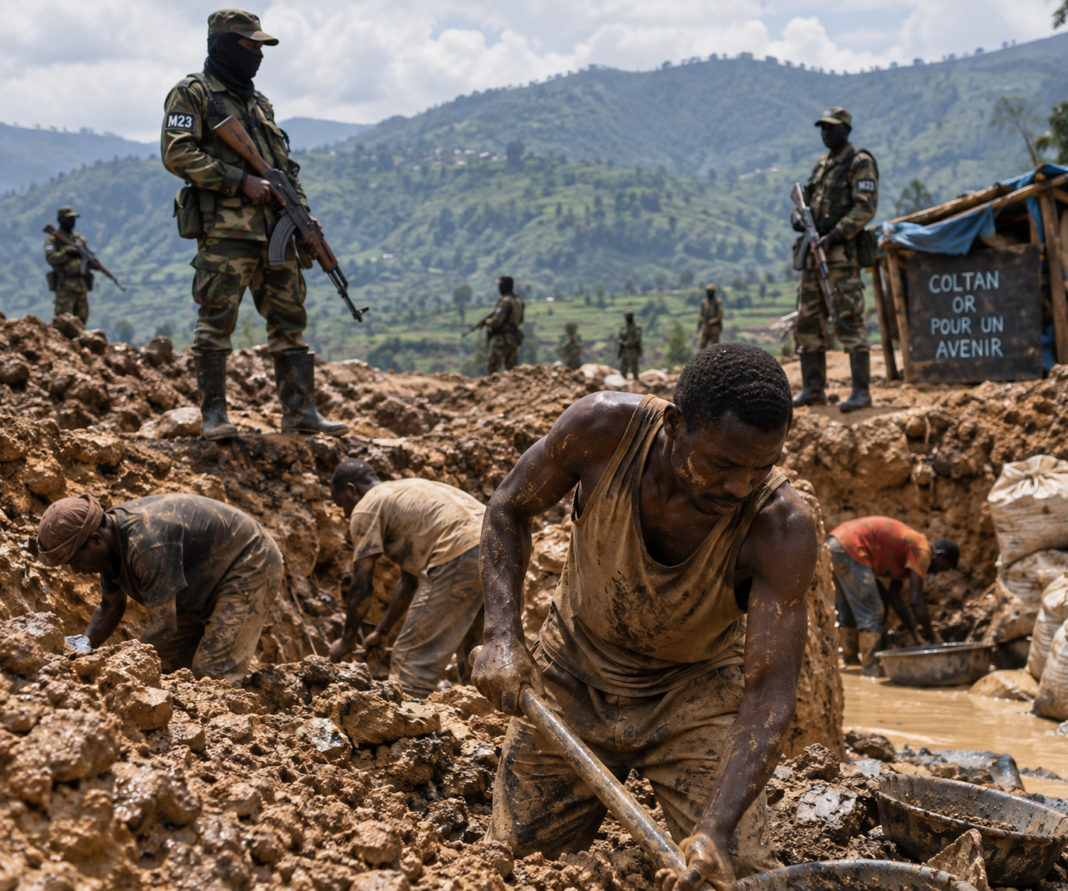
Amnesty International has accused the Rwanda-backed M23 armed group of committing serious abuses against civilians working in mines under its control in eastern Democratic Republic of Congo, including alleged killings, torture and forced labor.
The human rights organization says its investigation documented abuses at artisanal mining sites in the conflict-hit provinces of North Kivu and South Kivu, where miners extract valuable resources including gold and coltan.
According to Amnesty, M23 now controls dozens of mining locations in the region. The organization says some workers have been subjected to violence, coercion and dangerous working conditions as the armed group expands its influence over mineral-producing territory.
Miners Allegedly Killed
Amnesty said investigators interviewed 26 people while examining conditions in mining areas controlled by M23.
The organization documented the alleged killing of 18 miners at two locations: the Rubaya coltan mining area and the Lomera gold mine.
Amnesty said some of the conduct it documented could amount to violations of international humanitarian law and, depending on the circumstances and evidence, war crimes.
The allegations have not been independently adjudicated by a court, and responsibility for individual incidents would require further investigation.
Coltan at the Center of the Conflict Economy
Rubaya has particular international significance because of its deposits of coltan, an ore from which tantalum is produced.
Tantalum is widely used in electronic components found in smartphones, computers and other technology, connecting the mineral economy of eastern Congo to international supply chains.
Control over mineral-rich territory has long been intertwined with armed conflict in eastern Congo. Competition for mines, taxation routes and cross-border trade can provide armed groups with sources of revenue while exposing civilian workers and surrounding communities to exploitation.
Amnesty’s latest findings raise concerns that minerals produced under abusive conditions could enter legitimate international supply chains after being transported out of conflict-controlled territory.
Amnesty Alleges Minerals Smuggled Into Rwanda
The organization also alleges that gold and coltan originating in M23-controlled areas are being moved illegally across the border into neighboring Rwanda.
Such allegations are particularly significant because Rwanda has repeatedly rejected accusations that it is exploiting Congolese mineral resources or supporting M23 for economic gain.
Neither M23 nor Rwandan authorities responded to Amnesty International’s requests for comment on the findings described in the report, according to the rights organization.
Rwanda has previously denied supporting M23, although United Nations experts and several Western governments have documented what they describe as substantial Rwandan military support for the armed group. Kigali has disputed aspects of those accusations and has cited security threats from armed groups operating in eastern Congo as a central concern.
Conflict Has Devastated Eastern Congo
M23 has become one of the most powerful armed organizations operating in eastern Congo, where decades of warfare involving government troops, foreign forces and numerous militias have displaced millions of people.
The group’s territorial expansion has intensified international concern not only about civilian protection but also about who controls eastern Congo’s considerable mineral wealth.
Artisanal miners are especially vulnerable. Many depend on daily mineral extraction for survival and work in remote locations where government oversight, labor protections and access to independent investigators are limited.
Amnesty’s allegations suggest that civilians working in some M23-controlled mines face another layer of danger beyond the physical risks inherent in artisanal mining.
Global Supply Chains Face Renewed Scrutiny
The findings also put renewed attention on companies purchasing minerals originating in Central Africa.
Tracing gold is particularly difficult because it can be transported in small quantities, melted and mixed with material from other sources. Coltan can similarly move through multiple traders and countries before reaching international processors.
That complexity has prompted years of efforts by governments, manufacturers and international organizations to prevent minerals connected to armed groups or serious human-rights abuses from entering global markets.
Amnesty’s report argues that stronger scrutiny is needed to determine where minerals from M23-controlled areas ultimately go and whether existing systems designed to identify conflict-linked minerals are working effectively.
Civilians Continue to Bear the Cost
The allegations surrounding Rubaya and Lomera represent another dimension of a conflict already responsible for widespread displacement and humanitarian suffering across eastern Congo.
For mining communities, control of territory can determine far more than who profits from the minerals beneath the ground. It can determine who is allowed to work, what miners must surrender, whether they can leave—and, according to Amnesty’s allegations, whether refusing orders can place their lives at risk.
Amnesty is calling for accountability for abuses against miners and stronger action to prevent minerals associated with armed conflict and human-rights violations from reaching international markets.
The report also underscores a broader problem that has followed eastern Congo’s wars for decades: despite the extraordinary value of the minerals extracted from the region, many of the people working closest to that wealth remain among those most exposed to violence, exploitation and displacement.
By The Haitian Tribune Staff | September 21, 2026 | KINSHASA, Democratic Republic of Congo