
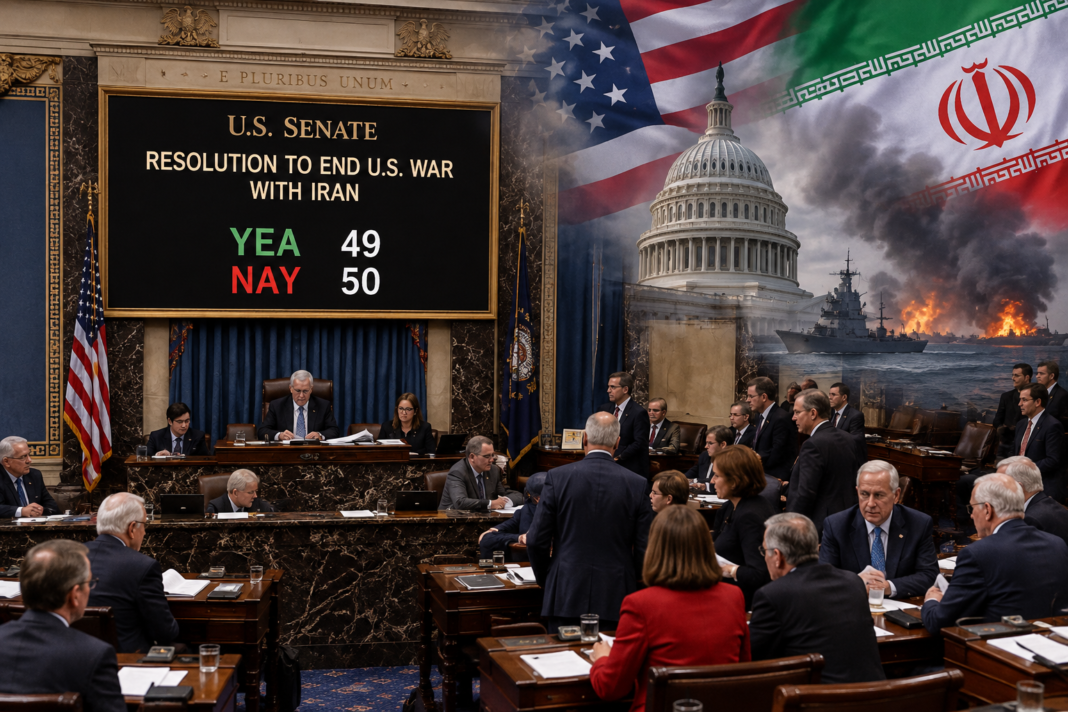

Four Republicans joined most Democrats in supporting the measure, but the Senate rejected it 50-49 as Congress again confronted the limits of presidential war powers
The U.S. Senate narrowly rejected a resolution Thursday that called for President Donald Trump to end American military involvement in the war with Iran unless Congress explicitly authorized continued hostilities.
The measure failed 50-49, according to the official Senate roll call. Four Republicans — Susan Collins of Maine, Lisa Murkowski of Alaska, Rand Paul of Kentucky and Thom Tillis of North Carolina — joined most Democrats and independents in supporting it. Democratic Sen. John Fetterman of Pennsylvania voted against the resolution, while Democratic Sen. Angela Alsobrooks of Maryland did not vote.
The resolution would have directed the president to remove U.S. armed forces from hostilities against Iran, including potential ground combat or occupation, unless Congress approved the operations through a declaration of war or a specific authorization for the use of military force.
Most Republicans Oppose the Measure
Most Republican senators voted against the resolution, including Sens. Jon Husted of Ohio and Dan Sullivan of Alaska. The vote came as some Republican lawmakers and candidates have publicly called for the conflict to end while expressing concerns about its economic and military costs.
The measure had previously passed the House in July by 214-208. Because it was a concurrent resolution, however, it was largely symbolic and would not have gone to Trump for his signature or carried the force of law.
Thursday’s vote nevertheless provided another formal measure of congressional sentiment over a conflict that has repeatedly generated disputes about the constitutional division of war-making authority between Congress and the president.
Debate Over Presidential War Powers
Supporters argued that Congress should explicitly authorize a prolonged military conflict rather than allow hostilities to continue solely under presidential authority.
Opponents of the resolution have defended the administration’s ability to conduct military operations and have resisted congressional efforts to restrict Trump’s authority during the conflict.
The Senate has repeatedly considered war-powers measures since U.S. and Israeli military operations against Iran began in late February. Thursday’s vote marked the chamber’s 14th consideration of an Iran-related war-powers resolution during the conflict, according to Stars and Stripes.
The constitutional debate centers on two overlapping authorities: Congress has the power to declare war and authorize military action, while the president serves as commander in chief of the armed forces.
War’s Economic and Military Costs Enter Debate
The conflict’s cost has become increasingly prominent in congressional debate.
Pentagon estimates cited by Stars and Stripes put the cost of the war at approximately $42 billion by this week. Lawmakers supporting restrictions on the conflict have also pointed to American military casualties, pressure on U.S. weapons stockpiles and higher energy costs.
Reuters reported that the conflict has contributed to increases in fuel and food prices as fighting around Iran and the Strait of Hormuz has disrupted global energy markets. The economic consequences have become an issue in congressional politics ahead of the November 3 midterm elections.
Congress Remains Divided
Thursday’s result demonstrated that opposition to the war crosses party lines, but not enough to secure passage in the Senate.
Collins, Murkowski and Paul had previously supported efforts to restrict unauthorized hostilities involving Iran. Tillis’ support represented a change from his position in earlier votes.
At the same time, the overwhelming majority of Senate Republicans opposed Thursday’s resolution, while nearly every Democrat present supported it.
The vote does not itself change U.S. military operations in Iran. It does, however, leave unresolved the broader dispute over whether continued American involvement should require a new, explicit authorization from Congress.
With the conflict approaching its seventh month, that constitutional question — alongside the war’s human, military and economic costs — remains at the center of an increasingly consequential debate in Washington.
By The Haitian Tribune Staff | September 24, 2026 | WASHINGTON