
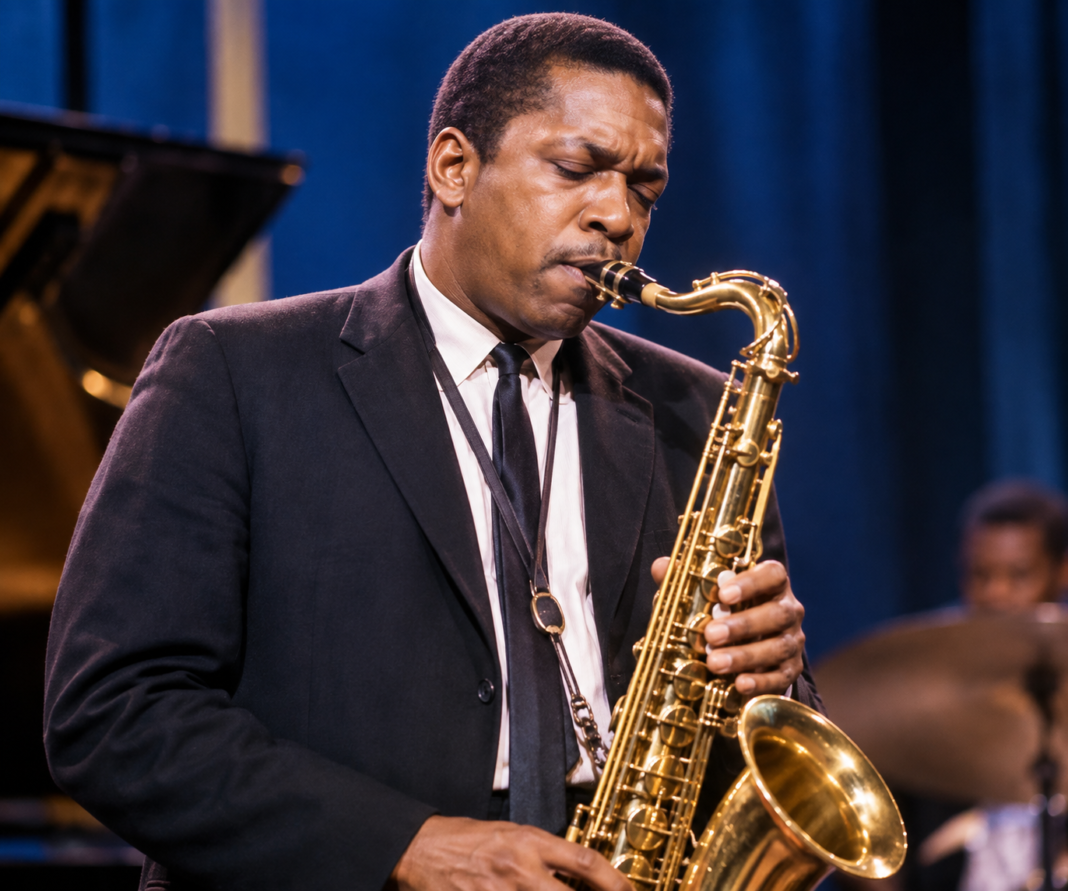

A century after his birth, concerts, conversations, films and poetry are tracing how Coltrane’s formative years in Philadelphia helped transform a young saxophonist into one of modern music’s most influential voices.
Philadelphia is marking the 100th anniversary of John Coltrane’s birth with an expansive celebration of the saxophonist whose restless musical imagination transformed jazz and influenced generations far beyond it.
Born on September 23, 1926, in Hamlet, North Carolina, Coltrane spent his childhood in High Point before moving north as a young man. Philadelphia became one of the most important places in his artistic development.
During his twenties and through much of the 1950s, Coltrane lived in the city, including at the now-famous house on North 33rd Street in the Strawberry Mansion neighborhood. Those Philadelphia years came before international recognition and gave him space to study, perform, experiment and develop the musical language that would eventually make him one of jazz’s defining figures.
The house itself has become part of that legacy. After years of deterioration, efforts are underway to preserve and restore the historic property and develop it as a cultural and community space devoted to Coltrane’s life and music.
Philadelphia Before the Fame
Coltrane’s relationship with Philadelphia is particularly important because the city knew him before the world did.
He immersed himself in Philadelphia’s thriving jazz community, encountering musicians and musical ideas that contributed to his development. His career would eventually place him alongside some of the greatest figures in jazz, including Miles Davis and Thelonious Monk, before Coltrane emerged as a bandleader with an increasingly distinctive sound of his own.
He relocated to the New York area in 1958, but Philadelphia remained part of his professional and personal orbit. He continued performing in the city and maintained relationships with musicians from the region.
By the early 1960s, Coltrane’s recordings were pushing jazz into increasingly adventurous territory. Albums such as Giant Steps, My Favorite Things and A Love Supreme became milestones, demonstrating both extraordinary technical command and a growing spiritual dimension in his music.
Coltrane died in 1967 at just 40 years old, but his relatively short recording career left an enormous body of influence.
A Centennial Across Philadelphia
The centennial is being commemorated across the city rather than confined to a single concert hall.
Philadelphia organizations are presenting performances, discussions, poetry, film and educational programs exploring different dimensions of Coltrane’s legacy.
Among the most ambitious projects is Ars Nova Workshop’s “Coltrane 100,” which brings together musicians and scholars for performances and conversations inspired by his work. The programming includes artists such as the Immanuel Wilkins Quartet, Sun Ra Arkestra, Odean Pope, Terri Lyne Carrington and Tyshawn Sorey with Marilyn Crispell.
The celebration is also expected to extend beyond this birthday week, with Coltrane-related programming continuing during the coming year.
Other Philadelphia institutions and public spaces, including the Philadelphia Museum of Art, the Mann Center and LOVE Park, are participating in centennial activities.
The scale of the celebration reflects something larger than nostalgia. Philadelphia is reclaiming its place in the Coltrane story.
Why Coltrane Matters Even If You Don’t Listen to Jazz
For someone unfamiliar with jazz, Coltrane’s reputation can initially make his music seem intimidating.
Some of his later recordings are long, intense and highly improvisational. His saxophone can move from lyrical melodies into dense cascades of notes, sometimes abandoning the conventional structures casual listeners expect from popular music.
But understanding every musical idea is not necessary to begin listening.
A newcomer could start with the recognizable melody of “My Favorite Things,” hearing how Coltrane takes a familiar song and gradually transforms it. Giant Steps demonstrates another side of him: technical precision and harmonic complexity delivered at extraordinary speed.
Then there is A Love Supreme.
Released in 1965, the four-part suite represents perhaps the clearest meeting point between Coltrane’s music and his spiritual search. Rather than treating jazz simply as entertainment, Coltrane approached music as a means of exploring faith, discipline, struggle and human connection.
That dimension helps explain why his influence reaches beyond saxophonists and jazz historians.
Writers, visual artists, experimental musicians, rock performers, hip-hop artists and spiritual thinkers have all found something in Coltrane’s work.
Listening as Exploration
Coltrane himself offered a useful philosophy for approaching unfamiliar ideas.
In a 1966 interview with writer Frank Kofsky, he spoke about the importance of approaching things one does not understand with humility — opening the mind, absorbing what is being encountered and becoming still enough to experience it.
That philosophy provides an unusually appropriate introduction to his music.
Listeners do not necessarily have to determine where one chord ends and another begins. They can instead listen to the emotional movement: tension and release, repetition and transformation, quiet reflection followed by enormous intensity.
The experience can come before the explanation.
For Coltrane, improvisation was not simply an opportunity to display technique. It became a process of searching.
The Philadelphia Chapter
The centennial also offers Philadelphia an opportunity to emphasize a chapter of music history sometimes overshadowed by Coltrane’s later association with New York.
Before the celebrated recordings, international tours and canonical quartet, there was a young musician living and practicing in Philadelphia.
The city provided part of the environment in which he learned his craft, encountered other musicians and developed the discipline that would later define his career.
That makes the restoration of his Strawberry Mansion home particularly significant. Preserving the building is not simply about maintaining the former residence of a celebrity. It connects a neighborhood to a period when one of America’s most consequential musicians was still becoming himself.
A century after John Coltrane’s birth, Philadelphia is therefore celebrating more than a jazz legend.
It is celebrating the process that created one.
And for listeners who have never considered themselves jazz fans, the centennial may provide the perfect invitation to begin — not by trying to understand everything Coltrane was doing, but simply by listening.
By The Haitian Tribune Staff | September 24, 2026 | PHILADELPHIA