
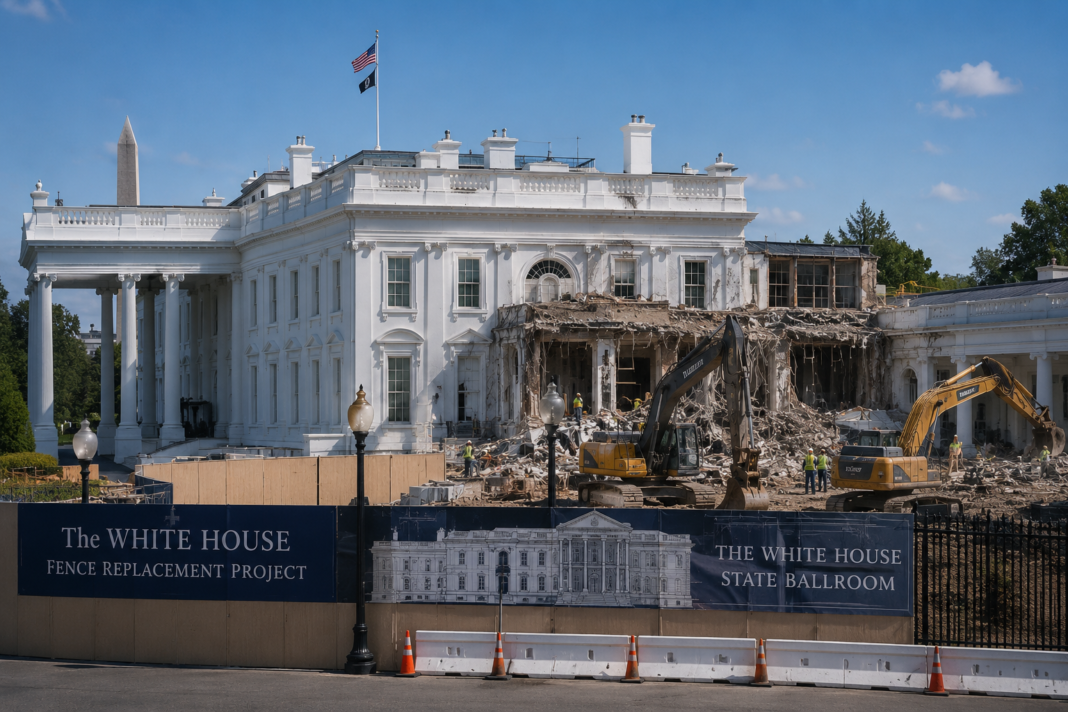

WASHINGTON — The Trump administration turned to the U.S. Supreme Court on Friday in an effort to restart construction of a massive new ballroom planned for the White House complex, escalating a legal battle over the president’s authority to proceed with the project without congressional approval.
The administration is seeking emergency intervention after a federal appeals court upheld restrictions on above-ground construction of the proposed 90,000-square-foot ballroom, which is planned for the site of the demolished White House East Wing.
The project is estimated to cost approximately $400 million.
Appeals Court Blocks Part of Construction
The Supreme Court request comes about a week after a federal appeals court concluded that the White House did not have sufficient authority to move forward with the ballroom project without approval from Congress.
Solicitor General D. John Sauer asked the justices to temporarily suspend the lower court’s order while litigation over the project continues.
Although construction above ground has been blocked, work involving underground portions of the project has been permitted to continue. Those plans reportedly include a secure bunker, medical facilities and other infrastructure.
Administration Cites National Security
In its Supreme Court filing, the administration argued that the renovation is more than an expansion of the White House’s ceremonial space.
Sauer described the development as part of an integrated security complex and argued that delaying construction could interfere with measures intended to protect President Donald Trump and the White House.
The administration pointed to security concerns surrounding recent alleged assassination plots involving the president, maintaining that the renovations are necessary to strengthen the safety and operational capabilities of the presidential complex.
Dispute Over Presidential Authority
At the center of the legal battle is whether the executive branch can undertake a construction project of this scale at the White House without first receiving authorization from Congress.
The lower courts’ decisions have raised broader questions about presidential authority over renovations to one of the nation’s most historically and politically significant properties.
The Supreme Court must now decide whether to temporarily lift the construction restrictions while the underlying case moves through the federal court system.
A decision in the administration’s favor would allow above-ground work on the ballroom to resume before the larger dispute over congressional approval is resolved.
The case represents another high-profile legal confrontation involving the Trump administration to reach the nation’s highest court, with both presidential authority and control over the future of the White House complex at stake.
The Haitian Tribune | Washington