
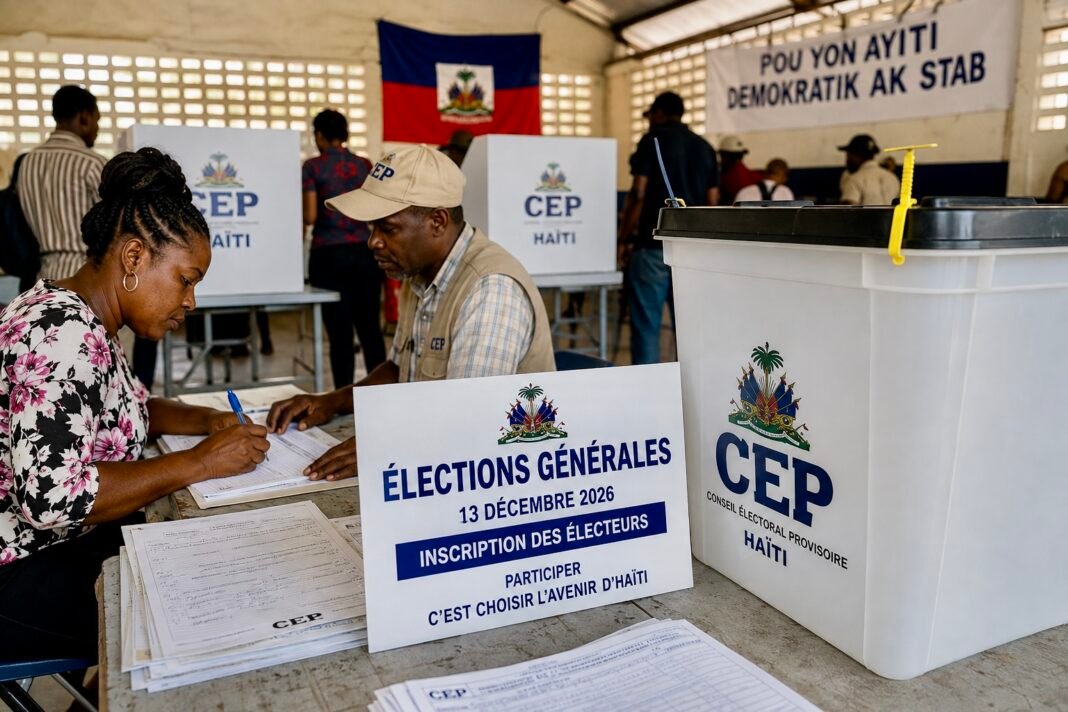

With 17 political groupings representing 227 parties entering the process, Haiti is preparing for its first national elections in a decade, but security, financing, and voter access could ultimately determine whether the timetable holds
PORT-AU-PRINCE, Haiti — Haiti’s long-awaited return to elected government is moving into a critical phase as the Provisional Electoral Council, known as the CEP, reviews political organizations seeking to participate in elections scheduled to begin on December 13, 2026. The CEP says 17 political groupings representing 227 of Haiti’s 316 approved political parties entered the registration process. Their applications must still be examined before the electoral authority publishes a definitive list of organizations authorized to participate.
The numbers reveal one of the unusual characteristics of Haitian politics: an extraordinarily fragmented party system. But the formation of larger alliances could begin to consolidate that landscape ahead of Haiti’s first presidential and legislative elections since 2016. The stakes extend far beyond deciding who occupies the National Palace. Haiti is attempting to rebuild elected institutions after years of political transition, institutional collapse, and escalating armed violence.
The Election Calendar: What Happens Next?
The CEP’s latest official calendar establishes a multistage process extending into March 2027. Voter registration began July 20 and is scheduled to continue through October 13. Candidate registration is scheduled from August 20 through October 2, followed by the first-round campaign from October 5 through December 12.
The first round is scheduled for December 13, 2026. Three major political decisions are expected that day: voters are scheduled to participate in the presidential election, legislative elections, and a popular ratification of proposed constitutional changes. The CEP calendar calls for preliminary presidential and legislative results on December 19, followed by a period for electoral challenges. Definitive first-round results are scheduled for January 9, 2027.
If second rounds are required, they are scheduled for February 21, 2027, alongside elections for territorial authorities. Final presidential and legislative results are currently scheduled for March 7. That timeline is important because it demonstrates that December 13 would not represent the end of the electoral transition. Under the current calendar, the entire process would continue for months.
Before Candidates Come Voters
One of the most important, and perhaps least discussed, parts of the process is voter registration. The CEP began registration on July 20 in the departmental capitals of nine departments, initially excluding the West Department because of security constraints. Citizens were instructed to report to Centres d’Inscription et de Vote, or CIVs, with a valid national identification card. Operations subsequently began in the West Department on July 29, initially through 10 registration and voting centers in selected communes.
This is more than an administrative detail. An election can be competitive on paper but still face legitimacy questions if large numbers of eligible citizens cannot safely register or vote. That is especially significant in the metropolitan Port-au-Prince region, where insecurity and displacement have disrupted normal life for enormous numbers of residents.
Why the 17 Political Groupings Matter
Haiti’s political-party system has historically been highly fragmented, with hundreds of registered organizations, many possessing limited national structures. The CEP ultimately approved 316 political parties, according to the figures surrounding the current registration process. Of those, 227 are associated with the 17 groupings submitted to the electoral authority. That means roughly 72% of the approved parties are represented within these 17 alliances. This consolidation could make the election easier for voters to navigate, but it does not necessarily mean Haiti suddenly has 17 unified political movements.
Political groupings can contain parties with different histories, personalities, and political interests. The important test will be whether these alliances develop common programs and durable organizational structures or primarily function as electoral vehicles. Among the groupings reported as registered are Ayiti Transfòme, Solèy, Delivrans, Debloke, LAPEH ak Alye’l Yo, En Avant pour Haïti, Solidarite pou Ayiti Respire, Viktwa, Gwoupman Rasanble, Gras pou Ayiti, Myèl, Rekonsilye and Men Pwòp, among others. These names are presented here only as part of third-party reporting on the registration process, not as an assessment, comparison, or endorsement of any political party or grouping.
Registration Does Not Mean Automatic Approval
Another distinction is important. Submitting documents to the CEP does not automatically authorize a political grouping to compete. The electoral authority must examine the applications and determine whether each organization satisfies the requirements of the electoral framework before publishing the definitive list. After that comes another potentially contentious phase: candidate registration and eligibility.
The CEP’s calendar schedules candidate registration between August 20 and October 2. This period could become one of the most politically sensitive stages of the entire process because disputes over eligibility, documentation and legal qualifications have historically generated controversy in Haitian elections.
Then Comes the Campaign
Under the current calendar, campaigning for the first round is scheduled to begin October 5 and continue until December 12—the day before voting. That provides approximately two months for presidential and legislative candidates to present their platforms. But conducting a truly national campaign could prove difficult.
Candidates must be able to travel. Political meetings must be held safely. Journalists must be able to cover competing campaigns. Citizens must be able to attend rallies without intimidation. Election officials must reach communities throughout the country. Those conditions cannot be taken for granted in today’s Haiti.
Security Is the Biggest Variable
This is the issue hanging over virtually every stage of the process. The CEP itself has explicitly stated that compliance with the electoral timetable depends on establishing an acceptable security environment and obtaining sufficient financial resources. That qualification is crucial. Haiti has already changed its electoral calendar. An earlier timetable called for the first presidential and legislative round on August 30, 2026, before the CEP moved it to December 13.
The revised schedule therefore should be understood as a target conditioned on circumstances, not a guarantee that voting will occur on that date. Recent reporting continues to identify gang violence, displacement, and insecurity as major obstacles to holding elections nationwide.
Elections Require More Than Protecting Polling Stations
Security on election day itself is only one component. Authorities need secure conditions months beforehand. Electoral workers have to register voters. Candidates need to campaign. Sensitive materials must be transported. Voting centers have to operate. Observers and journalists need access. Ballots must eventually reach tabulation centers without interference.
The official calendar schedules the acquisition and distribution of sensitive and non-sensitive election materials from October 18 through December 12. It also provides for the establishment of departmental vote-tabulation offices well before election day. If major roads or neighborhoods remain inaccessible, the problem could affect the election long before December 13.
Displacement Creates Another Electoral Challenge
Haiti’s massive internally displaced population presents another difficult question. People forced from their neighborhoods may now live far from where they previously voted. Some have lost documents or possessions. Others are living in temporary sites or with relatives.
For the electoral process to be broadly inclusive, authorities will have to ensure that displaced citizens can register and understand where they are expected to vote. This makes voter registration one of the most important indicators to watch over the coming weeks. The CEP currently plans to publish the electoral lists on November 13, exactly one month before the first round. Those lists should provide a much clearer picture of the electorate the council has actually been able to register.
Financing Could Be Just as Important as Security
Security receives most of the public attention, but the CEP has identified another prerequisite: money. Elections of this magnitude are expensive. Haiti must recruit and train electoral personnel, establish voting centers, print and secure ballots, purchase equipment, transport materials throughout the country, operate tabulation centers, provide voter education, and organize potentially two national rounds plus territorial elections.
The CEP has therefore explicitly tied the implementation of its calendar to the availability of financial resources. Without adequate funding at the appropriate stages, even security improvements would not by themselves guarantee that the timetable could be executed.
Counting the Votes, and Contesting the Results
The process does not stop when polls close. According to the official schedule, first-round tabulation is expected to take place from December 13 through December 15. Results of the constitutional ratification are scheduled for December 16, followed by preliminary presidential and legislative results on December 19.
Candidates would then have an opportunity to challenge preliminary results. The current calendar gives the dispute process until January 9, when definitive first-round presidential and legislative results are scheduled to be announced.
This phase could be critical to public confidence. Transparent tabulation, access for political representatives, observation and a credible mechanism for resolving disputes will matter almost as much as election-day security.
February 21: The Potential Second Round
The second major election date is February 21, 2027. The CEP plans to hold any necessary second-round presidential and legislative races on that date while simultaneously organizing elections for territorial authorities. Preliminary second-round presidential and legislative results are scheduled for February 22, followed by another dispute period. Definitive results are scheduled for March 7. Territorial election results would follow on a separate timetable, with final results scheduled for March 12.
A Particularly Ambitious Calendar
There is an important timing issue that deserves scrutiny. The current calendar schedules definitive presidential and legislative results for March 7, 2027. That means Haiti’s institutional transition cannot realistically be understood simply as a December election. If the presidential race requires a second round and challenges arise, the process could extend deep into 2027. This raises broader institutional questions about how the transitional authorities will manage the period between voting and the installation of newly elected officials.
What Would Make the Election Credible?
Holding an election is not the same as restoring democratic legitimacy. The credibility of the process will depend on whether Haitians across the country have a meaningful opportunity to participate. Several practical tests will therefore matter: whether voter registration reaches insecure and displaced communities; whether candidates can campaign freely; whether political violence and intimidation are contained; whether voting materials reach polling centers; whether observers and journalists can operate; whether ballots are counted transparently; and whether disputes are resolved through accepted legal procedures rather than violence.
The CEP says it intends to conduct the process independently, transparently, impartially and inclusively. The coming months will determine whether those principles can be translated into conditions on the ground.
Haiti Is Attempting More Than an Election
Ultimately, December 13 represents something larger than another presidential contest. Haiti has gone roughly a decade without national elections, and the assassination of President Jovenel Moïse in 2021 accelerated an institutional crisis that eventually left the country without nationally elected officeholders.
Restoring elected leadership therefore requires rebuilding confidence in the electoral system itself. The registration of 17 political groupings, voter enrollment, and publication of a new calendar demonstrate that the administrative process is moving forward. But the most difficult work remains ahead.
Between now and December, security, voter access, financing, candidate eligibility and institutional credibility will determine whether Haiti can transform an electoral calendar into an actual national vote.
The critical question is no longer simply whether Haiti needs elections. There is broad recognition that elected institutions must eventually return. The question is whether the country can create conditions in which Haitians can register, campaign, vote, and have their votes counted safely and credibly. That will be the real test of Haiti’s return to constitutional government.
The Haitian Tribune | Political Analysis