
At high-level talks in New York, Haiti’s prime minister called for stronger international security assistance while arguing that the country’s long-term recovery must be built on jobs, production and investment rather than permanent dependence on humanitarian aid.
By The Haitian Tribune Staff | September 25, 2026 | NEW YORK
Haitian Prime Minister Alix Didier Fils-Aimé is asking the international community to rethink its approach to Haiti, arguing that emergency assistance remains essential but cannot substitute for the investment, security and functioning institutions required to rebuild the country.
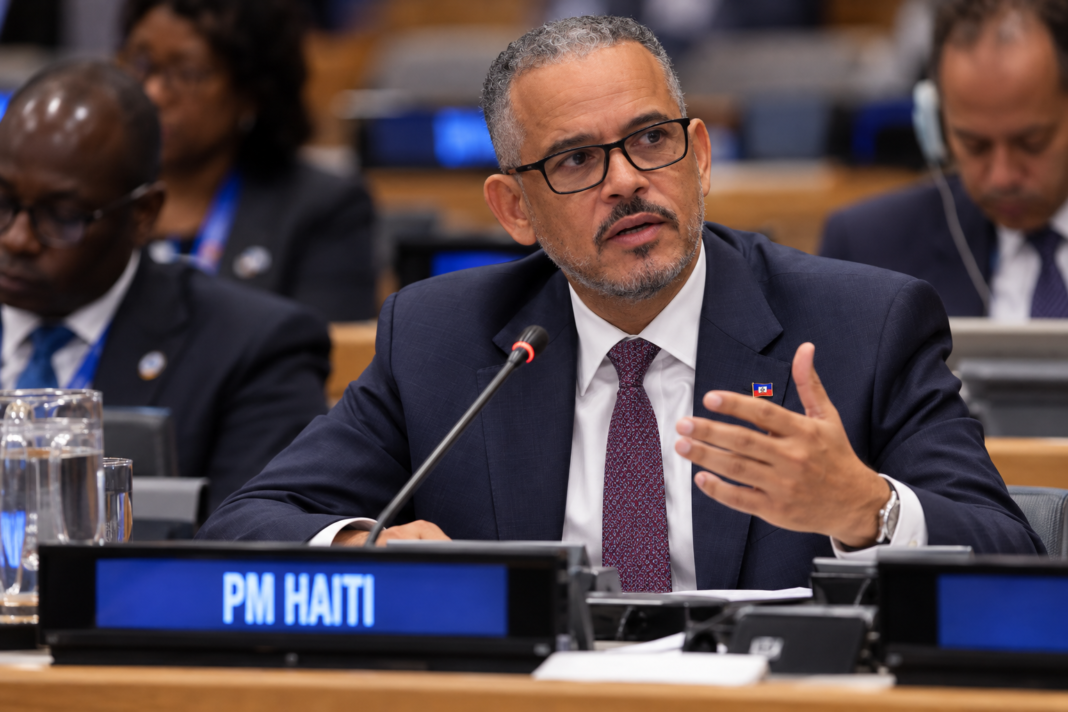
Speaking Thursday at a ministerial meeting of the United Nations Economic and Social Council’s Ad Hoc Advisory Group on Haiti, held during U.N. General Assembly high-level week in New York, Fils-Aimé placed security, elections and economic recovery at the center of his government’s message to foreign partners.
His economic argument was particularly direct: Haiti needs international solidarity during emergencies, he said, but its long-term future cannot remain dependent on aid.
Fils-Aimé called for a transition “from aid to investment,” from assistance toward production and from dependency toward partnership, with international resources increasingly directed toward employment, businesses and productive economic activity. The same investment-oriented approach has also been promoted by Foreign Minister Raina Forbin during diplomatic meetings in New York this week.
The message represents an attempt by the Haitian government to broaden an international conversation that has increasingly centered on armed gangs and foreign security deployments.
Security remains urgent. But Port-au-Prince is arguing that suppressing gangs without rebuilding Haiti’s economy and institutions will not resolve the conditions that have allowed instability to persist.
A Country Still Confronting a Humanitarian Emergency
The appeal comes against an extraordinarily difficult backdrop.
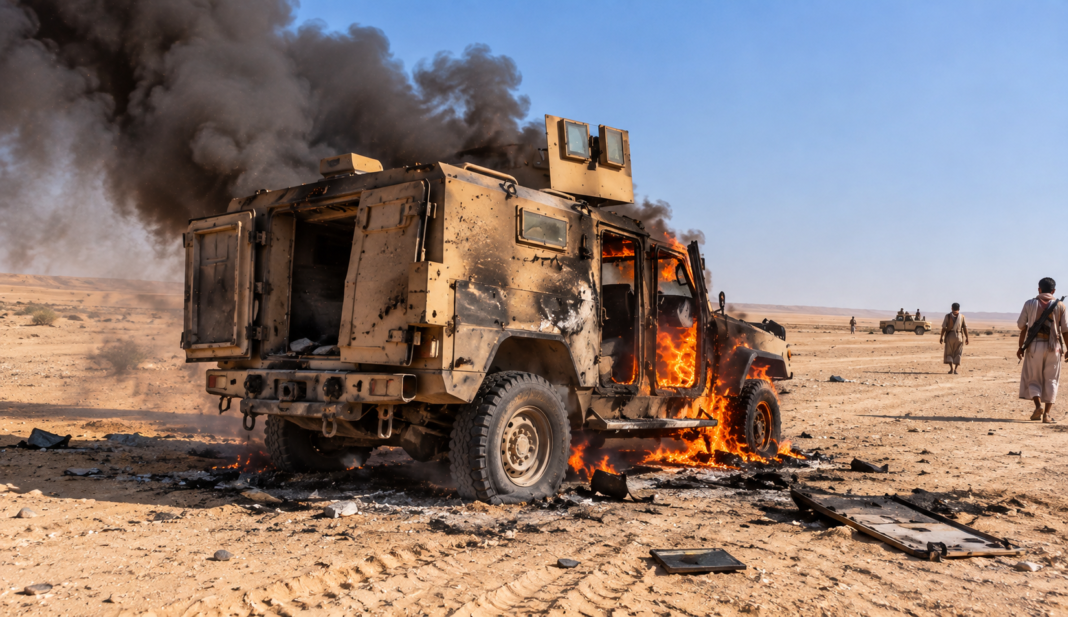
Nearly 1.5 million Haitians are internally displaced, while more than half of the population requires humanitarian assistance and faces acute food insecurity at crisis levels or worse, according to figures cited by Human Rights Watch from international agencies. Armed groups that were once concentrated largely in metropolitan Port-au-Prince have expanded into rural communities in multiple departments.
The Council on Foreign Relations estimates that gangs control roughly 90% of Port-au-Prince and says armed groups now exercise control in parts of three of Haiti’s 10 departments.
Those conditions demonstrate the dilemma behind Fils-Aimé’s argument.
Humanitarian assistance remains indispensable when families need food, shelter and medical care immediately. But emergency spending does not necessarily create factories, farms, permanent employment, infrastructure or the tax revenues Haiti’s government needs to provide public services.
The government’s proposed shift therefore does not mean eliminating humanitarian assistance. Rather, it seeks to connect emergency spending to a longer-term strategy capable of producing economic activity.
That distinction will determine whether the phrase “from aid to investment” becomes a meaningful development policy or remains primarily a diplomatic slogan.
Elections Remain the Political Test
Fils-Aimé also reiterated that restoring Haitians’ ability to choose their political leadership remains a central objective of the transition.
Haiti is preparing for its first national elections in roughly a decade, with the first round currently scheduled for December 13, 2026.
But serious obstacles remain.
The electoral process is unfolding while large sections of the country remain affected by insecurity, displacement and restricted movement. Those conditions complicate voter registration, campaigning, election administration and the ability of candidates and citizens to travel safely.
The question is therefore no longer simply whether Haiti possesses an electoral calendar. It is whether authorities can create sufficient security, participation and administrative capacity for that calendar to be implemented credibly.
Fils-Aimé told the New York gathering that the electoral machinery was moving forward, according to reporting on the meeting.
The government faces increasing pressure to demonstrate measurable progress as December approaches.
Security and Elections Are Closely Connected
Haiti’s security crisis and its electoral challenge cannot easily be separated.
Candidates cannot campaign freely where armed groups control roads. Election workers cannot reliably reach communities without secure transportation. Displaced citizens may have difficulty registering or voting where they previously lived. And an election conducted without meaningful participation across significant portions of the country could face questions about legitimacy.
That explains why Haiti continues pressing for full deployment of the internationally backed Gang Suppression Force, or GSF.
The U.N. Security Council authorized the GSF through Resolution 2793 in September 2025 as a non-U.N. multinational force. It succeeded the earlier Multinational Security Support mission and is intended to work alongside Haitian authorities to reduce gang control, secure critical infrastructure and strengthen Haiti’s own security institutions.
Its current authorization is approaching its September 30 expiration, making renewal by the Security Council an immediate diplomatic priority for Haiti.
The force’s own strategy defines three principal objectives: reducing gang control over territory, securing essential infrastructure and increasing the capacity of Haitian authorities to contain armed violence. Its intended end state is not permanent foreign security management but conditions under which Haitian institutions can progressively assume greater responsibility.
International Promises Must Become Capacity on the Ground
A recurring problem has been the difference between what foreign governments promise and what actually arrives in Haiti.
At Thursday’s meeting, U.S. Ambassador to the United Nations Michael Waltz said countries have pledged more than 17,000 personnel for a force authorized at 5,500, according to reporting from the gathering. He said roughly 1,200 were currently deployed and that approximately 2,500 were expected within months.
The precise deployment numbers have varied across official testimony and reporting as contingents rotate and arrive. Earlier assessments cited more than 17,000 personnel pledged internationally but substantially fewer physically deployed.
That gap is crucial.
A pledge does not patrol a highway.
An announced contingent does not protect an airport until its personnel, transportation, communications, weapons, logistics and command arrangements are actually operational.
The same applies to helicopters, armored vehicles, maritime equipment and financing.
For Haiti, the effectiveness of international security support will ultimately be measured not by the number of countries appearing on a list of contributors, but by whether Haitian citizens can travel, attend school, operate businesses and participate in elections without armed groups determining where they can go.
Canada Adds New Funding
Canada has also announced additional assistance during this week’s diplomatic meetings.
On September 22, Foreign Minister Anita Anand announced C$25.4 million in new funding following talks with Haitian Foreign Minister Raina Forbin.
According to Global Affairs Canada, the money will support efforts against corruption and organized crime, programs aimed at preventing youth recruitment by gangs, responses to gender-based violence and locally led peacebuilding initiatives.
Canada says it has provided more than C$570 million in international assistance to Haiti since 2022, in addition to C$126 million for the multinational security mission.
That package illustrates the broader approach increasingly being discussed internationally: security operations cannot operate in isolation from programs addressing recruitment, justice, corruption and economic vulnerability.
If young Haitians have no viable employment, education or economic future, armed organizations retain a pool from which to recruit.
Security policy and economic policy therefore intersect.
Haiti’s Investment Argument
Fils-Aimé’s proposal raises another important question: What would moving from aid to investment actually require?
Investment operates differently from humanitarian assistance.
Businesses generally require predictable electricity, functioning ports, reliable transportation, enforceable contracts, access to financing and reasonable physical security. Investors also assess corruption, political stability and whether courts can resolve commercial disputes.
Haiti’s current crisis affects virtually every one of those conditions.
That means the government’s proposed economic transition cannot simply consist of asking foreign governments to redirect humanitarian money toward private businesses.
Security, judicial reform, infrastructure, anti-corruption measures and institutional credibility become prerequisites for attracting sustainable investment.
The potential opportunities nevertheless remain substantial.
Haiti could seek greater investment in agriculture and agro-processing, renewable energy, infrastructure, manufacturing, technology and education — sectors Haitian officials have highlighted during diplomatic discussions this week.
A successful strategy would also have to ensure that economic development reaches communities beyond traditional centers of wealth and political influence.
Otherwise, investment could increase economic activity without addressing the inequality and exclusion that contribute to instability.
Beyond Another International Intervention
There is also a historical dimension to Haiti’s appeal.
International security missions have repeatedly operated in Haiti over the past three decades. The current GSF is deliberately structured as a non-U.N. multinational force rather than a traditional U.N. peacekeeping operation.
That history has produced considerable skepticism among Haitians about foreign intervention.
The challenge for international partners is therefore not merely deploying another security force. It is helping create conditions under which Haiti eventually requires less external security assistance.
That would mean strengthening the Haitian National Police and other legitimate state institutions, restoring the justice system, controlling illicit weapons flows, rebuilding public services and expanding economic opportunities.
Without those elements, tactical victories against gangs may prove temporary.
From Crisis Management to State Building
The significance of Fils-Aimé’s message in New York lies in its attempt to connect several problems that are often discussed separately.
Haiti needs security to conduct elections.
It needs legitimate and functioning institutions to attract investment.
It needs investment and employment to reduce economic desperation.
And it needs stronger Haitian institutions so that international security deployments do not become permanent substitutes for the state.
That is a far more difficult undertaking than deploying troops or announcing another aid package.
But it also gets closer to the fundamental question Haiti and its international partners have struggled with for decades: how to move from repeatedly managing emergencies to building institutions capable of preventing the next one.
For Fils-Aimé, the message in New York was that Haiti still needs international help — urgently.
What his government is asking to change is the ultimate purpose of that help.
The objective, he argued, should not be to sustain Haiti indefinitely through crisis assistance, but to help create the security, productive economy and institutions that eventually make such dependence unnecessary.
By The Haitian Tribune Staff | September 25, 2026 | NEW YORK